
Thailand Cracks Down on Cannabis Amid Smuggling Surge
Thailand’s relaxed marijuana laws, introduced in 2022, are now facing a tightening grip as the government attempts to regulate a booming, yet chaotic, industry. New restrictions are planned to curb consumption, responding to international pressure and a surge in cannabis smuggling.
Reining in the Green Rush
The Thai government has approved new measures targeting its freewheeling marijuana market. Consumption will soon be limited to those with a doctor’s prescription. Public health officials also suggest that consuming marijuana may become a criminal offense once again, although the exact timing is unknown.
Since the drug’s decriminalization in 2022, Thailand has seen a massive influx of investment into cannabis. Around 11,000 cannabis dispensaries have been registered. Neon signs and the pervasive smell of marijuana are common in Bangkok, the capital city.
In Bangkok’s Khao San Road, a popular tourist district, a shopping mall entirely dedicated to selling marijuana accessories and hallucinogenic products exists. Derivative products, such as edibles, are offered online, though technically illegal, with rapid delivery.
Prior government efforts to restrict the industry have been unsuccessful. One of the largest coalition parties aimed to reclassify cannabis as a controlled substance. However, its former partner, who championed decriminalization, blocked this plan.
International Pressure and Smuggling
The impetus for this renewed crackdown appears to be pressure from the UK. The UK is experiencing a rise in smuggled Thai marijuana. Young travelers are being lured by drug syndicates to carry suitcases filled with the drug.
Two British women were recently arrested in Georgia and Sri Lanka for carrying large amounts of marijuana from Thailand. They now face lengthy prison sentences.
According to the UK’s National Crime Agency, the number of couriers carrying cannabis from Thailand has dramatically increased. In 2023, 142 couriers were intercepted, carrying five tonnes. This number jumped to 800 couriers in 2024, carrying 26 tonnes, and continues to climb.
“We really want to stop people doing this. Because if you are stopped, in this country or many others, you face life-changing consequences, for something many of them think is low-risk. If you bring illicit drugs into the UK you might get through the first time, but you will eventually be found, and you will most likely go to jail.”
—Beki Wright, Spokesperson at the National Crime Agency in London (NCA)
So far this year, 173 individuals accused of cannabis smuggling, nearly all from Thailand, have been sentenced in the UK, receiving a total of 230 years. These rising numbers underscore the urgent need for more effective regulation.
Challenges and Loopholes
Authorities in Thailand are working with the UK to deter young people from smuggling. However, regulations controlling the drug are very few.
“This is a loophole,”
—Panthong Loykulnanta, spokesman for the Thai Customs Department.
He adds that while profits are high, the penalties in Thailand are not. Those caught at the airport often abandon their luggage. Those who insist on checking the luggage face fines and repeat offenses.
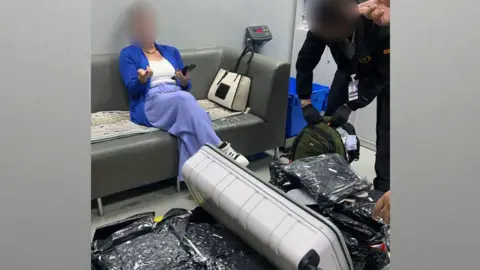
The original legalization of cannabis in 2022 was to be followed by a new regulatory framework, which never happened. The delay, according to one MP, was due to obstruction by interests connected to the marijuana industry.
The lack of regulations has led to a “weed wild west.” Foreign drug syndicates have entered the market, growing massive amounts of potent marijuana, driving down prices, and attracting smugglers. Even if half of the smugglers are stopped, they can still earn a profit.
Divergent Views on the Future
Tom Kruesopon, a businessman involved in the legalization, now believes things have gone too far.
“When there is a weed shop on every corner, when people are smoking as they’re walking down the street, when tourists are getting high on our beaches, other countries being affected by our laws, with people shipping it illegally – these are negatives.”
—Tom Kruesopon, Businessman
He contends that the new regulations will help restore the industry’s focus to medical use. However, cannabis enthusiasts disagree, stating the rules will not curb smuggling or unregulated growers. They fear the measures will harm small-scale businesses.
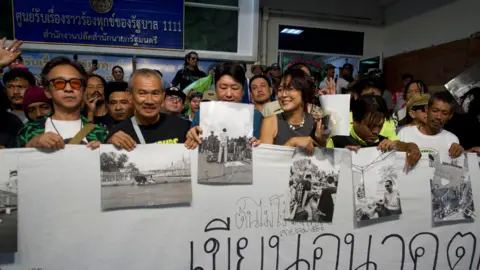
Small cannabis growers protested at the prime minister’s office, calling for more sensible regulations. Kitty Chopaka, a vocal advocate for smaller producers, says the government should enforce existing rules before implementing new ones. She was forced to close her dispensary because of falling prices.
“I totally understand that the government is probably getting yelled at during international meetings…Countries saying ‘All your weed is getting smuggled into our country,’ that is quite embarrassing. But right now they are not even enforcing the rules that already exist. If they did, that would probably mitigate a lot of the issues like smuggling, or sale without a licence.”
—Kitty Chopaka, Advocate for smaller producers
Parinya Sangprasert, a grower at the protest, said the illegal growers will disregard the new regulations. He emphasized that his farm does not sell the large quantities of marijuana, typically carried by smugglers.
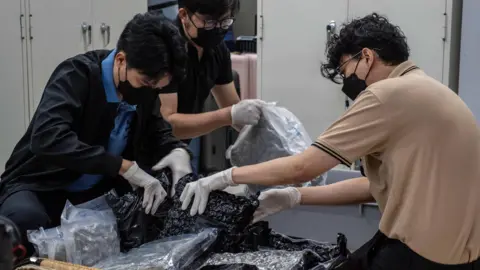
Thai customs officers continue to target potential smugglers, using intelligence on travel patterns. They are also utilizing licensing requirements to prosecute those intercepted, though the usual penalty is a fine. The suitcases of marijuana, with names like “Runtz” and “Zkittlez,” continue to accumulate at the airports.
The future of Thailand’s cannabis market remains uncertain. The government’s tightening of restrictions is a reaction to the challenges arising since decriminalization. Whether the new regulations can successfully balance the interests of the industry, consumers, and international concerns remains to be seen.
