
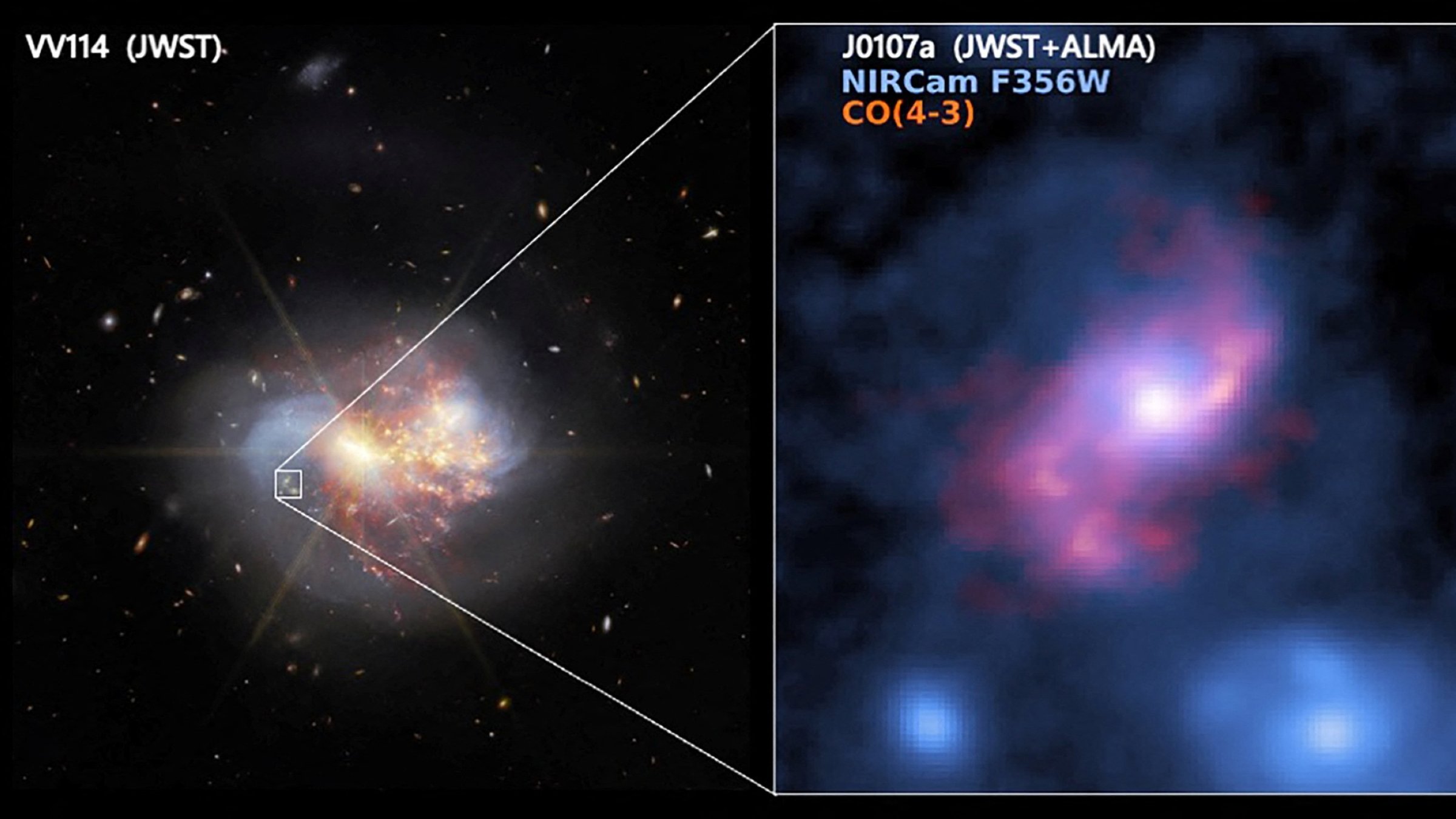
Ancient Galaxy Mirrors Milky Way, But on steroids
Bucharest – May 24, 2024 – Astronomers have made a stunning discovery: an ancient, massive galaxy, dubbed J0107a, that resembles our Milky Way but is far more dynamic. Observed as it appeared 11.1 billion years ago, J0107a challenges existing theories about galaxy formation due to its meaningful size and intense star-forming activity. The findings,published in Nature,offer valuable insights. For more on this, stay tuned.
Ancient Galaxy Mirrors Milky Way, But on Steroids
Astronomers have peered back 11.1 billion years too witness a galaxy, dubbed J0107a, that defies expectations. This ancient galaxy, observed as it appeared when the universe was just a fifth of its current age, boasts a spiral structure and a central bar remarkably similar to our own Milky Way. However, J0107a is far more massive and actively forming stars at an amazing rate, challenging existing theories of galactic formation.
Key Findings: A Cosmic Anomaly
- Massive Scale: J0107a’s mass, encompassing stars and gas, exceeds that of the Milky Way by more than tenfold.
- Intense Star Formation: The galaxy is churning out stars at a rate approximately 300 times greater than the Milky Way.
- Compact Size: Despite its immense mass and star formation activity, J0107a is more compact than our galaxy.
- Barred spiral Structure: Like the Milky Way, J0107a features a distinct bar of stars and gas running through its center.
Did You Know?
A light year, the unit used to measure cosmic distances, is the distance light travels in one year. That’s approximately 5.9 trillion miles (9.5 trillion kilometers)!
The Puzzle of Early Formation
The discovery of J0107a raises profound questions about how such a massive, well-structured galaxy could have formed so early in the universe’s history. This discovery raises the important question: How did such a massive galaxy form in such an early universe?
said Toshiki Saito, an astronomer at Shizuoka University in Japan and co-author of the study.
Tools of Discovery: ALMA and James Webb
Researchers utilized data from the Atacama Large Millimeter/submillimeter Array (ALMA) in Chile and NASA’s James Webb Space Telescope to study J0107a. These powerful instruments allowed them to observe the galaxy’s structure, mass, and star formation activity with unprecedented detail.
A “Monster Galaxy” Unlike Others
While some galaxies in the present-day universe exhibit similar star formation rates to J0107a,they are typically undergoing mergers or collisions. Though, there is no evidence to suggest that J0107a is involved in such a process. The galaxy is a monster galaxy with a high star formation rate and plenty of gas, much more than present-day galaxies,
said Shuo Huang, an astronomer at the National Astronomical Observatory of Japan and lead author of the study, published in the journal Nature.
Challenging Existing Theories
The existence of J0107a challenges prevailing theories about galaxy formation. In the early universe, galaxies were generally more turbulent and gas-rich, fostering extreme bursts of star formation. However, galaxies with highly organized structures like the barred spiral shape of the Milky Way were thoght to be rare at that time. compared to other monster galaxies in the distant universe (dating to an earlier cosmic epoch) whose shapes are usually disturbed or irregular, it is unexpected that J0107a looks very similar to present-day spiral galaxies,
Huang said.
The Role of the Bar Structure
About two-thirds of spiral galaxies observed today possess a bar structure. This bar is believed to act as a stellar nursery,channeling gas inward from the galaxy’s spiral arms. This gas then forms molecular clouds, which collapse under gravity to create new stars. Huang noted that the bar in J0107a spans approximately 50,000 light years.
Pro Tip: Understanding Galactic Bars
Galactic bars are not just aesthetic features. They play a crucial role in the evolution of spiral galaxies by influencing the distribution of gas and the rate of star formation.
Implications for Future Research
The James Webb Space Telescope’s ongoing studies of early massive galaxies are providing valuable insights into their morphology. Though,as Saito pointed out,their dynamics remain poorly understood. Further research is needed to unravel the mysteries of how galaxies like J0107a formed and evolved in the early universe. Theories about the formation of present-day galactic structures may need to be revised,
Huang added.
Similarities and Differences
While J0107a and the Milky Way share a similar barred structure, their timelines differ significantly. They are similarly huge and possess a similar barred structure. However, the Milky Way had plenty of time to form its huge structures, while J0107a didn’t,
Saito said.
