
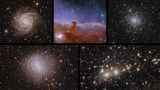
euclid Space Telescope Unveils Millions of Galaxies, Promises Dark Matter Breakthrough
Scientists are diving into a treasure trove of data from the Euclid space telescope, wich has already photographed approximately 26 million galaxies after less than two years of operation. These galaxies where discovered in a mere 1.5 per mille of the sky, specifically targeting deep fields that offer unobstructed views of the distant universe.
The data, recently released, covers about 63.1 square degrees of the sky, equivalent to roughly 300 times the area of the full moon. To put this in perspective, the entire celestial sphere encompasses approximately 41,253 square degrees.
Mapping the Cosmic Web
Euclid is expected to observe more than 1.5 billion galaxies over its six-year mission, some as far as 10.5 billion light-years away. The telescope transmits about 100 gigabytes of data to Earth daily, enabling scientists to map the large-scale arrangement of these galaxies within the fibers of the cosmic cobweb.
An Avalanche of Discoveries
The current data includes numerous galaxy clusters, active galactic nuclei, and transient phenomena. This wealth of data allows scientists to explore cosmic history and uncover the forces shaping the universe. Over the coming years, Euclid will gather precise data on about a billion galaxies from the last 10 billion years of cosmic history.
This will enable the first 3D map of dark matter distribution in the universe.
Euclid vs. Hubble
Euclid in a single shot captures the area about 240 times larger than Hubble’s space telescope, which is more focused on individual objects and their details.
While Hubble excels at detailed observations of individual objects, Euclid’s strength lies in its ability to survey vast areas of the sky. Euclid also provides excellent image quality in both visible and infrared light.
Unveiling Dark Matter
Understanding the nature of dark matter is a key goal of the Euclid mission. We have very little guides to what is exactly dark matter,what particles or objects make it. But one of the methods we could find out is how exactly it clusters,
said Stephen Serjeant,professor of astronomy at Open University.
Professor Adam Amara,head of scientist of the British space agency,added,Now I believe that we have quality images in such a resolution that Euclid will discover new categories of objects in six years.
Mission Progress
As of March 19, 2025, Euclid had observed approximately 2,000 square degrees, about 14% of its planned area. The three deep fields comprise 63.1 square degrees. Over six years, Euclid will survey about one-third of the sky.
for comparison, the Sloan digital Sky Survey (SDSS), a thorough sky survey using a terrestrial telescope, discovered about 15 million galaxies across 35% of the sky. Euclid’s superior sensitivity allows it to capture fainter, more distant galaxies, explaining its higher performance
in terms of total galaxies photographed.
The Role of Dark Energy
Euclid’s slightly lower light sensitivity compared to Hubble is a trade-off that allows it to survey a larger area, crucial for testing cosmological models related to dark matter and dark energy. The first cosmological data from the mission is expected in October 2026.
The prevailing theory suggests that only 5% of the universe’s mass-energy consists of ordinary matter. Dark matter accounts for 25%, while dark energy, a mysterious force accelerating the universe’s expansion, makes up the remaining 70%.
German Contributions
German physicists and engineers played a meaningful role in developing Euclid’s infrared-sensitive devices.
We have compiled a catalogue of more than 70,000 spectroscopic red feeds from various previous sky shows and combined it with Euclid data,
explained Christoph Saulder, who led this part of the project. This catalog allows accurate measurement of distances and clear identification of many galaxies and yeast in the images of high -resolution Euclida. It serves as a basis for deeper understanding of these objects,their space and their internal properties.
Hendrik Hildebrandt of Ruhr University Bochum added, New data is also used to test techniques of measurement of so -called weak gravitational lens (weak space gravitational fields a little bending rays of all light sources within reach and thus slightly deform their images) and red feed calibration that will soon be applied to much larger data sets to achieve the primary scientific objective. The energy that accelerates the expansion of the universe.
Scientists at Ludwig Maximilian University (LMU) in Munich have tested methods for identifying galaxy clusters, a crucial step for studying the universe’s large-scale structure. The methodology used to detect a bunch of galaxies in current data will be the key to the full use of future extensive data sets from the Euclid telescope,to improve the identification of the buy and the deeper understanding of the formation of cosmic structures,
said Barbara Sartoris,LMU scientist.
Researchers at the Max Planck Institute for Astronomy (MPIA) in Heidelberg are using the data to monitor supermassive black holes, galaxy development, and transient celestial objects.
AI and Data Processing
Processing Euclid’s vast data requires powerful supercomputers and advanced artificial intelligence for searching, analyzing, and cataloging galaxies. The Euclid consortium has established a European network of nine data centers.
The first detailed catalog contains over 380,000 galaxies, classified by structural properties like spiral arms and tidal tails. This catalog represents only 0.4% of the final catalog but will provide detailed morphology for ten times more galaxies than ever captured, helping answer questions about spiral arm formation and supermassive black hole growth.
Gravitational Lensing
The light from distant galaxies is bent by the gravity of visible and dark matter, a phenomenon called gravitational lensing. Strong lensing can magnify, distort, or create multiple images of distant objects.
Researchers published the first Euclid catalog of 500 strong lens candidates in March, located in previously unknown areas. MPIA scientists participated in classifying these lenses, using machine learning to assess the probability of each candidate being a true lens.
artificial intelligence systems will be necessary to analyze 200 times more powerful lenses at the end of the mission.The number of galaxies distorted by lenses will eventually increase to about 100 thousand, which is about 100 times more than we certainly know today.
Euclid will also measure weak lensing, detecting subtle distortions through statistical analysis of galaxy shapes and positions. Over the coming years, Euclid will measure these distortions for over a billion galaxies, providing a 3D view of dark matter distribution.
