683 Urine Samples Used to Analyze Bladder and Prostate Cancer cfRNA
Researchers collected 683 urine samples from 515 individuals to evaluate cell-free RNA for bladder cancer detection and treatment response prediction, as detailed in findings published on nature.com. The study evaluates how non-invasive urinary biospecimens can track oncology metrics compared to traditional tissue biopsies, utilizing cohorts from Stanford University, Stanford Health Care, and the Veterans Affairs Palo Alto Health Care System (VA Palo Alto).
Key Clinical Takeaways:
- A total of 683 urine samples from 515 participants were analyzed to assess urine cell-free RNA utility in bladder, prostate, and kidney cancers.
- Biospecimen collection protocols at Stanford and VA Palo Alto utilized Institutional Review Board-approved frameworks (IRB 55427, 12597, 18225, and 49693).
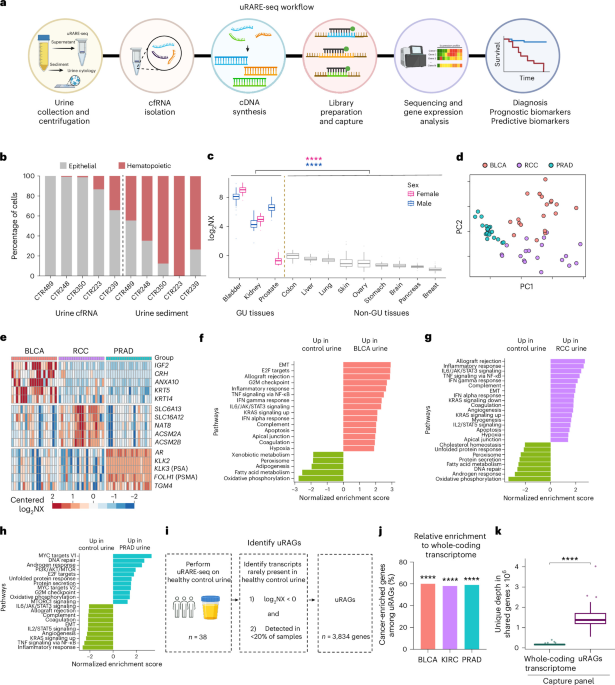
- Whole-coding transcriptome capture and DNA digestion protocols were applied to urine supernatants to isolate and sequence cfRNA effectively.
Institutional Approvals and Participant Cohorts at Stanford and VA Palo Alto
All clinical samples analyzed in the research were gathered under strict protocols approved by Institutional Review Boards at Stanford University, Stanford Health Care, and the Veterans Affairs Palo Alto Health Care System. Bladder cancer (BLCA) cases were collected under IRB 55427. Control cases fell under IRB 55427, 12597, or 18225. Renal cell carcinoma (RCC) samples utilized IRB 12597, while prostate cancer samples relied on IRB 49693. Every participant provided written informed consent permitting the research use of their clinical data and biospecimens.
The total cohort comprised 683 urine samples derived from 515 individuals. Demographic details, including patient age, sex, and smoking history, were documented from medical records and self-reported metrics. Participants received no financial compensation for joining the study. Risk stratification followed the American Urological Association risk classification system, incorporating tumor grade, stage, size, and the presence of carcinoma in situ.
Study Cohorts Include Cancer Patients and Noncancer Controls
Patient enrollment encompassed specific oncology cohorts presenting with BLCA, prostate cancer (PRAD), or kidney cancer at Stanford University or VA Palo Alto. The noncancer control cohorts included individuals who were asymptomatic, patients presenting with hematuria, or those exhibiting lower urinary tract symptoms. These symptoms featured frequent urination, difficulty with urination, or discomfort during urination. Validation cohorts consisted of additional BLCA patients and noncancer controls who were strictly segregated from the initial model training phase.
Formalin-Fixed Paraffin-Embedded Tumor Extraction Protocols
To establish a benchmark comparing primary tumor RNA against urine cfRNA and UROMOL/BRS subtype analyses, investigators examined hematoxylin and eosin-stained sections from formalin-fixed paraffin-embedded (FFPE) bladder tumor blocks. A pathologist annotated these sections to identify distinct tumor regions. Pathological reports supplied the specific grade and stage for each BLCA patient.
Core punches targeted the annotated tumor tissue within the FFPE blocks. RNA extraction was performed using the CELLDATA DNAstorm/RNAstorm 2.0 Combination Kit from Biotium, adhering strictly to manufacturer recommendations with minor adjustments. The resulting eluate underwent a 30-minute room-temperature incubation with 28 units of DNase I from the Qiagen RNase-Free DNase Set to eliminate DNA contamination. Subsequent RNA isolation utilized the Zymo RNA Clean and Concentrator kit, with purified products stored at minus 80 degrees Celsius.
Quantification of RNA concentration relied on Nanodrop or quantitative PCR techniques. Library preparation utilized 100 nanograms of RNA input. For samples yielding less than 100 nanograms, the entire extracted tumor RNA was utilized, spanning a range of 25 to 100 nanograms. Double-stranded complementary DNA (cDNA) was synthesized using the NEBNext Ultra II RNA First-Strand Synthesis Module and Non-Directional Second Strand Synthesis Module from New England Biolabs.
Single-stranded regions were hydrolyzed using 100 units of S1 nuclease from Thermo Fisher during a 30-minute room-temperature incubation. Sequencing libraries were constructed via the KAPA Hyper Prep kit following modified manufacturer instructions. Whole-coding transcriptome capture was executed utilizing the Twist Biosciences Comprehensive Exome Hybridization kit. Captured libraries underwent sequencing via 150 base-pair paired-end reads on Illumina HiSeq4000 or NovaSeq6000 instruments, targeting approximately 30 million read pairs per FFPE capture panel.
Urine Collection and Cell-Free RNA Processing Methods
First void urine samples were obtained prior to any clinical instrumentation into empty 120-milliliter collection cups. These cups either contained ethylenediaminetetraacetic acid at a final concentration of 5 millimolar or were standard Norgen Urine Collection and Stabilization Cups. Within a 24-hour window, urine supernatant was isolated by centrifugation at 2000g for 10 minutes. The isolated supernatant was stored at minus 80 degrees Celsius until nucleic acid extraction.
Cell-free nucleic acids were extracted using a previously published protocol optimized for urine cfDNA extraction. The resulting eluate was treated with 14 units of DNase I from the Qiagen RNase-Free DNase Set for 30 minutes at room temperature to digest remaining DNA traces. The digested eluate was subsequently purified via the Zymo RNA Clean and Concentrator kit and preserved at minus 80 degrees Celsius, alongside parallel testing evaluated through the standard QIAamp method.
Disclaimer: The information provided in this article is for educational and scientific communication purposes only and does not constitute medical advice. Always consult with a qualified healthcare provider regarding any medical condition, diagnosis, or treatment plan.