
5 Dumbbell Exercises to Restore Core Strength After 60
For many adults over 60, core training is often reduced to a singular, static struggle: the plank. While holding a rigid position provides a baseline of tension, it fails to address the complex, multi-planar demands the human body faces during actual movement. True stability is not found in stillness, but in the ability to maintain control under load.
Key Clinical Takeaways:
- Dynamic resistance training with dumbbells is more effective than static holds for restoring functional core strength and balance in older adults.
- Prioritizing anti-rotation and loaded carries better mimics real-world movement and reduces the risk of instability.
- Integrating controlled, multi-directional movements reinforces spinal stabilization and force transfer between the upper and lower body.
The clinical gap in geriatric fitness often stems from a reliance on isometric exercises. While the plank is a common benchmark, it represents only one dimension of core function. The core’s primary biological role is to stabilize the spine, transfer force between extremities, and maintain equilibrium during dynamic shifts in center of gravity. Relying solely on static positions ignores the necessity of training the core to resist unwanted motion—such as lateral flexion and rotation—while the body is in motion.
This limitation increases the risk of morbidity associated with balance loss and postural decline. To mitigate these risks, the standard of care is shifting toward dynamic resistance. According to a systematic review published in Frontiers in Sports and Active Living by Bustos Carvajal and Arias Coronel (2025), core muscle training is critical for enhancing overall performance, and stability. Similarly, a meta-analysis by Zhong et al. (2025) in Frontiers in Public Health underscores the significant effects of core training on balance performance specifically within older adult populations.
For individuals experiencing significant age-related muscle atrophy or chronic instability, implementing a new resistance program requires professional oversight to avoid contraindications. This proves highly recommended to consult with board-certified physical therapists to ensure movement patterns are executed without compromising joint integrity.
Comparative Efficacy: Static Holds vs. Dynamic Resistance
The transition from static exercises to dumbbell-based dynamic training allows for “loading” the core in multiple directions. This approach challenges the deep stabilizers—including the transverse abdominis and obliques—in a way that isometric holds cannot. The following table delineates the clinical differences in training outcomes.
| Training Modality | Primary Mechanism | Functional Outcome | Real-World Application |
|---|---|---|---|
| Static (e.g., Planks) | Isometric Tension | Rigid Stability | Holding a fixed position |
| Dynamic (Dumbbells) | Eccentric/Concentric Loading | Adaptive Stability | Walking, lifting, reaching |
| Anti-Rotation/Carry | Resisting External Force | Postural Resilience | Maintaining balance during movement |
Clinical Application: 5 High-Yield Dynamic Exercises
To restore core strength effectively, the focus must shift to exercises that challenge stability through motion. These movements prioritize the “anti-movement” patterns—resisting bending or twisting—which are essential for maintaining independence and confidence in daily activities.
1. Suitcase Carry: Addressing Anti-Lateral Flexion
The suitcase carry is a premier tool for training the core without requiring the patient to descend to the floor. By holding a dumbbell in one hand, the body is forced to resist bending toward the weighted side. This demand activates the obliques and deep stabilizers to maintain a vertical axis. This movement reinforces the posture necessary for basic ambulation and lifting.
- Protocol: Hold a dumbbell at one side; walk with controlled steps while keeping shoulders level.
- Prescription: 3 to 4 sets of 20 to 40 seconds per side.
2. Dumbbell Dead Bug: Spinal Stabilization
The dead bug mimics real-life coordination by requiring the core to stabilize the spine while the limbs move independently. Adding a dumbbell increases the load, forcing the transverse abdominis to work harder to prevent the lower back from arching. This is a foundational movement for those rebuilding coordination after a period of inactivity.
- Protocol: Lie on the back, holding a dumbbell above the chest; alternate leg extensions while pressing the lower back into the floor.
- Prescription: 3 sets of 10 to 12 reps per side.
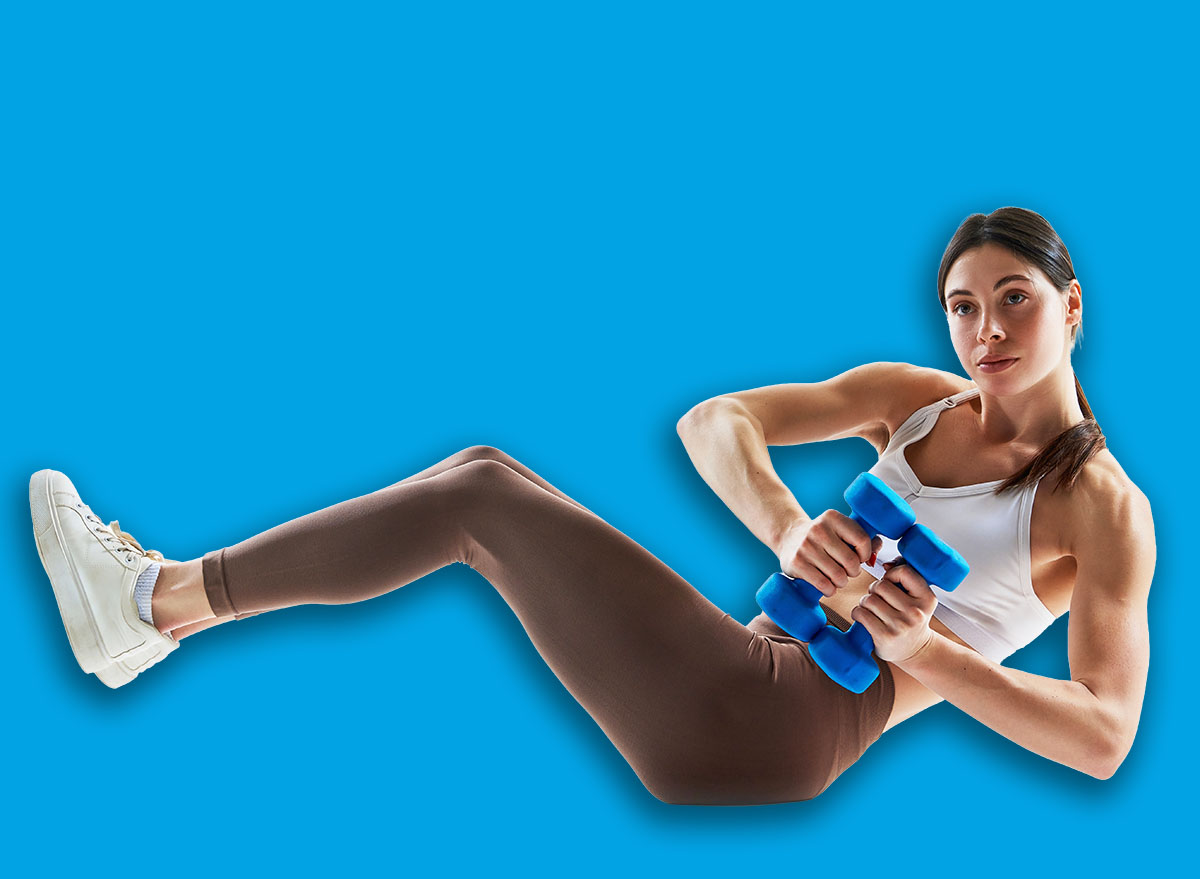
3. Dumbbell Russian Twist: Rotational Control
Rotational strength is often the first to decline with age, yet it is vital for mobility. The Russian twist trains the core to control rotation rather than simply creating it. Using a dumbbell adds resistance that targets the obliques, improving the body’s ability to transfer force across the torso.
- Protocol: Sit with a slight lean back, rotating the torso to bring the dumbbell across the body.
- Prescription: 3 sets of 12 to 16 reps per side.
4. Dumbbell Front Carry: Resisting Extension
Holding a load in front of the body forces the core to brace against extension, challenging the deep stabilizers and reinforcing an upright chest. This exercise is particularly effective for those struggling with kyphosis or forward-leaning posture, as it teaches the core to support a load in a functional, upright position.
- Protocol: Hold a dumbbell at chest height; walk forward while maintaining a braced core and tucked elbows.
- Prescription: 3 sets of 20 to 40 seconds.
5. Dumbbell March: Dynamic Equilibrium
The dumbbell march integrates balance and strength by shifting the center of gravity with every step. This mimics the instability encountered in real-world environments, making it a critical exercise for fall prevention. It engages the hip flexors, glutes, and core stabilizers simultaneously.
- Protocol: Hold dumbbells in one or both hands; march in place, lifting knees to hip height.
- Prescription: 3 sets of 10 to 14 reps per leg.
Patients who struggle with the balance requirements of these movements, particularly the dumbbell march, may benefit from a comprehensive gait analysis. Seeking a referral to geriatric specialists can help determine if underlying vestibular issues or neurological declines are contributing to instability.
Optimizing Recovery and Progression
Restoring strength after 60 is not about maximum load, but about consistent, controlled volume. The objective is to train the body to move as it was designed. To maximize clinical results, the following parameters should be observed:
- Volume: Aim for 8 to 12 total working sets per week.
- Tempo: Unhurried, controlled repetitions to maximize muscle engagement.
- Respiratory Integration: Exhale during the point of maximum effort to reinforce core bracing.
- Load Management: Utilize weights that challenge the user without causing a breakdown in form.
The shift from static holds to dynamic resistance represents a more sophisticated approach to aging. By moving away from the limitations of the plank and embracing loaded carries and controlled rotations, adults over 60 can build a resilient foundation that supports long-term mobility. For those requiring a structured environment to begin this transition, specialized rehabilitation centers provide the necessary equipment and supervision to ensure safety and efficacy.
As research continues to evolve, the integration of multi-planar resistance will likely become the cornerstone of preventative geriatric care. The goal is a body that is not just stable in a stationary position, but capable and confident in motion.
Disclaimer: The information provided in this article is for educational and scientific communication purposes only and does not constitute medical advice. Always consult with a qualified healthcare provider regarding any medical condition, diagnosis, or treatment plan.