
Alien Probe Suspected in Interstellar Visitor’s Trajectory
Harvard physicist **Avi Loeb** points to unusual flight path of 3I/ATLAS
An interstellar object, designated 3I/ATLAS, currently traversing our solar system, is being eyed as a potential alien spacecraft by renowned theoretical physicist **Avi Loeb**. The Harvard professor cites the comet’s peculiar trajectory, scale, and observed behavior as strong indicators that it may not be a natural celestial body but rather an artifact of an advanced extraterrestrial civilization.
Unnatural Flight Path Raises Eyebrows
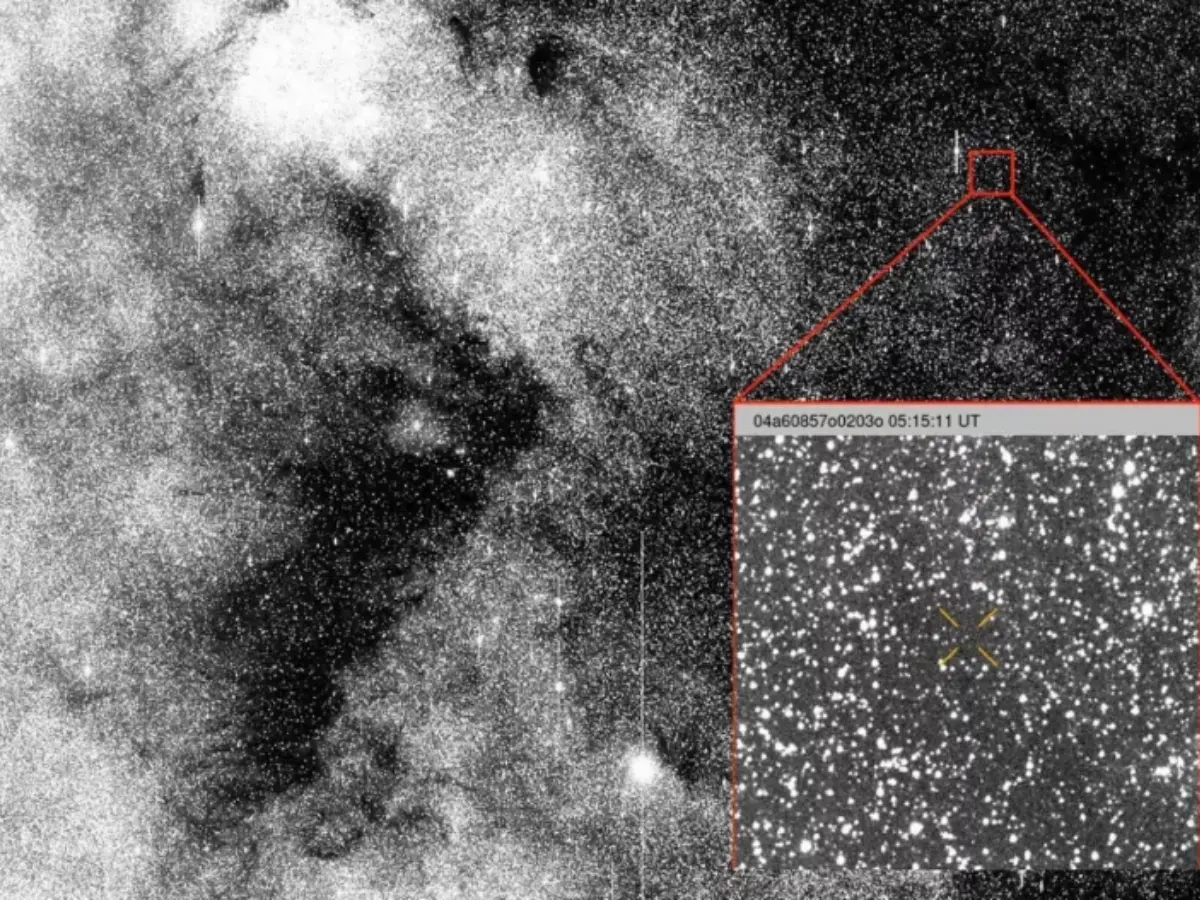
3I/ATLAS, the third recorded interstellar visitor to our cosmic neighborhood, was identified on July 1 by NASA’s ATLAS telescope in Chile and initially categorized as a comet. However, **Loeb** asserts that its orbital plane’s retrograde motion relative to the Sun, occurring within a mere 5 degrees of Earth’s, is statistically improbable for a random celestial orientation.
“The retrograde orbital plane of 3I/ATLAS around the Sun lies within 5 degrees of that of Earth… The likelihood of that coincidence out of all random orientations is 0.2 per cent.”
—Avi Loeb
This assessment, however, is met with skepticism by many other scientists who see no definitive evidence to support the alien probe theory.
Size and Speed Defy Natural Explanations, Says Loeb
The comet is currently hurtling through space at a remarkable 60 kilometers per second. **Loeb** contends that no known natural cosmic processes can account for such a precise trajectory towards the inner solar system.
“An alternative is that the object targets the inner solar system by some technological design.”
—Avi Loeb, to MailOnline
Upon its initial detection, scientists noted its highly elliptical orbit and significant velocity, both characteristics pointing to an origin beyond our solar system. Hailing from the constellation Sagittarius, 3I/ATLAS is projected to make its closest approach to the Sun on October 30, passing at a distance of approximately 210 million kilometers, roughly aligning with Mars’ orbit.
Mammoth Scale Stretches Credulity for Natural Origins
**Loeb** further emphasizes the extraordinary size of the interstellar visitor as a key factor challenging natural explanations. Currently positioned 490 million kilometers from Earth, its diameter, estimated from light reflection, is between 20 to 24 kilometers—a staggering 200 times larger than ‘Oumuamua, the 100-meter-long interstellar object observed in 2017.
He argues that sustaining such a massive object on an intergalactic journey without disintegration is highly improbable from a natural standpoint. **Loeb** highlights the rarity of encountering such a colossal object when, statistically, smaller objects like ‘Oumuamua should be far more prevalent. According to data from the International Astronomical Union, there are estimated to be over 100 billion stars in the Milky Way galaxy alone, with many theorized to host planetary systems, increasing the potential for diverse interstellar objects. Yet, the appearance of such a large object is, for **Loeb**, a significant anomaly.
Dismissal of Comet Classification
The physicist has even authored a paper, slated for publication in the Research Notes of the AAS, exploring hypothetical scenarios for the existence and arrival of such a massive object. His calculations, based on existing data regarding the frequency of large celestial bodies in the Milky Way, yielded results that he describes as “zero sense,” suggesting insufficient mass in the galaxy to naturally produce such a large object with the observed rarity. The lack of direct evidence for dust or gas emission, typically associated with comets, further fuels **Loeb**’s skepticism regarding the object’s classification, suggesting the observed “reddening” might simply be due to its inherent color.
