
10-Minute Bed Exercises to Restore Back Strength After 60
Getting out of bed is becoming more difficult for millions of older adults, and it’s often a sign of declining back strength, not simply the effects of aging. A gradual weakening of the erector spinae – the muscles running along the spine – and the latissimus dorsi, the large muscles on the sides of the back, can impact daily life, from standing upright to lifting groceries, according to fitness professionals.
Jonathan Landsman, a spine surgeon with Banner Brain & Spine, explained that seniors are at risk of the same back pain issues as younger people, such as strains and sprains, but also face age-related factors like inflammation and degeneration. A weak core, common in older adults due to muscle loss, contributes significantly to back pain, as does prolonged sitting and being overweight, according to Banner Health.
Whereas a gym membership or specialized equipment can help rebuild strength, a series of exercises can be performed in bed, offering a low-impact and accessible solution. “Bed-based exercises work because they remove most of the barriers that stop older adults from exercising consistently,” explains a personal trainer and fitness educator at TRAINFITNESS, with 40 years of experience in the fitness industry. “There’s no need to get dressed, drive to a gym, or worry about people watching. You can do them immediately when you wake up, which means you’re more likely to actually do them.”
The surface of a bed provides enough instability to engage core and stabilizer muscles without being dangerous, offering a balance between support and effectiveness. This approach is particularly beneficial for those who discover floor work challenging. The exercises can be progressively increased in difficulty without requiring additional equipment.
One effective exercise is the prone shoulder blade squeeze. Lying face down with arms at the sides, squeeze the shoulder blades together as if holding a pencil between them, holding for 3-5 seconds and repeating 10 times for two sets. The focus should be on movement in the upper back, avoiding tension in the neck or shoulders.
Supine arm raises, performed while lying on the back with knees bent, involve slowly raising both arms overhead, keeping them straight as comfortable, and repeating 12 times for two sets. Maintaining contact between the lower back and the bed is crucial, engaging the core to prevent arching.
Prone back extensions, often called “Superman holds,” target the erector spinae. Lying face down with arms extended, lift the chest and arms slightly off the bed, focusing on engaging the lower back muscles. Start with two sets of six repetitions, holding for five seconds, and gradually increase the hold time to 10 seconds as strength improves. Avoid lifting too high to prevent hyperextension.
The bridge hold, while primarily a glute exercise, also works the erector spinae and core. Lying on the back with knees bent, lift the hips until the body forms a straight line from shoulders to knees, squeezing the glutes and holding for 10-15 seconds, repeating eight times for two sets. Maintaining a straight line and avoiding over-arching the lower back is important.
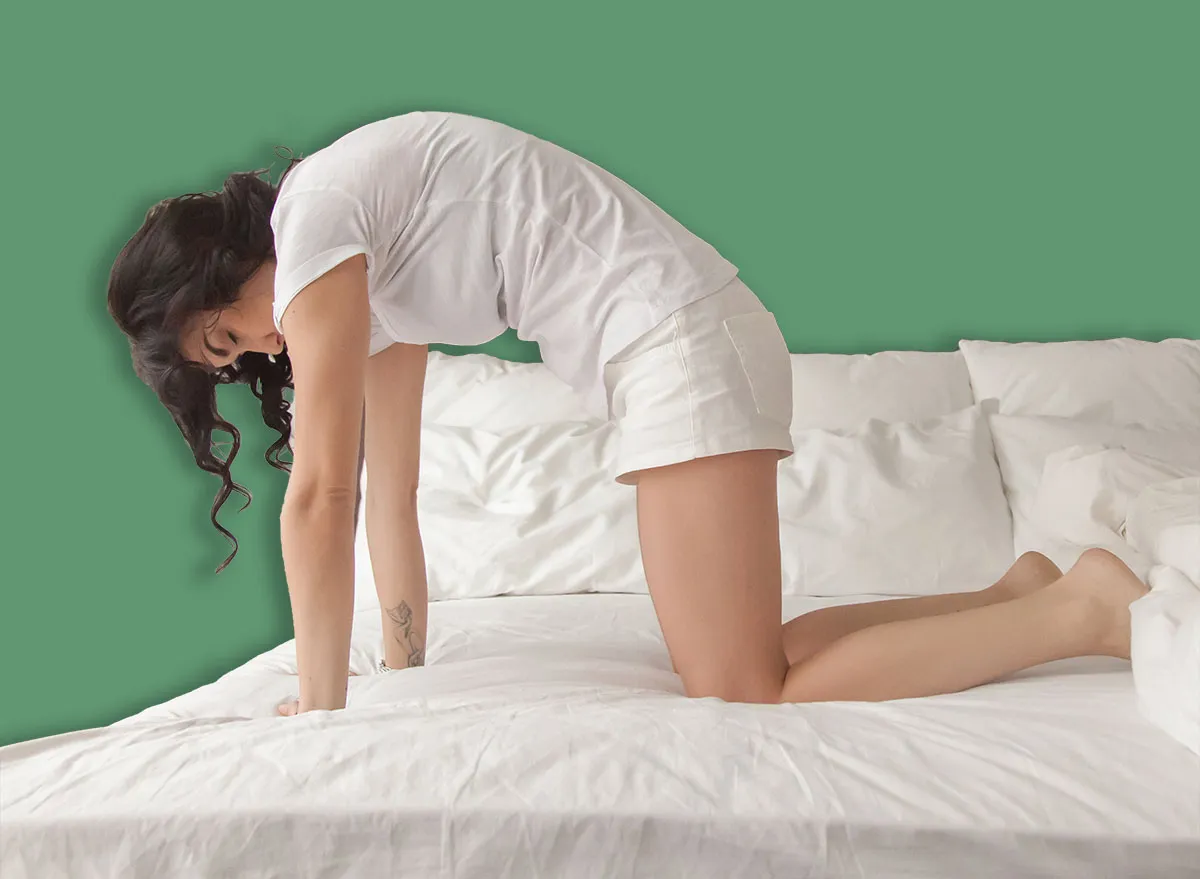
Finally, a modified bed version of the cat-cow stretch can improve spinal mobility. Performed on hands and knees, arching and rounding the back slowly and deliberately, this exercise helps coordinate movement throughout the spine. Two sets of 10 repetitions are recommended.
Consistency is key. Starting with one set of each exercise and gradually increasing to two sets over several weeks allows the body to adapt. Exercising every other day allows for muscle recovery. It’s important to stop immediately if experiencing sharp pain, and to consult a doctor before starting if there is a history of osteoporosis, back surgery, herniated discs, severe arthritis, or uncontrolled high blood pressure.
After four to six weeks of consistent practice, individuals may experience improved ease in daily activities, better posture, and increased confidence in movement. However, progress requires consistent effort, adequate recovery, and a patient approach, recognizing that muscle function improvements take time, especially after the age of 60.