Yoga Journal Revisits Evidence on Restorative Yoga Benefits
Yes — restorative yoga can measurably blunt the physical effects of chronic stress. The practice uses props to hold the body in fully supported poses, shifting it out of the fight-or-flight state and into what physiologists call the relaxation response, a state marked by slower heart rate, lower blood pressure, and quieter brain waves.
Yoga Journal revisited the evidence this month, republishing on November 19 a 1995 article by Judith Lasater, Ph.D., P.T., as part of its Archives series drawing on issues dating back to 1975. The piece argues that an ancient body coping with modern overload needs deliberate, supported rest — and it maps the physiology of why.
- Chronic stress keeps adrenal hormones circulating, slowing digestion, disturbing sleep, and impairing the body’s capacity to heal, Yoga Journal reported.
- Restorative yoga counters that state through full prop support, spinal movement in all directions, and gentle inversion of the legs.
- Relaxation training has documented clinical backing going back to Edmund Jacobson’s 1934 work on progressive relaxation.
Why does chronic stress make people sick?
Stress begins as a survival mechanism. The adrenal glands, sitting above the kidneys, secrete catecholamine hormones — adrenaline and noradrenaline — that raise heart rate, blood pressure, alertness, and muscle tension while shutting down systems the body deems non-essential: digestion, elimination, growth, repair, and reproduction.
For human ancestors, that response resolved quickly. They fought or ran, the hormones were spent, and normal function resumed. Modern stressors — job insecurity, a family member’s health crisis — rarely resolve so cleanly, so the adrenals keep pumping and the suppressed systems stay suppressed, Yoga Journal reported.
Left in that state, the body’s self-repair capacity is compromised, inhibiting recovery from an existing illness or injury, or creating a new one, including high blood pressure, ulcers, back pain, immune dysfunction, reproductive problems, and depression — each of which then adds stress of its own.
What exactly is the relaxation response?
Herbert Benson, M.D., coined the term for the physiological state that occurs when a person consciously relaxes. In The Wellness Book, he defined it as “a physiological state characterized by a slower heart rate, metabolism, rate of breathing, lower blood pressure, and slower brain wave patterns.”
The research lineage is older than the phrase. Edmund Jacobson, M.D., published You Must Relax in 1934, describing his progressive relaxation techniques. Jacobson reported success treating high blood pressure, indigestion, colitis, insomnia, and what he called “nervousness.”
Common to all stress-reduction techniques, per the Yoga Journal article, is placing the body in a comfortable position with gentle attention directed toward the breath. Scientists studying these methods report measurable benefits, including reduced muscle tension and improved circulation.
“In medicine, we are learning that physical problems such as high blood pressure and heart disease can be influenced by psychological interventions such as relaxation training. Indeed, the Food and Drug Administration issued a report recommending these non-drug approaches as the treatment of choice for milder forms of hypertension. Mind and body are connected and must work together, and this should be a powerful asset in treating medical illness.” — David Spiegel, M.D., author of Living Beyond Limits
The mind-body framing has since grown into its own medical specialty, psychoneuroimmunology, which studies how the psyche, nervous system, and immune system interact. Dean Ornish, M.D., author of Dr. Dean Ornish’s Program for Reversing Heart Disease, concluded from his study of patients with atherosclerotic heart disease that daily periods of relaxation are essential in preventing further deterioration.
How does a supported pose change physiology?
Lasater calls restorative poses “active relaxation.” Props hold the body completely, and carefully sequenced poses move the spine through backbends, forward bends, and gentle twists in both directions — reflecting yoga’s teaching that well-being is enhanced by a healthy spine.
The inverted element matters most for circulation. Because people stand or sit most of the day, blood and lymph fluid accumulate in the lower extremities; elevating the legs on a bolster or pillow reverses gravity’s pull and returns those fluids to the upper body, enhancing heart function. The change can be as simple as legs up on a bolster or pillow, yet the effects, per the article, are dramatic.
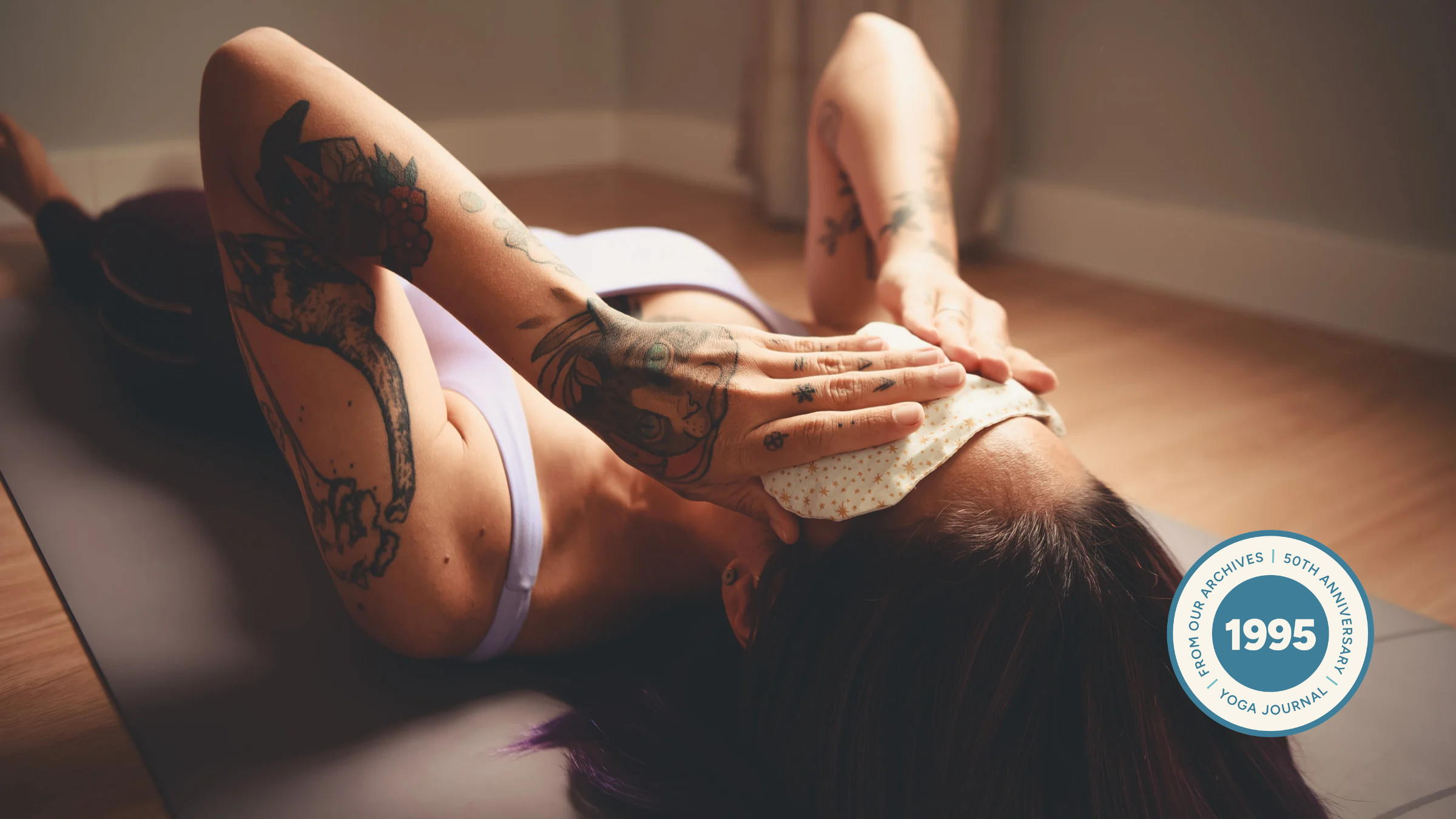
Lasater refers to restorative yoga poses as “active relaxation.”
What did the sleep researcher find?
Roger Cole, Ph.D., a psychobiologist and yoga teacher who consulted for the University of California, San Diego, in sleep research and biological rhythms, conducted preliminary research on inverted poses. He found that they dramatically alter hormone levels, reducing brain arousal, blood pressure, and fluid retention.
Cole attributed those benefits to a slowing of heart rate and dilation of blood vessels in the upper body due to reversing the effects of gravity.
Who is restorative yoga for, and when?
Per the Yoga Journal article, restorative poses suit times when a person feels weak, fatigued, or stressed by daily activities — and especially the periods before, during, and after major life events such as a death of a loved one, change of job or residence, marriage, divorce, major holidays, and vacations. The practice can also be used when ill or recovering from illness or injury.
Yoga’s energetic framing underpins the sequencing: prana, the masculine energy above the diaphragm governing respiration and heart rate, and apana, the feminine energy below it governing the abdominal organs, are balanced so the practitioner is neither overstimulated nor depleted.
Yoga Journal itself began in May 1975, when the California Yoga Teachers Association launched the magazine with Judith Lasater on its founding board as copy editor. Its first issue of 300 copies was distributed personally by the founders, who worked as volunteers.
By the mid-1990s, when Lasater’s article first appeared, circulation had reached 66,000, and the magazine has since won eight Western Publications Association’s Maggie Awards as “Best Health and Fitness Magazine.” It was acquired by Outside in 2020.
The material is drawn from Relax and Renew: Restful Yoga for Stressful Times, copyright 1995 by Judith Lasater, Ph.D., P.T., published by Rodmell Press of Berkeley, California, and reprinted with permission.