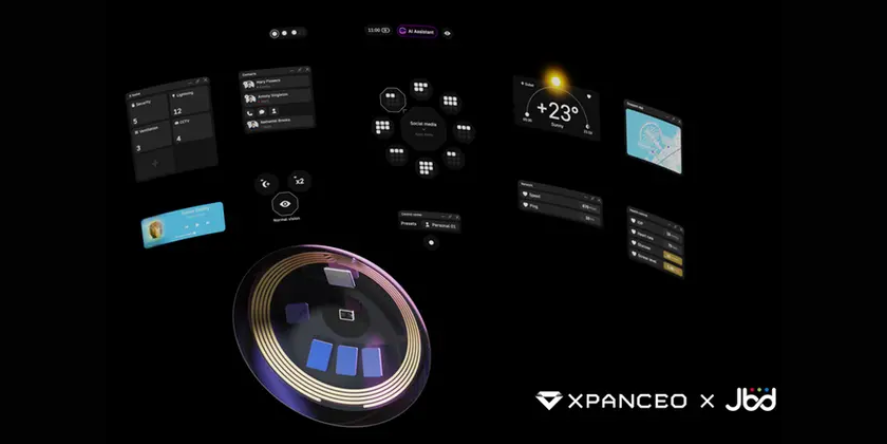
XPANCEO and JBD Redefine AR With Smart Contact Lens Display
XPANCEO and JBD have developed a smart contact lens display utilizing micro-LED technology to project augmented reality (AR) interfaces directly onto the wearer’s eye. According to reports from intlbm, this integration leverages JBD’s expertise in micro-scale optics to solve the primary bottleneck of AR wearables: the physical footprint of the display engine.
- Hardware: Transition from bulky headsets to micro-LED projectors embedded in contact lenses.
- Impact: Eliminates the “glass slab” form factor, reducing latency between user intent and visual overlay.
- Enterprise Use: Potential for hands-free data telemetry in surgical, industrial, and high-security environments.
The industry has spent a decade attempting to shrink AR from the “face-computer” (like the HoloLens) to the “smart glass” (like Ray-Ban Meta). However, the physics of light projection—specifically the need for a focal plane that doesn’t cause eye strain—remains a hurdle. XPANCEO’s approach targets the final frontier of miniaturization: the ocular surface. By utilizing JBD’s micro-LED architecture, the system bypasses the need for heavy frames, instead using a high-brightness, low-power emitter that can function within the tight energy budget of a lens-based battery or inductive power source.
Micro-LED Architecture vs. Traditional Waveguides
Most current AR devices rely on waveguides—transparent pieces of glass or plastic that steer light from a projector into the eye. These are prone to “rainbowing” and require significant depth. The XPANCEO and JBD collaboration shifts the focus to a direct-projection model. Micro-LEDs are preferred over OLED or LCD because they offer higher nits of brightness at a fraction of the power consumption, which is critical for a device sitting on a cornea where thermal dissipation is a primary safety concern.

| Spec | Traditional AR Glasses | XPANCEO/JBD Contact Lens |
|---|---|---|
| Display Tech | LCoS / Waveguide | Micro-LED |
| Form Factor | Frame-based (Grams) | Ocular-surface (Milligrams) |
| Power Draw | Watt-scale (Battery pack) | Milliwatt-scale (Micro-battery/Inductive) |
| Visual Field | Limited FOV Window | Direct Retinal Projection |
From a systems architecture perspective, the lens acts as a peripheral “dumb terminal.” The heavy lifting—spatial mapping, NPU processing, and connectivity—is offloaded to a paired compute puck or smartphone. This prevents the lens from overheating and allows for the use of standard ARM-based processors to handle the OS layer. For developers, this means the API must be optimized for extremely low-bandwidth visual overlays to prevent lag, as any latency in a retinal display can cause immediate nausea (vestibular-ocular reflex mismatch).
The Integration Bottleneck: Power and Data Transmission
Shipping a product like this requires solving the “power gap.” Since a contact lens cannot house a lithium-ion battery of any significant size, the system likely relies on a combination of ultra-low-power ASICs and wireless power transfer. This introduces a cybersecurity vector: the wireless link between the compute puck and the lens. If the connection is not secured with end-to-end encryption, an attacker could theoretically inject visual artifacts or “spoof” the user’s field of vision.
Enterprises deploying this tech for field technicians or surgeons will need to ensure SOC 2 compliance for the data pipelines feeding the lenses. Because these devices capture biometric data and potentially record the user’s environment, corporations are deploying [Relevant Tech Firm/Service] to conduct rigorous penetration testing on the wireless protocols to prevent “man-in-the-middle” attacks on the visual stream.
For developers looking to interface with similar micro-display systems, the data flow typically involves a serialized stream of coordinates and pixel intensities. A conceptual cURL request to a hypothetical AR rendering API for such a device might look like this:
curl -X POST https://api.xpanceo-ar.dev/v1/overlay
-H "Authorization: Bearer YOUR_API_KEY"
-H "Content-Type: application/json"
-d '{
  "device_id": "lens_left_001",
  "layer": "telemetry",
  "coordinates": {"x": 120, "y": 450},
  "content": "BPM: 72 | O2: 98%",
  "color": "#00FF00",
  "opacity": 0.8
}'
Deployment Realities and Hardware Limitations
Despite the technical achievement, the path to mass production is fraught with regulatory hurdles. The FDA and similar global bodies treat contact lenses as Class II or III medical devices. The integration of electronics into a biocompatible polymer requires rigorous testing for oxygen permeability (Dk/t) to ensure the cornea does not suffer from hypoxia. This is where the “vaporware” risk is highest; moving from a lab prototype to a certified medical device often takes years of clinical trials.

Furthermore, the software stack must be lean. We aren’t talking about running a full Android build on a lens. This is a specialized environment requiring a real-time operating system (RTOS) that can handle interrupts with microsecond precision. For firms attempting to build custom apps for this hardware, partnering with [Relevant Tech Firm/Service] for embedded C++ and Rust optimization is non-negotiable to minimize the memory footprint.
The current state of the art, as seen in IEEE whitepapers on micro-LEDs, suggests that the biggest win here is the “Always-On” capability. By reducing the power floor, XPANCEO can provide a persistent HUD (Heads-Up Display) that doesn’t drain a wearable battery in two hours. This moves AR from a “novelty session” to a “persistent utility.”
The Trajectory of Ocular Computing
The shift toward contact lens displays represents the logical conclusion of the “invisible computing” trend. Once the hardware is invisible, the friction shifts entirely to the software UX. We are moving toward a world where the digital and physical layers are indistinguishable, but only if the security and power problems are solved. As enterprise adoption scales, the demand for specialized [Relevant Tech Firm/Service] to manage the fleet of these devices and their associated data privacy audits will skyrocket.
Disclaimer: The technical analyses and security protocols detailed in this article are for informational purposes only. Always consult with certified IT and cybersecurity professionals before altering enterprise networks or handling sensitive data.