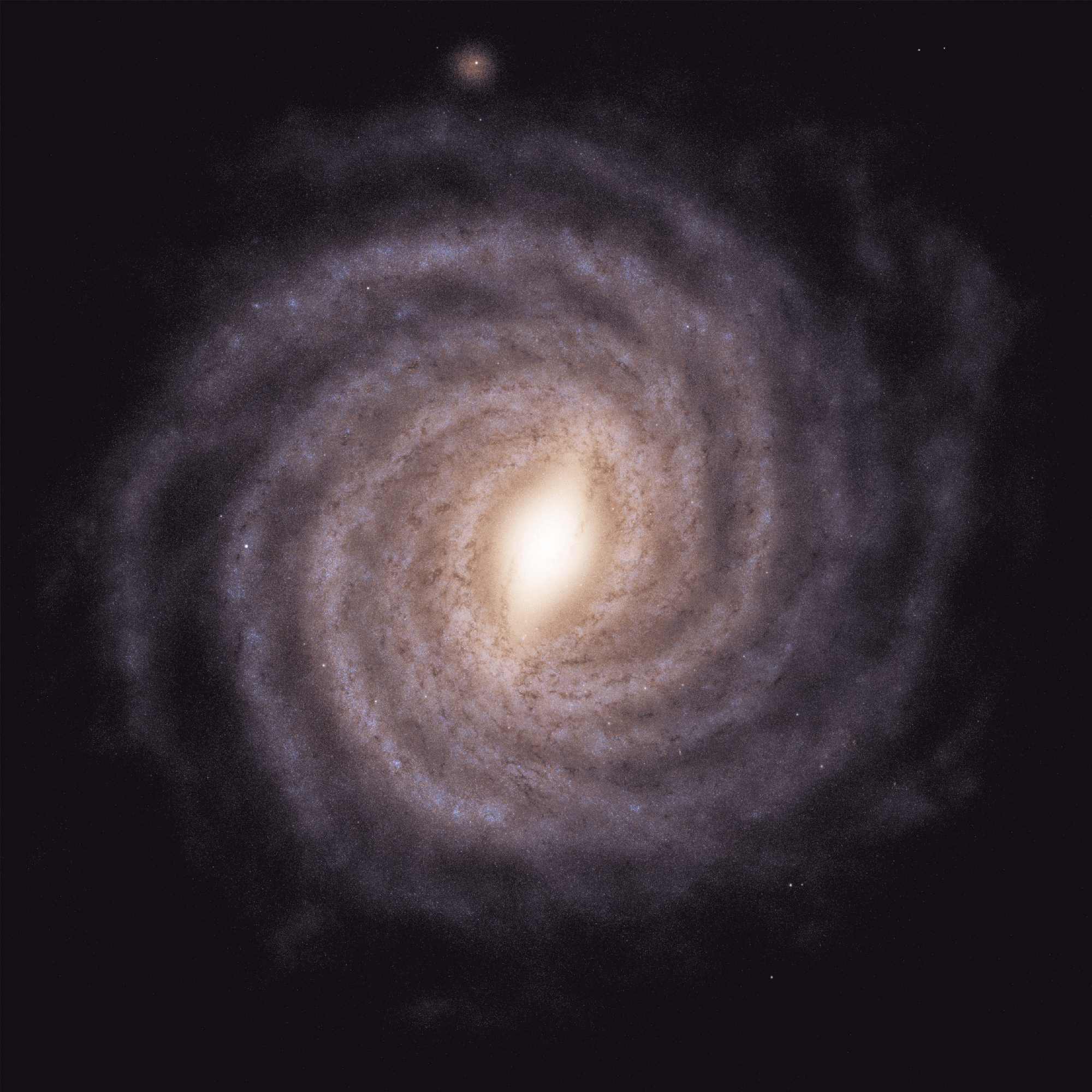
XMM-Newton Discoveries Reveal Milky Way Is Larger Than Previously Thought
The European Space Agency’s XMM-Newton telescope has detected gamma-ray emissions that indicate the Milky Way galaxy is significantly larger than previous astronomical models suggested, according to reports from Phys.org and The Brighter Side of News. By analyzing high-energy radiation from the galaxy’s outer spiral arms, researchers have revised the distance scales of our galactic structure, challenging the long-held consensus on the Milky Way’s physical boundaries.
- Data Shift: XMM-Newton and Chandra X-ray Observatory data have pushed the estimated boundaries of the Milky Way’s outer arms further into space.
- Sensor Precision: The discovery relies on high-energy gamma-ray and X-ray detection to map gas and dust where optical telescopes fail.
- Model Impact: This forces a recalibration of galactic mass calculations and the gravitational influence of the Milky Way on satellite galaxies.
Mapping the Milky Way from the inside is a classic “edge-case” problem in astrophysics. Because we are embedded within the galactic disk, interstellar dust obscures the view, creating a massive data bottleneck for optical instruments. To bypass this, astronomers utilize X-ray and gamma-ray detection—essentially treating the galaxy as a high-energy signal processing problem. The recent findings from XMM-Newton and the Chandra X-ray Observatory provide a higher-resolution “ping” of the outer spiral arms, revealing that the galactic disk extends further than previously mapped.
How X-Ray Detection Solves the Galactic Mapping Bottleneck
Optical telescopes struggle with “extinction,” where cosmic dust absorbs visible light. X-ray and gamma-ray emissions, however, penetrate this debris. According to Phys.org, the collaboration between XMM-Newton and Chandra allowed researchers to identify specific high-energy signatures in the outer reaches of the galaxy. This is analogous to using a LiDAR scan to map a room filled with smoke; the higher frequency allows the signal to pass through the noise to hit the actual boundary.
This revised mapping isn’t just a matter of aesthetics. In the same way that a developer must account for every byte in a memory leak, astrophysicists must account for every kilo-parsec of mass to understand the galaxy’s rotation curve. If the disk is larger, the distribution of dark matter and baryonic mass must be recalculated. For enterprises dealing with massive geospatial datasets or satellite telemetry, this highlights the critical need for high-precision data processing. Many firms are now deploying [Relevant Tech Firm/Service] to handle the ingestion and analysis of such high-velocity, high-volume astronomical data streams.
Comparing Galactic Models: Previous vs. Current
The shift in our understanding of the Milky Way’s size stems from a discrepancy between different observation methods. While radio astronomy provided the initial blueprint, the X-ray data provides a more concrete verification of where the gas-rich spiral arms actually terminate.

| Metric | Previous Optical/Radio Model | XMM-Newton/Chandra Model |
|---|---|---|
| Boundary Detection | Based on star counts and HI gas lines | Based on high-energy gamma-ray/X-ray emissions |
| Disk Radius | Conservative estimate of outer arm reach | Expanded radius; arms extend further than predicted |
| Visibility | High interference from interstellar dust | High penetration of galactic “noise” |
EarthSky notes that the Milky Way’s arms may not look exactly as we once thought, suggesting that the structure is more complex and expansive. This structural revision impacts how we calculate the “escape velocity” of stars and the orbital mechanics of the entire system. When dealing with these scales of data, the latency between observation and processing is immense, often requiring the use of distributed computing clusters and containerized analysis pipelines to manage the petabytes of raw telemetry.
The Implementation Mandate: Processing Astronomical Data
To handle the type of data generated by XMM-Newton, researchers often use Python-based libraries like Astropy. For those attempting to query public astronomical archives (such as the HEASARC archive), the process typically involves an API request to filter for specific energy ranges. Below is a conceptual example of how a researcher might programmatically filter for high-energy X-ray events using a Python wrapper for a data query:
import astropy.units as u
from astroquery.heasarc import Heasarc

# Initialize Heasarc query for XMM-Newton data
heasarc = Heasarc()

# Query for sources with high energy flux in the outer galactic plane
table = heasarc.query_object("Milky Way Outer Arm",
                               mission="XMM",
                               energy_min=2.0*u.keV,
                               energy_max=10.0*u.keV)

# Filter for results that exceed the previous distance threshold
expanded_disk_data = table[table['dist'] > 15000] # Distance in parsecs
print(f"Detected {len(expanded_disk_data)} sources beyond previous boundary.")
Integrating this level of precision requires significant computational overhead. As research institutions scale these operations, they frequently turn to [Relevant Tech Firm/Service] to optimize their HPC (High-Performance Computing) clusters, ensuring that the data pipeline doesn’t throttle during the processing of massive FITS (Flexible Image Transport System) files.
Why the Expanded Galaxy Changes the Math
A larger galaxy implies a different gravitational profile. According to the data provided by the European Space Agency (ESA) via the XMM-Newton project, the detection of these distant arms suggests that the Milky Way’s influence extends further into the local group of galaxies. This creates a ripple effect in our understanding of galactic evolution. If the disk is larger, the rate of star formation in the periphery may be higher than previously modeled, altering the “lifecycle” benchmarks of the galaxy.
From a technical perspective, this is a problem of signal-to-noise ratio (SNR). The gamma-ray detections are faint, requiring sophisticated background subtraction algorithms to ensure the signal isn’t just cosmic microwave background radiation. This is where the intersection of AI and astrophysics becomes critical; machine learning models are now being trained to distinguish between genuine galactic emissions and instrumental noise, a task that requires the same level of rigor as a SOC 2 compliance audit for data integrity.
As we refine the map of our home galaxy, the demand for more precise instrumentation grows. The transition from XMM-Newton to next-generation observatories will likely involve even more aggressive use of NPUs (Neural Processing Units) to handle real-time data filtering at the edge, reducing the amount of “junk” data transmitted back to Earth. For organizations managing these complex data architectures, partnering with [Relevant Tech Firm/Service] ensures that the underlying infrastructure can support the next leap in observational resolution.
Disclaimer: The technical analyses and security protocols detailed in this article are for informational purposes only. Always consult with certified IT and cybersecurity professionals before altering enterprise networks or handling sensitive data.