
Wyoming Dinosaur Mummies Rewrite Our Understanding of Edmontosaurus
WORLAND, WYOMING - Newly analyzed fossilized skin and bone from exceptionally preserved Edmontosaurus specimens unearthed in Wyoming are dramatically reshaping paleontologists’ understanding of this duck-billed dinosaur. Utilizing cutting-edge imaging technology, a team led by paleontologist paul Sereno has revealed details about the animal’s skin, crest, and, surprisingly, its feet.
The research centers on “mummies” – remarkably complete fossils where skin impressions remain. Sereno’s team employed CT scans,X-rays,and photogrammetry to create a detailed model of the Edmontosaurus,updating previous reconstructions.These analyses confirm aspects of earlier artistic depictions while adding significant new facts.
Previous interpretations of the Edmontosaurus‘ back differed.Artist Charles Knight envisioned a fleshy crest extending from the head along the spine, while paleontologist Jack Horner proposed a row of spikes. The new data shows both were partially correct: a crest did extend rearward from the head, transitioning into a series of spikes aligned with the vertebrae, similar to those found on modern chameleons.
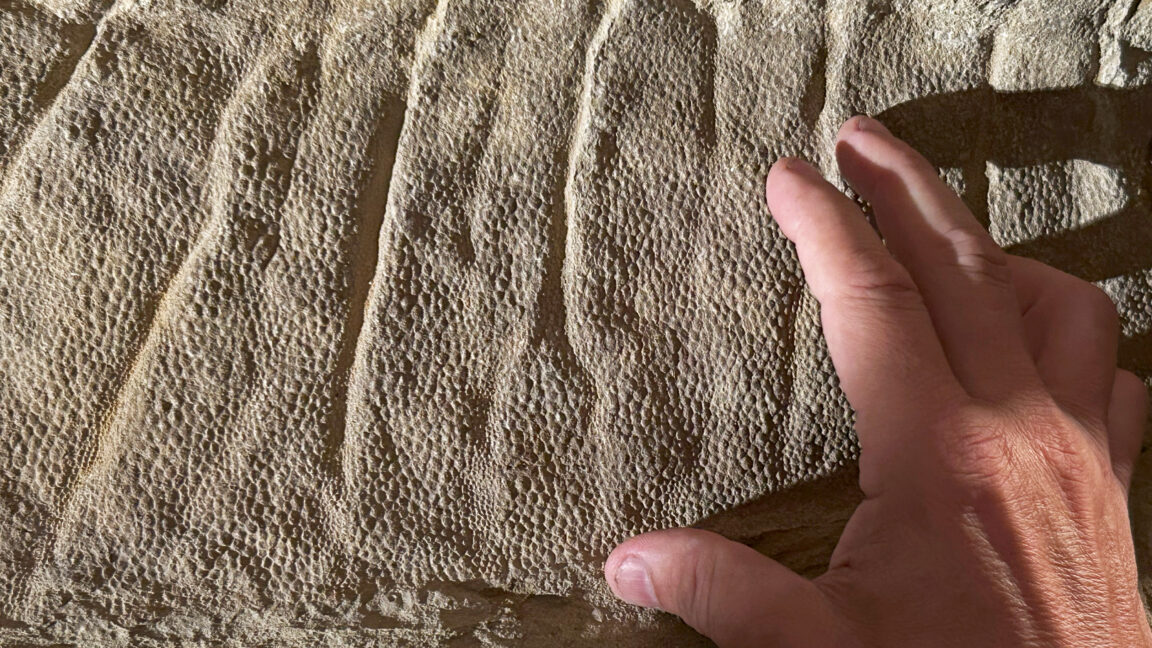
Perhaps the most surprising revelation concerns the dinosaur’s scales.”Another thing that was stunning in Edmontosaurus was the small size of its scales,” Sereno says. The scales,measuring just 1 to 4 millimeters across-growing to a maximum of 1 centimeter on the tail-are proportionally tiny for an animal the size of an elephant. The team also determined the skin was incredibly thin, based on observed wrinkles in the fossilized impressions.
Further analysis revealed the Edmontosaurus possessed hooves. The forelimbs featured a single, central hoof with a “frog,” a rubbery structure on the underside, resembling equine hooves. “They looked very much like equine hooves, so apparently these were not invented by mammals,” Sereno explains. ”Dinosaurs had them.” The hind legs, bearing the majority of the animal’s weight, had three wedge-shaped hooves around three digits and a fleshy heel, a structure comparable to that of modern rhinoceroses.
These findings, made possible by technologies unavailable even a decade ago, offer a fresh viewpoint on Edmontosaurus and challenge long-held assumptions about dinosaur anatomy.
