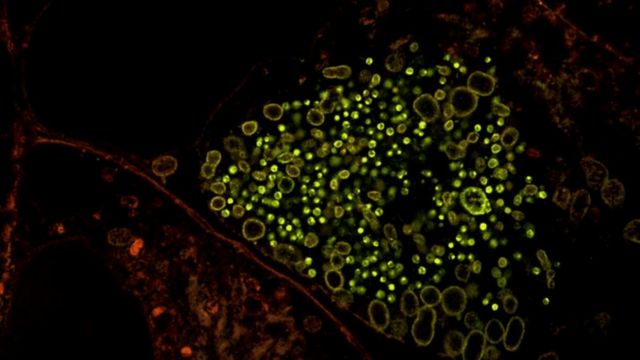
Würzburg Study Reveals Lipids Organize Chlamydia DNA
Würzburg Researchers Discover Sphingolipids Pack Chlamydia DNA
Scientists at the University of Würzburg have discovered that lipids play a central role in organizing the genetic material of Chlamydia trachomatis, a finding published in Nature Communications that challenges current understandings of bacterial DNA packaging. According to an official study led by Professor Thomas Rudel, Head of the Chair of Microbiology, alongside co-first authors Marcel Rühling and Fabienne Wagner, roughly 90 percent of the nucleoid in the infectious form of the pathogen is occupied by sphingomyelin.
The Tech TL;DR:
- Researchers at the University of Würzburg discovered that sphingolipids, specifically sphingomyelin, are incorporated directly into the compacted nucleoid of Chlamydia trachomatis elementary bodies.
- Using expansion microscopy and cryo-electron tomography, the team observed that approximately 90 percent of the infectious form’s nucleoid is occupied by these lipids.
- This lipid-based DNA compression is identified as a potential energy-efficient mechanism that replaces specialized proteins, offering a novel target for interrupting bacterial infections.
Chlamydia Trachomatis Hijacks Human Metabolites to Fuel Development
Biologically classified as a specialized nutrient thief, Chlamydia trachomatis has lost the capacity to reproduce independently outside a host cell. Instead, the bacterium relies on hijacking human metabolites, including sphingolipids, to fuel its development. Inside the host cell, the pathogen establishes a sheltered, membrane-bound structure known as an inclusion, which frequently grows to a magnitude that exceeds the size of the human host cell’s nucleus.
The life cycle features a morphological transition, shifting between hardy, infectious elementary bodies designed for survival outside the host and active reticular bodies that multiply internally. To protect its genetic blueprint during the infectious phase, the DNA inside the tiny elementary bodies is compressed into a tight nucleoid. Measuring between 200 and 300 nanometres, these elementary bodies sit below the resolution limit of standard light microscopes, a limitation that historically led scientists to mistake chlamydia for viruses until the 1960s.
Advanced Imaging Reveals Nanoscale Architecture
To bypass traditional optical limits, the Würzburg team deployed expansion microscopy, a technique where biological samples are embedded in a swellable hydrogel. When water is added, the hydrogel expands up to eight times its original size, stretching the sample so that details previously compressed into a single pixel become visible under conventional light microscopes. Cryo-electron tomography in a flash-frozen state confirmed these observations, proving that specific membrane stacks form a structural bridge between the inner bacterial envelope and the DNA core.
Using these combined methods, the researchers documented the dynamic incorporation and removal of a sphingomyelin derivative within the bacterial nucleoids throughout the developmental cycle. The separation of lipids and DNA operates as one of the earliest measurable steps when the bacterium transitions back to its active form after entering a host cell.
Implications for Medical Research and Interventions
The study indicates that lipid metabolism functions as a central regulator controlling access to genes, rather than merely acting as a supplier for the cell envelope. Researchers suggest that utilizing lipids for DNA compression provides an energy-efficient strategy that reduces the need for resource-intensive specialized protein synthesis. Understanding that the controlled release of DNA from its lipid packaging triggers the infection opens a targeted avenue for future medical research aimed at disrupting this lipid-DNA bridge before the infection can be nipped in the bud.