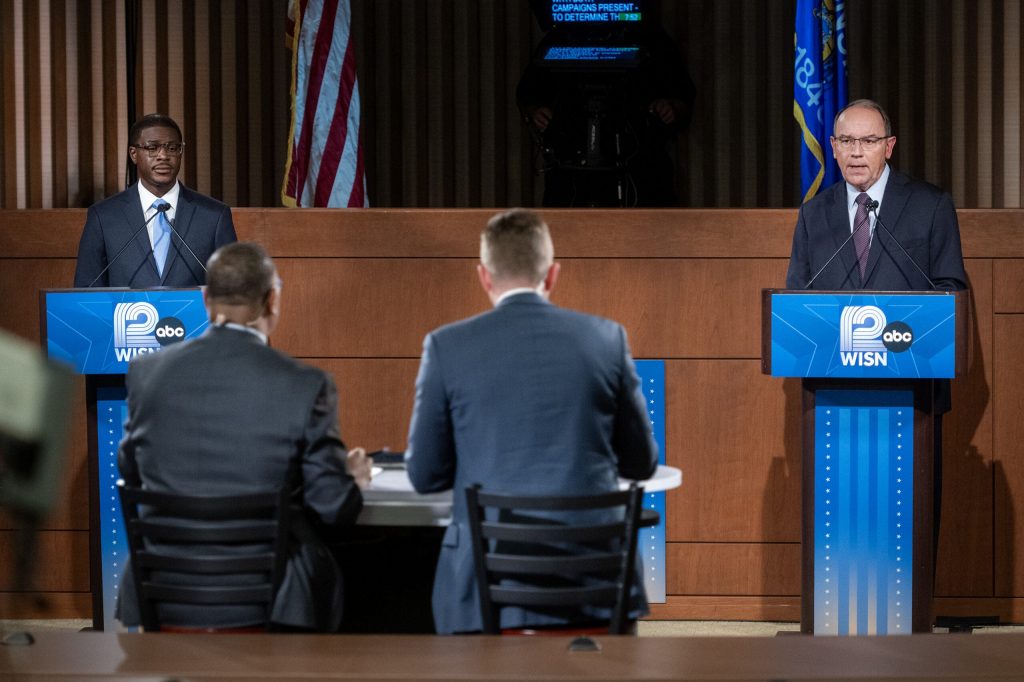
Wisconsin Governor Candidates Clash Over Tolls During Debate
“I think we should be open,” David Crowley said during the Oct. 21, 2026, debate at Marquette University Law School’s Eckstein Hall in Milwaukee, Wis.,. That single sentence turned toll roads into a flashpoint in Wisconsin’s race for governor as the Democratic Milwaukee County Executive and his Republican opponent, U.S. Rep. Tom Tiffany, clashed over how to permanently fund the state’s roads.
Clashing Positions on Toll Roads at Marquette University
The transportation funding debate forced both candidates to stake out contrasting approaches to Wisconsin’s long-standing budget shortfall. While Crowley expressed willingness to consider tolling as a stable revenue stream, Tiffany answered “no” when asked if he would support tolls, maintaining that the state already possesses adequate funds for road maintenance.
The Republican Party of Wisconsin quickly attacked Crowley’s debate stance. Spokesperson Anika Rickard claimed the Democrat supported policies that would force drivers to pay just to reach grocery stores, workplaces, or schools.
Despite Tiffany’s current opposition, his legislative record reveals a different approach. During the 2017 state budget negotiations, Tiffany served on the Legislature’s Joint Committee on Finance and voted to spend $2.5 million on a tolling feasibility study. Former Gov. Scott Walker ultimately blocked that funding through a partial veto.
Former state Senate Majority Leader Scott Fitzgerald later noted that a tolling plan had already been agreed upon within the legislative deal before the veto stopped it.
Decades of Borrowing and Budget Transfers in Madison
Wisconsin’s transportation funding relies on a volatile mix of revenue sources that has pushed lawmakers to seek alternative cash infusions for decades. An analysis by the nonpartisan Legislative Fiscal Bureau details how Scott Walker’s administration borrowed nearly $743 million from the state’s general fund for roads and transferred another $531 million. When Tony Evers took office in 2019, the state transferred an additional $1.1 billion from the general fund into transportation.

Fuel efficiency gains and a frozen gas tax have compounded the structural deficit. Wisconsin’s gas tax has remained unchanged since 2006 because lawmakers halted automatic adjustments tied to inflation.
Both Crowley and Tiffany rejected the return of gas tax indexing during the debate. Collin Driscoll, a lobbyist for the Wisconsin Counties Association, noted that opposing the gas tax hike is politically necessary given current fuel prices well above $4 per gallon, though it removes a crucial funding tool from the table.
Evaluating Future Road Funding Solutions
Crowley proposed convening a blue-ribbon commission to consult stakeholders and identify sustainable transportation revenue, while also expressing openness to new user fees. Tiffany countered that his gubernatorial administration would increase transportation investment directly through the standard budgeting process and shorten construction timelines on major infrastructure projects like the I-94 East-West expansion in Milwaukee.
Driscoll pointed out that while the current general fund surplus masks the underlying road budget deficit, local government leaders remain concerned about long-term fiscal stability if that surplus eventually disappears. Implementing toll roads would require federal approval, leaving policymakers facing difficult choices as the campaign enters its final weeks.