
Will Oil Prices Ever Return to Normal?
As oil markets grapple with structural shifts from energy transition policies and OPEC+ production discipline, the question of whether prices will return to pre-2020 ‘normal’ levels has become a critical fiscal concern for energy-intensive industries, prompting CFOs to reassess hedging strategies and operational budgets amid persistent volatility in Brent and WTI benchmarks.
The End of ‘Normal’ in Oil Markets
The era of predictable oil price cycles anchored around $60-$70 per barrel appears structurally impaired. Since 2020, Brent crude has averaged $82/bbl, with volatility driven less by traditional supply-demand imbalances and more by geopolitical risk premiums and decarbonization policies. According to the U.S. Energy Information Administration’s Short-Term Energy Outlook (April 2026), global oil demand is projected to grow at just 0.8% annually through 2027, down from 1.4% in the 2010s, while non-OPEC supply growth remains constrained by capital discipline. This structural shift means industries like chemicals, aviation, and logistics face prolonged exposure to elevated input costs, directly impacting EBITDA margins—European ethylene producers, for instance, saw average margins compress from 18% in 2019 to 9% in 2024 amid naphtha price volatility.

“We’re no longer pricing oil on pure fundamentals; the market now incorporates a permanent ‘transition risk’ premium of $10-$15/bbl,” stated Linda Zhang, Chief Commodity Strategist at Goldman Sachs, during the bank’s April 2026 Global Energy Conference. “Hedging programs built on historical mean-reversion models are failing.”
This paradigm shift creates a clear B2B problem: energy-intensive corporations need sophisticated risk management tools beyond basic futures hedging. Companies are increasingly turning to specialized providers for dynamic hedging solutions that integrate real-time geopolitical analytics and AI-driven price forecasting. For example, a major European airline recently engaged a commodities risk advisory firm to restructure its fuel hedging program after suffering $220 million in unhedged losses during Q4 2025’s Brent spike to $95/bbl.
Supply Chain Realignment and Margin Pressure
The persistent elevation of oil prices is forcing a reevaluation of global supply chains, particularly for plastics and transportation. BASF’s Q1 2026 earnings call revealed that European manufacturing clients are accelerating nearshoring initiatives to reduce diesel-dependent logistics costs, with 34% of surveyed automotive suppliers planning to shift Tier 2 sourcing within 300km of assembly plants by 2028. This trend directly benefits logistics optimization software providers and regional warehousing operators, as companies seek to minimize exposure to diesel price volatility—which has correlated at 0.89 with Brent crude over the past 24 months per ICE Futures Europe data.
Meanwhile, upstream producers face their own challenges. Despite OPEC+ maintaining 3.66 million bbl/day of voluntary cuts through Q3 2026, U.S. Shale producers are constrained by wellhead breakeven averages of $58/bbl (Permian Basin) and $62/bbl (Eagle Ford), according to Dallas Fed Energy Survey data. This creates a pricing floor that prevents a return to historical lows but also caps upside, reinforcing a range-bound market environment. Oilfield service companies are pivoting toward efficiency-focused offerings—such as predictive maintenance platforms and modular drilling units—to help operators maintain profitability at $70-$80/bbl.
“The shale industry’s breakeven has risen due to service cost inflation and stricter ESG compliance,” noted Mark Rivera, CEO of Pioneer Natural Resources, in the company’s Q1 2026 investor presentation. “We need $75 oil to sustain 5% annual production growth, not the $50 environment of a decade ago.”
This environment elevates the demand for B2B services that enhance operational resilience. Exploration and production firms are contracting with specialized energy efficiency consulting firms to reduce lease operating expenses, while midstream operators are engaging pipeline integrity monitoring specialists to mitigate leak risks amid aging infrastructure—both direct responses to the need for cost control in a higher-for-longer oil price regime.
Investment Implications and the Path Forward
Capital markets are adapting to this new oil price paradigm. Integrated majors like Shell and TotalEnergies are allocating less than 20% of 2026 capex to upstream oil projects, per their respective annual reports, favoring dividends and share buybacks instead. This capital restraint further limits long-term supply elasticity, suggesting that any meaningful price decline would require demand destruction—such as a severe global recession—or a breakthrough in affordable, scalable alternatives like green hydrogen or advanced biofuels.
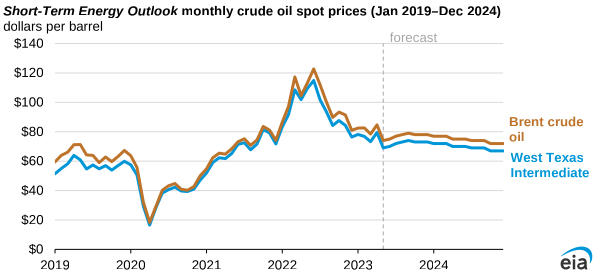
For now, the market’s equilibrium rests on a fragile balance: OPEC+’s spare capacity of 5.2 million bbl/day (primarily Saudi Arabia) acts as a buffer against supply shocks, while demand growth remains tethered to non-OECD economies. The International Monetary Fund’s April 2026 World Economic Outlook projects emerging market oil demand to grow at 2.1% annually through 2029, offsetting OECD declines—a dynamic that keeps prices structurally elevated.
As corporations navigate this landscape, the ability to anticipate and mitigate oil price-related fiscal risk becomes a competitive advantage. Those who partner early with agile commodities risk management providers and supply chain resilience consultants will be best positioned to protect margins and capitalize on volatility—turning a macroeconomic challenge into a strategic lever in an era where ‘normal’ is no longer a reliable benchmark.