
New Telescope Tech Aims to Spot Habitable Worlds, Banishing “Waterworld” Lies
Future Exoplanet Hunters Could Differentiate Oceans from Land
Scientists are refining methods to identify landmasses on distant exoplanets, a crucial step to avoid misinterpreting “waterworld” candidates as potentially life-bearing worlds. A recent study explores how future telescopes could distinguish these planets.
Unveiling Earth-like Features
A team of researchers analyzed spectral data, excluding desert sand and ice, to assess the capabilities of the proposed Habitable Worlds Observatory (HWO). Their goal was to determine if HWO could detect continents on rocky exoplanets. The study suggests an 8-meter telescope size would be necessary for HWO to identify land based on signal-to-noise data in visible and ultraviolet wavelengths.
“Detecting land via reflected light spectroscopy can help HWO rule out O2 biosignature false positives associated with the suppression of O2 sinks due to extremely deep oceans. Land detection is possible because all likely land surfaces for exo-Earth analogs have a positive sloping reflectance spectrum in the visible, whereas liquid water and water ice/snow are flat or slope negatively, respectively.”
—Research Study Authors
A Leap Beyond Webb
HWO, envisioned as the successor to the James Webb Space Telescope (JWST), is planned for a 2040s launch. Its mission includes directly imaging at least 25 habitable exoplanets across optical, infrared, and ultraviolet spectra. This initiative is expected to usher in a new era of exoplanet exploration.
Navigating Potential Waterworlds
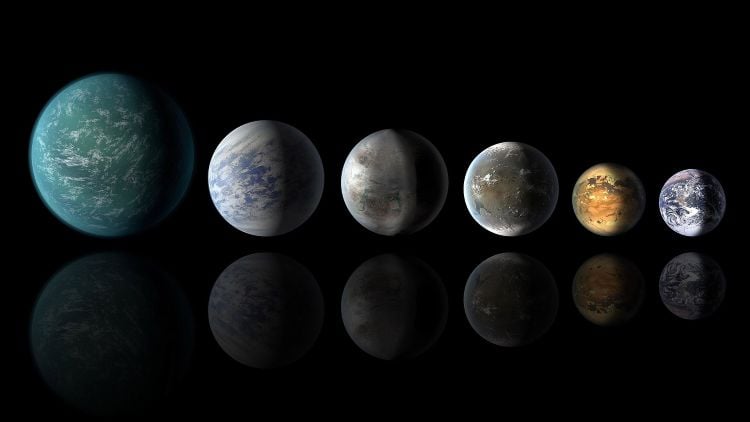
Currently, confirmed exoplanets like those orbiting TRAPPIST-1 (40 light-years) and Kepler-22b (587 light-years) are considered waterworld candidates. Most recently, JWST identified GJ 9827d, a “steam world” approximately 97 light-years away. Despite its steamy atmosphere, its extreme heat makes it unlikely to support life as we know it.
The Growing Catalog of Exoplanets
With the number of confirmed exoplanets in our Milky Way galaxy nearing 6,000, including hundreds of rocky planets and super-Earths, the search for life beyond Earth intensifies. For instance, the exoplanet LHS 1140 b, located 40 light-years away, is a rocky super-Earth that orbits within its star’s habitable zone and is a prime target for future atmospheric studies, according to NASA Exoplanet Archive data. HWO’s advanced capabilities could confirm whether any of these worlds host life, familiar or alien.
