
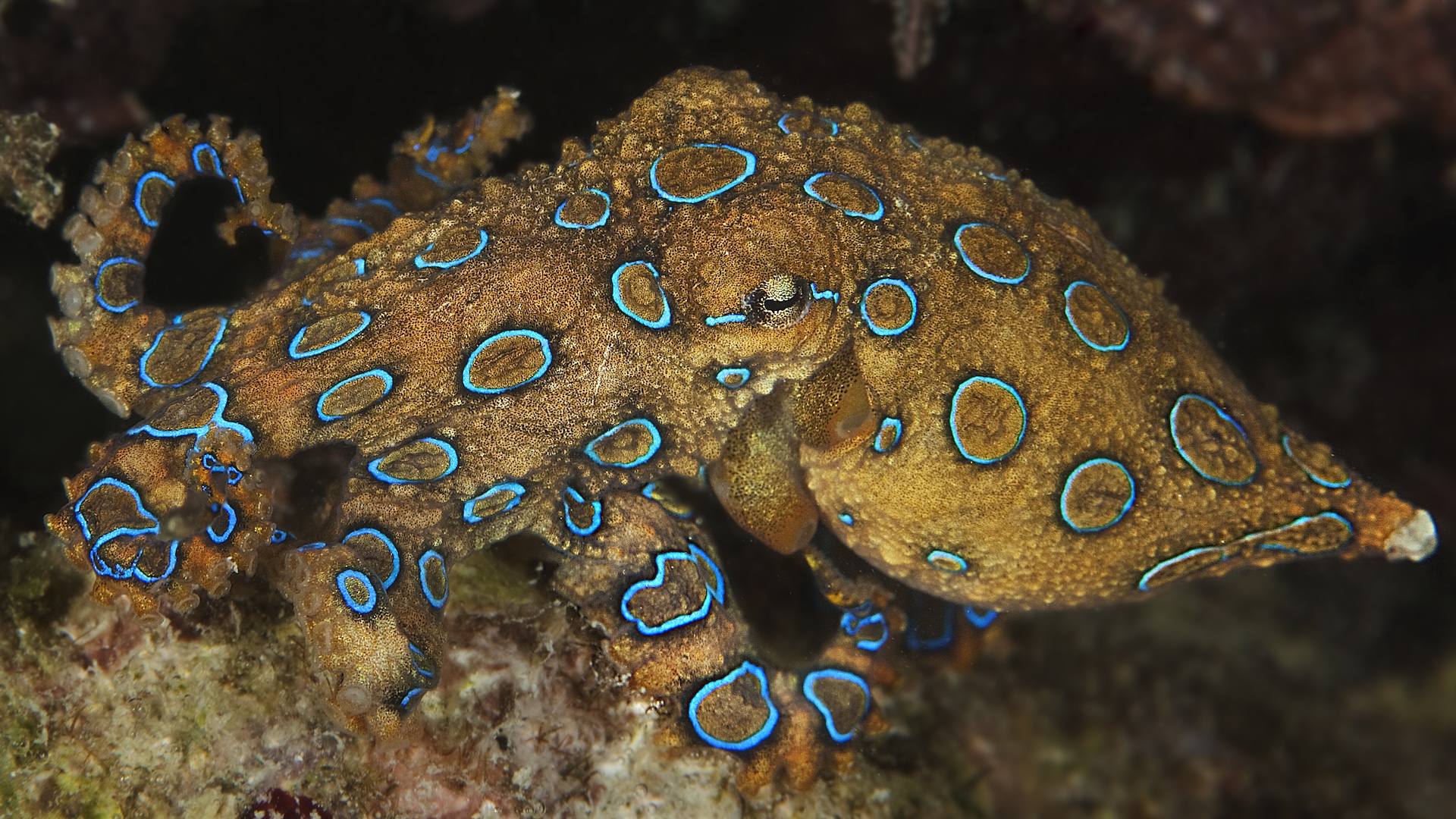
Blue-Ringed Octopus: Small Size, Deadly Venom
Don’t let their iridescent beauty fool you. Blue-ringed octopuses, denizens of the Pacific and Indian Oceans, pack a powerful, potentially lethal neurotoxin. Here’s what makes them so dangerous.
Tetrodotoxin: A Potent Threat
Blue-ringed octopuses carry tetrodotoxin (TTX), a neurotoxin capable of paralyzing humans. While TTX is about 50 times deadlier than cyanide, it’s most well-known from pufferfish. Improperly prepared fugu can be deadly because of this very compound. According to the Smithsonian Museum of Natural History’s adjunct zoologist, Michael Vecchione, all octopods possess venom, but blue-ringed octopuses are especially dangerous.
Meet the Deadly Family
Four species make up the blue-ringed octopus genus (Hapalochlaena), all possessing tetrodotoxin. These include the greater blue-ringed octopus (H. lunulata), the southern or lesser blue-ringed octopus (H. maculosa), the blue-lined octopus (H. fasciata), and the common blue-ringed octopus (H. nierstraszi). They are considered the most venomous octopus species.
How the Venom Works
Tetrodotoxin, while found throughout the octopus’s body, is produced by symbiotic bacteria in their salivary glands, according to the Australian Institute of Marine Science. This toxin comprises multiple compounds including histamine, acetylcholine, and dopamine. Acting as a neural inhibitor, TTX blocks sodium channels—essential for nerve cell communication—potentially stopping lung muscles and the heart.
Defense, Offense, and Mating
These creatures use their venom for both defense and predation, commonly injecting it through bites. According to Bret Grasse, manager of cephalopod operations at the University of Chicago Marine Biological Laboratory, they can also release venom into the water, paralyzing nearby creatures.
Intriguingly, blue-ringed octopuses also use venom during mating. Males, smaller than females, risk cannibalization. To overcome this, they may temporarily paralyze the female with venom to safely transfer a sperm packet. Females also layer their eggs with the toxin for protection.
Risk to Humans
Human bites are rare but can be fatal. The Australian Institute of Marine Science notes at least three deaths attributed to blue-ringed octopuses: two in Australia and one in Singapore. However, outcomes vary greatly, with some bites causing no effects.
In a notable 2006 incident, a 4-year-old boy in Australia was bitten. While he experienced severe symptoms requiring ventilation, he recovered fully within 28 hours. Grasse advises seeking immediate medical attention and ventilation for severe bites.
Small but Mighty
Reaching only 5 to 9 inches in length, these octopuses inhabit coral reefs and rocky seafloors in the Pacific and Indian oceans, typically at depths of 66 to 164 feet. Grasse noted that these impressive abilities are a widely utilized advantage for the small octopuses.
