
India’s Aditya-L1 Mission Prepares for Unprecedented Solar Activity in 2026
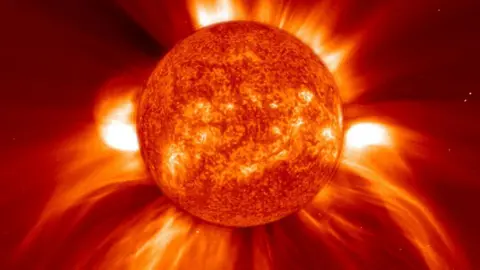
Bengaluru – India’s Aditya-L1 mission is gearing up for a critical period of observation as the Sun approaches the peak of its activity cycle in 2026, a phase expected to unleash substantially more powerful coronal mass ejections (CMEs) than those observed to date. Recent collaborative analysis between the Indian Institute of Astrophysics (IIA) and NASA, focusing on a substantial CME recorded on September 13, 2024, is establishing a baseline for understanding and mitigating the potential impacts of heightened solar activity on Earth and near-space infrastructure.
This planning is vital as the Sun’s activity waxes and wanes in roughly 11-year cycles. As the current cycle nears its maximum, the frequency and intensity of events like CMEs – massive expulsions of plasma and magnetic field from the Sun – will increase dramatically.Aditya-L1’s unique ability to measure CME temperature and heat energy in visible light provides crucial data for predicting the strength of these events shoudl they be directed towards Earth, offering a key advantage in safeguarding satellites and understanding the near-Earth space surroundings.
The CME studied, originating at 00:30 GMT on September 13, 2024, possessed a mass of 270 million tonnes – fifteen times the mass of the iceberg that sank the Titanic, according to Prof. Ramesh of the IIA. at its source, the eruption reached a temperature of 1.8 million degrees Celsius and released energy equivalent to 2.2 million megatons of TNT, dwarfing the atomic bombs dropped on Hiroshima (15 kilotons) and Nagasaki (21 kilotons).
despite these immense figures, Prof. Ramesh characterized the event as “medium-sized,” noting that the asteroid responsible for the extinction of the dinosaurs released energy equivalent to 100 million megatons. He anticipates even more powerful CMEs during the peak of the solar cycle.
“I consider the CME we evaluated to have occurred when the Sun was in the normal activity phase,” Prof. Ramesh stated. “Now this sets the benchmark that we’ll be using to evaluate what is in store when the maximum activity cycle occurs.”
The insights gained from analyzing this and future CMEs will be instrumental in developing countermeasures to protect satellites and enhance our understanding of the space surrounding Earth. This knowledge is crucial for maintaining vital communication, navigation, and weather forecasting systems that rely on these satellites.
