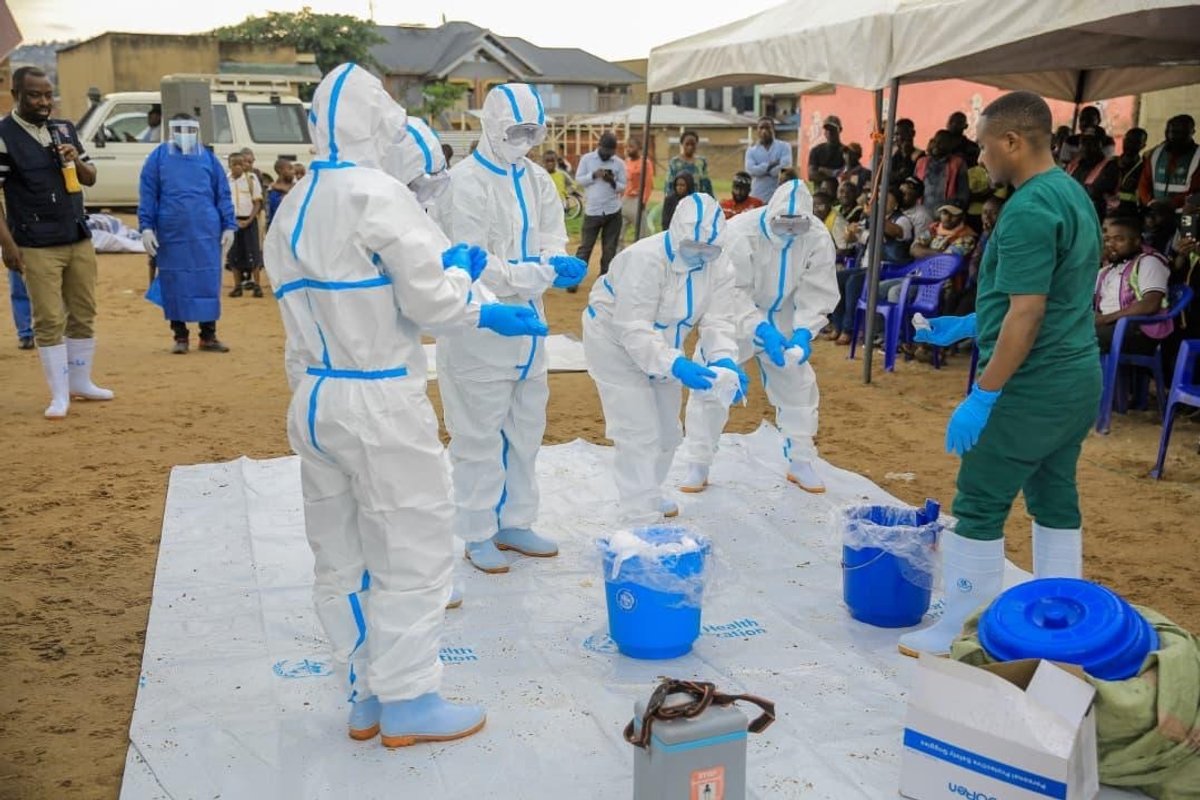
WHO: Fighting Traps Ebola Workers in Ituri Hospital as UNICEF Finds Violence Against Women Rising
WHO spokesperson Christian Lindmeier told journalists in Geneva that conflict and torrential rain prevented the safe evacuation of the trapped team.
“We’re hoping to do this as soon as possible, ideally today,” he said, adding that hospitals must remain safe spaces during conflict.
Meanwhile, UNICEF released initial findings Tuesday from what it calls the first real-time surveillance of violence against women and girls during an active Ebola outbreak. Researchers have interviewed 1,062 women and adolescent girls across five health zones in Ituri with SOFEPADI, a Congolese women-led organization, and Washington University.
Nearly six in ten women and girls said violence and abuse had started or increased since the outbreak began. More than a third reported increased control over their lives, followed by emotional and psychological abuse, physical and sexual violence. Seven in ten respondents live in households that have experienced isolation, quarantine or contact tracing; nearly two-thirds of those reported new or increased violence, nine in ten linking it to outbreak-related stress and fear.
SOFEPADI runs eight safe spaces in Ituri. Visits rose from 1,183 between January and March to 3,584 between July and September, a threefold increase. “Some women tells us about the violence they face in their homes. Others describe the insecurity they face when they go out to find food for their families,” said Sandrine Lusamba, SOFEPADI National Coordinator.
Dr. Noble stressed that isolation and contact tracing are critical to halting Ebola, but families are under enormous pressure. “Women and girls are bearing much of the cost,” he said. He called for keeping services for women and girls open, accessible and funded.
The outbreak is the second-largest in history and the fastest-spreading, according to Scientific American. About 65 percent of deaths occur in community settings rather than treatment centers, complicating contact tracing.
More than 80 percent of new cases emerge outside known contact lists, Africa CDC Director-General Jean Kaseya told Foreign Policy. Infections are spreading at double the rate seen in May.
Three vaccine candidates have been approved for a phase 2/3 trial in the outbreak zone, with hopes for approval in the first quarter of 2027. Previous Ebola vaccines did not include the Bundibugyo species, which has had only two prior outbreaks, in 2007 and 2012.
Heavy fighting near a hospital in Ituri Province, in the northeast of the Democratic Republic of the Congo bordering Uganda and South Sudan, has disrupted the Ebola response since April 2026, when the outbreak’s earliest known case emerged in the province’s Bunia, Mongbwalu, and Rwampara health zones.
By late May 2026, the epidemic had spread to four additional zones — Aru, Kilo, Nizi, and Nyankunde — while conflict and torrential rain prevented the safe evacuation of a trapped WHO team, according to Director-General Tedros and spokesperson Christian Lindmeier.
UNICEF’s real-time surveillance across five Ituri health zones with SOFEPADI and Washington University interviewed 1,062 women and adolescent girls, finding nearly six in ten reported violence starting or increasing since the outbreak began.
Just some more detail on Bundibugyo as co0ntext: there are zones where the outbreak was brought to a halt, showing DRC DOES have the capacity to do this. But the challenges are huge https://t.co/RBSgfqy5CO pic.twitter.com/tBifMGRyRW
More on Ituri
Heavy fighting has been ongoing since yesterday in the vicinity of a hospital in Ituri — in an area close to where the #Ebola outbreak first emerged. As a result, colleagues and response partners have been sheltering for their lives in a maternity ward of the facility for over 24… pic.twitter.com/cKqvfriqNf
#SouthSudan 🇸🇸 has taken steps to improve its ability to detect and respond to a potential Ebola outbreak caused by Bundibugyo virus disease, following the declaration of the outbreak in neighbouring #DRC 🇨🇩 on 15 May 2026. Read more 👇🏿https://t.co/Rgu30bqnYp