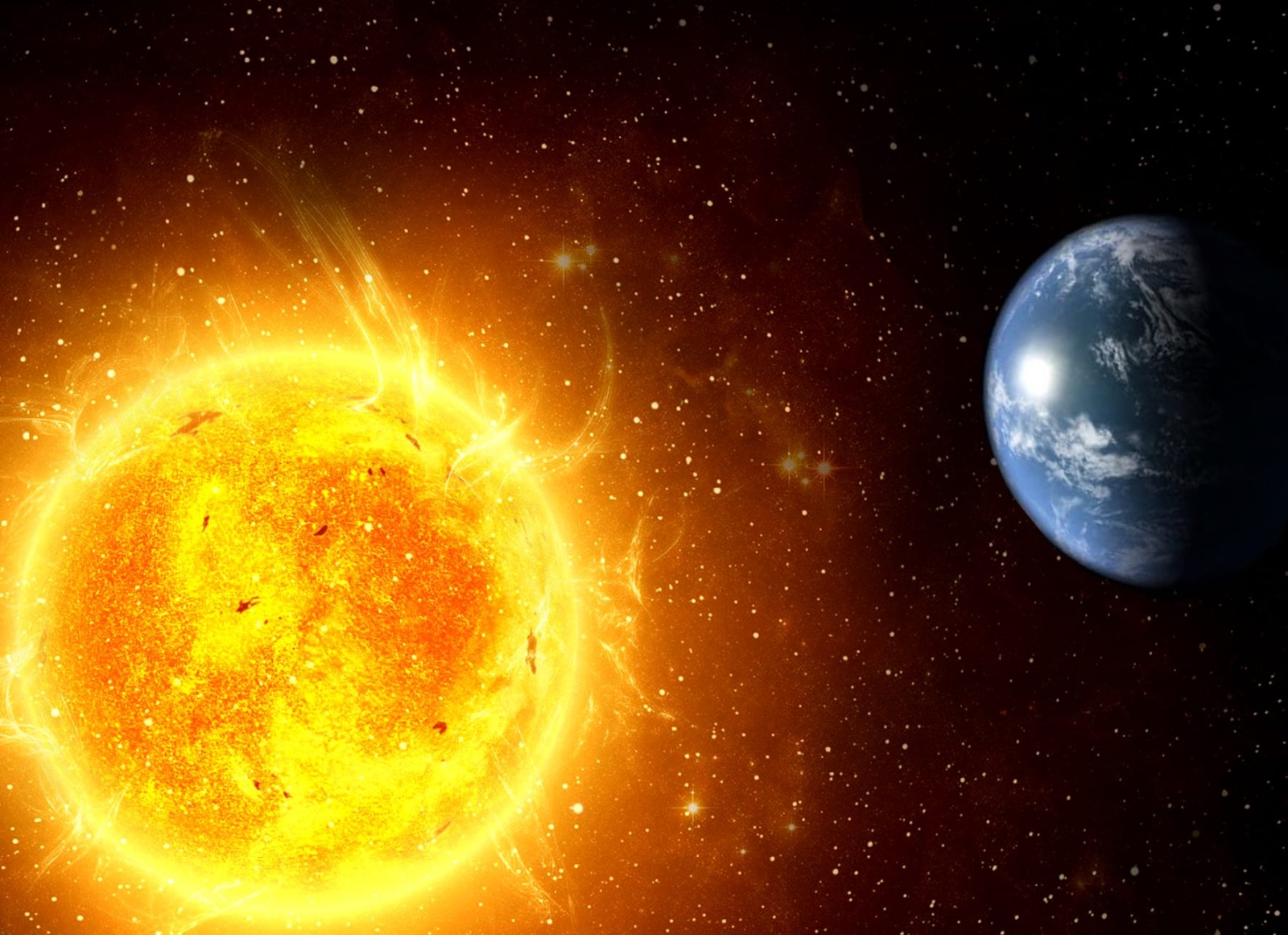
What If The Sun Disappeared? Earth’s Fate Explained
The sudden disappearance of the Sun would trigger a cascade of catastrophic events, beginning with darkness and culminating in the disintegration of the solar system, according to NASA assessments. While the scenario is highly improbable, understanding its consequences underscores the fundamental reliance of life on Earth on the Sun’s continued stability.
The initial effect would be deceptively delayed. Due to the finite speed of light, Earth would continue to experience daylight for approximately eight minutes after the Sun ceased to exist. This delay is a direct consequence of Einstein’s theory of relativity, which posits that gravitational effects, like light, travel at the speed of light. After those eight minutes, darkness would descend abruptly.
However, the loss of light would be only the first, and arguably least impactful, consequence. Within the same eight-minute timeframe, the Sun’s gravitational influence would also begin to diminish. Once the gravitational tether was severed, Earth would no longer maintain its orbit and would instead continue moving in a straight line, tangent to its previous orbital path. This fate would be shared by all other planets in the solar system, resulting in a complete breakdown of the solar system’s structure, and sending them adrift into interstellar space.
The temperature implications are equally dire. NASA scientists predict a rapid and drastic decline in global temperatures. Within days, the Earth’s surface would begin to freeze, and within weeks, a widespread, deep freeze would set in. Long-term projections estimate that surface temperatures could plummet to below -100 degrees Celsius. While the Earth’s core would continue to generate some internal heat, it would be insufficient to prevent the oceans from freezing over, at least from the surface down.
The cessation of photosynthesis, driven by the absence of sunlight, would initiate a collapse of the Earth’s ecosystems. Plant life would perish, leading to the disruption of food chains and a catastrophic decline in oxygen levels. While some microbial life forms might persist in extreme environments, such as hydrothermal vents on the ocean floor, the prospects for complex life, including humans, would be virtually nonexistent without advanced, self-sustaining technological systems.
The Indonesian news outlet, Media Indonesia, reported on these findings, highlighting the Sun’s role not merely as a source of light, but as the central force governing the dynamics of the entire solar system. The report emphasized that the Sun’s stability is paramount to the continuation of life on Earth.
Despite the dramatic nature of this hypothetical scenario, NASA maintains that the Sun is not expected to disappear suddenly. Stellar evolution occurs over billions of years, and the Sun will undergo a gradual process of change. However, the exercise of contemplating such a catastrophic event serves as a stark reminder of the delicate balance that sustains life on our planet and the critical importance of understanding the forces that govern our solar system.