
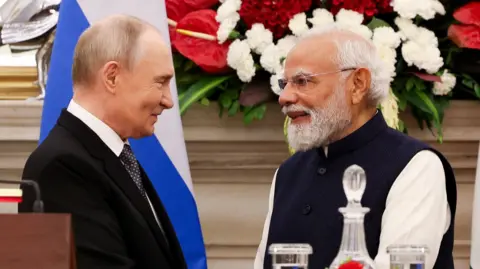
Putin & Modi Forge broader Partnership in Delhi, Aiming for $100 Billion trade Despite Oil Shift
New Delhi – Russian President Vladimir Putin’s visit to india concluded today with a series of agreements extending beyond traditional defense and energy ties, signaling a deepening partnership as India seeks to diversify its economic relationships. While a major defense deal wasn’t publicly announced,both leaders emphasized a five-year economic framework targeting $100 billion in bilateral trade,despite a recent dip in Indian crude oil imports from Russia following U.S. sanctions on two Russian firms.
The meeting yielded agreements and memorandums of understanding in areas including shipbuilding, training for Indian seafarers in polar navigation, investments in new shipping lanes, civil nuclear energy, visa-free travel for certain citizens, and collaboration on critical minerals. Prime Minister narendra Modi highlighted the importance of boosting business ties, reflecting India’s drive to explore new markets.
Discussions also included progress toward a potential free trade agreement with the eurasian Economic Union (EAEU) – comprising Russia, Armenia, Belarus, Kazakhstan, and Kyrgyzstan – which would open market access for all members.
Although discounted Russian oil has been a important component of the bilateral trade, the focus on diversification suggests a strategic shift. India continues to rely on Russia for its defense needs, and while no public commitment was made regarding the purchase of Su-57 fifth-generation fighter aircraft, negotiations are believed to be ongoing. A key point of discussion centered on the timely delivery of existing defense orders, particularly the remaining units of the S-400 air defense system, deliveries of which are currently delayed – a challenge Russia may struggle to address given its resource allocation to the conflict in Ukraine.
