
West Virginia Labor Force Shrinks, Sparking Economic Concerns
Table of Contents
Charleston, WV – A concerning trend is emerging in West Virginia’s labor market, as the state experiences a decline in both workforce participation and overall employment numbers. These shifts have prompted the West Virginia Chamber of Commerce to issue a warning about potential economic softening.
Declining Workforce Participation
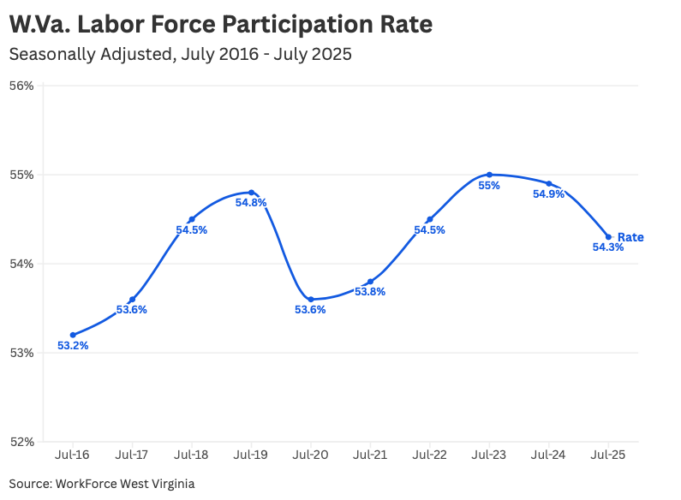
Recent data from WorkForce west Virginia reveals a decrease of 7,600 workers in the state’s seasonally adjusted labor force, dropping from 787,600 in July 2024 to 780,000 last month. This figure encompasses individuals aged 16 and older who are either employed or actively seeking employment. Seasonally adjusted data accounts for predictable employment fluctuations throughout the year.
The state’s labor force peaked in the final two months of 2019 at 795,800, with a participation rate of 54.8% prior to the disruptions caused by the COVID-19 pandemic. The pandemic triggered a significant contraction, with the labor force falling to 760,800 in April 2020 and the unemployment rate soaring to 15.8%.
Post-Pandemic recovery and Recent Setbacks
Following the initial shock of the pandemic, West Virginia saw a gradual recovery in labor force numbers and a corresponding decrease in unemployment. The unemployment rate reached a low of 3.5% in February and March 2023, and the labor force peaked again at 790,200 in October 2023. However, this progress has stalled, with the unemployment rate remaining steady at 3.7% since May and the state now experiencing 14 consecutive months of total employment decline.
Did You Know? The labor force participation rate is a key indicator of an economy’s health, reflecting the proportion of the working-age population actively engaged in the labor market.
Sector-Specific Employment Losses
While the private sector experienced a slight overall increase in employment-from 565,900 jobs in 2024 to 567,500 in 2025-several key industries within West Virginia’s economy have seen job losses. These include:
- Mining: Down 600 jobs (from 21,300 to 20,700)
- Manufacturing: Down 200 jobs (from 45,600 to 45,400)
- Hospitality: Down 3,700 jobs (from 71,400 to 68,700)
- Retail: Down 600 jobs (from 78,400 to 77,800)
Regional and National Comparisons
West Virginia currently holds the lowest labor force participation rate in the nation, at 54.2%, frequently competing with Mississippi for the bottom spot.Neighboring states demonstrate significantly higher participation rates: Kentucky (58.4%), Maryland (64.7%),pennsylvania (61.5%), Ohio (62.7%), and Virginia (65%).
| State | Labor Force Participation Rate (June – Seasonally Adjusted) |
|---|---|
| West Virginia | 54.2% |
| Mississippi | 54.2% |
| Kentucky | 58.4% |
| Maryland | 64.7% |
| Pennsylvania | 61.5% |
| Ohio | 62.7% |
| Virginia | 65% |
Future Outlook and Recommendations
The Bureau of Business and Economic Research at West Virginia University projects relatively flat employment growth for the state through 2029,lagging behind the national average of 0.5% annual job growth. Factors contributing to this slow growth include high interest rates, demographic challenges, and economic weakness in many counties.
Though, the anticipated launch of the Nucor steel plant in Mason County, the TIMET/BHE renewables titanium plant in Jackson County, and expansion at Form Energy in Weirton offer potential for future job creation.
Pro Tip: Investing in workforce development programs and addressing barriers to employment, such as health issues and substance use disorder, are crucial steps toward reversing these trends.
The Bureau recommends that state leaders prioritize improving health outcomes, addressing substance use disorder, and investing in educational and vocational training. A regionally tailored approach to addressing employment issues is also advised.
What steps can West Virginia take to attract and retain a skilled workforce in the face of these challenges? How can the state leverage its emerging industries to drive economic growth?
The challenges facing West Virginia’s labor force are part of a broader national trend of demographic shifts and economic restructuring. The state’s reliance on traditional industries, coupled with an aging population and out-migration of young people, presents significant hurdles to long-term economic prosperity. Addressing these issues requires a comprehensive strategy that focuses on diversifying the economy, investing in education and training, and creating a welcoming habitat for businesses and workers.
Frequently Asked Questions
- What is West Virginia’s current labor force participation rate? West Virginia’s labor force participation rate is currently 54.2%, the lowest in the nation.
- What factors are contributing to the decline in West Virginia’s labor force? Factors include the lingering effects of the COVID-19 pandemic, demographic shifts, and economic challenges in key industries.
- What industries are experiencing job losses in West Virginia? Mining, manufacturing, hospitality, and retail are all experiencing employment declines.
- What is the projected employment outlook for West Virginia through 2029? Employment is expected to remain relatively flat, lagging behind the national average.
- What steps are being recommended to address these challenges? Recommendations include improving health outcomes, addressing substance use disorder, investing in education and training, and tailoring strategies to regional needs.
