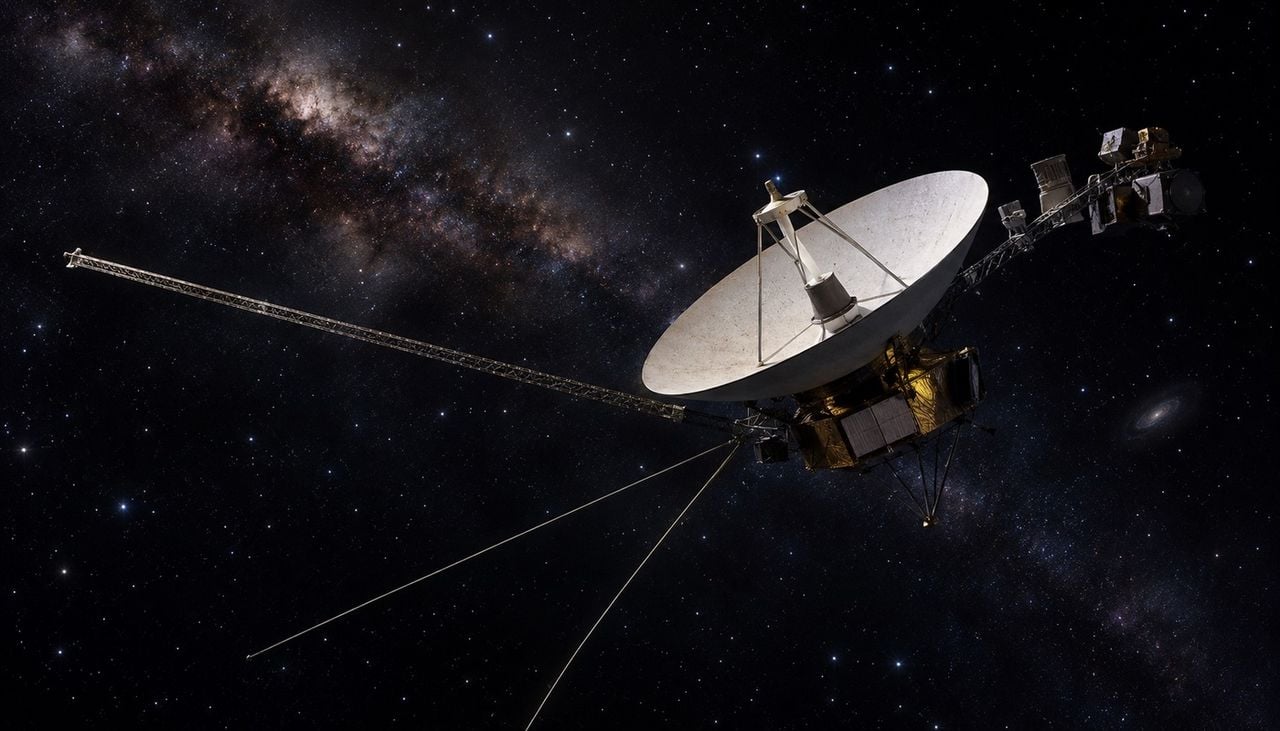
Voyager 1 Crosses Light-Day Distance Threshold at 25.9 Billion Kilometers
Voyager 1 crossed the light-day distance threshold from Earth on Wednesday, reaching more than 25.9 billion kilometres away in what is a record-breaking milestone for any human-built object.
The National Aeronautics and Space Administration confirmed that the spacecraft achieved the milestone after 49 years, two months, and 11 days of flight, according to Zonebourse Suisse. A radio signal sent from the robotic explorer was received in Madrid through the Deep Space Network, confirming the landmark position.
Launched from Cape Canaveral on September 5, 1977, the spacecraft initially studied Jupiter and Saturn before crossing the heliopause into interstellar space in August 2012, according to Meteored France. It now takes a radio signal 24 hours to reach the probe, and another full day for a response to return to Earth.
That immense distance creates practical hurdles for mission engineers managing aging equipment. “The anomalies have become normal for us,” Badaruddin said, noting that teams must operate aging technology using current systems.
The spacecraft experienced a 48-hour loss of contact in October and stopped transmitting scientific data on November 14. Its nuclear generator also loses about 4 watts of power annually, prompting NASA to shut down several instruments and implement energy-saving measures like the September “Big Bang” operation to keep key systems running.
“When is the mission going to end? It will never end, even when we can no longer communicate with Voyager,” said Fox, as cited by Zonebourse Suisse, while the probe traverses the interstellar void.
No other traveler has ever journeyed so far from home. Voyager 1 is about to become the first human-made object to reach a distance of one light-day from Earth, or about 16 billion miles. ½ pic.twitter.com/uETo8DHUF1
“It’s a striking reminder of the vastness of space,” Tiffany Kataria, a researcher at NASA’s Jet Propulsion Laboratory, told Agence France-Presse in coverage published by Le Soir, according to L'Avenir. “We often dream of traveling to other star systems. Yet it took Voyager 1 nearly fifty years to reach only the edge of our own solar system.”
NASA aims to keep the remaining active instruments functioning until at least the fiftieth-anniversary milestone in the summer of 2027. Communications could persist into the early 2030s before power reserves run out entirely.

Interstellar Journey
Even after transmissions cease, the spacecraft will continue its path through the interstellar medium, carrying its golden record of sounds and images meant for any potential extraterrestrial civilization. It is projected to pass near the star Gliese 445 in roughly 40,000 years.
The National Aeronautics and Space Administration, established on July 29, 1958, and operational from October 1, 1958, succeeded the National Advisory Committee for Aeronautics to give the U.S. space program a distinct civilian orientation. It began by absorbing 8,000 employees and three major research laboratories from NACA, along with the Army’s Jet Propulsion Laboratory — the very center that today manages the Voyager mission.
Meanwhile, its twin, Voyager 2, remains healthy and is projected to reach the one light-day distance milestone in November 2035, according to Zonebourse Suisse. Whether NASA engineers can restore data transmission from Voyager 1 before its power reserves deplete remains unresolved.
Earlier coverage: NASA's Voyager 1 Crosses One Light-Day From Earth