
Asteroid 4 Vesta Reaches stationary Point in Virgo: How to Spot It Tonight
Table of Contents
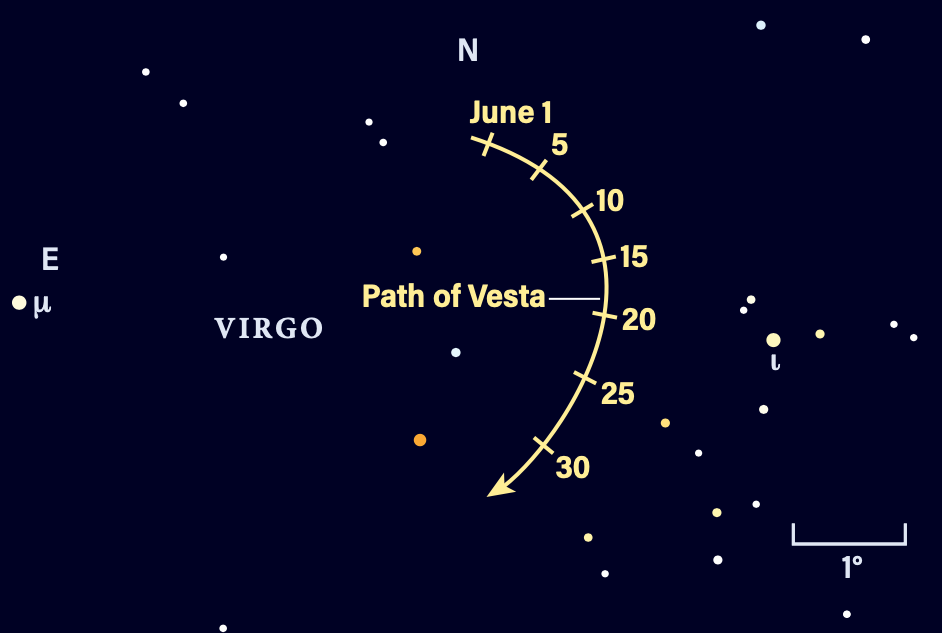
Look up! Asteroid 4 Vesta, a prominent resident of the main asteroid belt, arrives at its stationary point in the constellation Virgo today, June 18, 2025.This presents a prime chance to observe this celestial body, easily visible from any location with binoculars or a small telescope.
Spotting Vesta in the Night Sky
To witness this astronomical event, venture outdoors an hour or two after sunset. The constellation Virgo will be visible in the southwestern horizon.Identify Spica, Virgo’s brightest star, situated approximately 30° above the horizon.
Vesta is currently positioned to the upper left of Spica, near Virgo’s eastern boundary with libra. Locate Iota (ι) Virginis, a 4th-magnitude star about 13.5° northeast of Spica. From Iota, Vesta is a short 1.5° hop to the east. For those using larger binoculars or a telescope, the globular cluster NGC 5634, a small, faint cluster with a 5′ diameter and a magnitude of 9.6, lies just under 2° east-southeast of Vesta’s location.
Did You Know? Vesta is one of the largest asteroids in the asteroid belt, with an average diameter of approximately 326 miles (525 kilometers) .
Vesta’s Movement and Location
Having previously moved westward (retrograde),Vesta will now commence its eastward journey,specifically moving southeast against the backdrop of stars,heading towards Libra.
The asteroid belt, where Vesta resides, is located between the orbits of Mars and Jupiter and contains millions of asteroids .
Key Viewing Information:
| Event | Time (EDT) |
|---|---|
| vesta Stationary Point | 3:00 P.M. |
| Sunrise | 5:31 A.M. |
| Sunset | 8:32 P.M. |
| Moonrise | 12:51 A.M. |
| Moonset | 12:56 P.M. |
| Moon Phase | Waning Gibbous (51%) |
Pro Tip: Use a sky map app on your smartphone or tablet to help you locate Virgo and the surrounding stars.
Understanding Asteroids
Asteroids are rocky and metallic celestial bodies that orbit the Sun . They are remnants from the early solar system, failing to coalesce into a planet.
Unlike planets, asteroids frequently enough have irregular shapes due to their relatively small size and insufficient gravity to pull themselves into a sphere .
Evergreen Insights on Asteroids
Asteroids provide valuable insights into the formation of our solar system. Studying their composition and distribution helps scientists understand the conditions that prevailed billions of years ago.
The composition of asteroids varies. Some are primarily rocky, while others are rich in metals like iron and nickel. This diversity reflects the different regions of the early solar system where they formed.
Frequently Asked Questions About Asteroids
What are asteroids?
Asteroids are rocky and metallic objects orbiting the Sun, smaller than planets [[2]].
How big can asteroids get?
Asteroids range in size from a few meters to hundreds of kilometers in diameter [[1]].
Where is the asteroid belt located?
The asteroid belt is located between the orbits of Mars and Jupiter.
Are asteroids a threat to Earth?
While most asteroids pose no threat, some have orbits that could possibly intersect with Earth’s. NASA and othre space agencies monitor these objects closely.
What is NASA doing to track asteroids?
NASA’s Planetary Defense Coordination Office tracks potentially hazardous asteroids and develops strategies to mitigate any potential impact threats.
What other celestial events are you looking forward to this year? Share your thoughts and observations in the comments below!
