UW Study: Reinforced Vertebrae Help Plunge-Diving Birds Survive
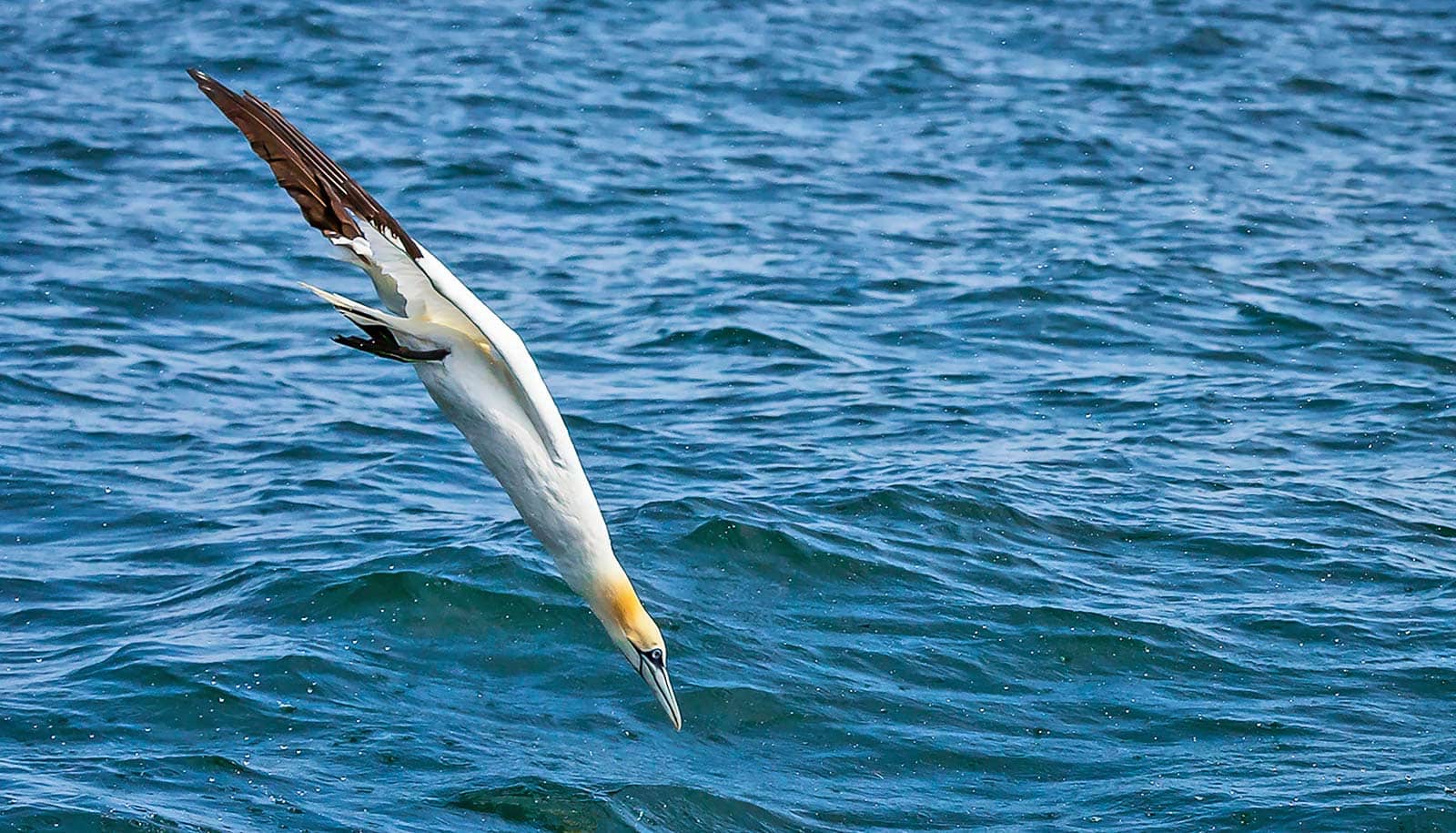
A northern gannet spots a school of fish from one hundred feet in the air and pitches its body into a high-speed nosedive, breaking the ocean surface at seventy miles per hour without breaking its neck, according to a University of Washington study published October 12 in The Anatomical Record.
- Plunge-diving birds such as gannets, boobies, and kingfishers possess stockier, thicker neck vertebrae than non-diving avian species.
- An additional contact surface known as an articular facet spans the second through sixth cervical vertebrae in gannets and boobies to prevent backward bending upon impact.
- Researchers utilized three-dimensional CT scans and geometric morphometrics on museum specimens to establish that larger necks experience proportional stress loads during dives.
Unique Morphological Adaptations of Gannets and Boobies
The study details how gannets and boobies survive high-speed water entries through specialized skeletal structures. Researchers at the University of Washington examined bird specimens from the Burke Museum using computed tomography scans to generate three-dimensional models of cervical vertebrae.
Birds that rotate their heads side to side, or move them front to back, separate out from birds that use their heads in compression,
said lead author Megan Vanderberg, a graduate student of biology at UW’s Friday Harbor Labs, as noted by Futurity. We see that the birds that plunge-dive have more robust vertebrae. They’re thicker, wider, and also shorter, shaped more like a square.
Gannet necks feature fifteen stacked vertebrae forming a slight s-curve. While previous research demonstrated that surrounding muscles help lock the neck in place before impact, the current investigation focused directly on skeletal morphology. The data reveal that the stockier shape provides critical support against compressive forces.

Stabilizing the Cervical Column During Impact
Beyond broader bone geometry, gannets and boobies possess an additional contact surface called an articular facet located on the second through sixth vertebrae. Senior author Bart Boom, a postdoctoral scholar at the UW’s Friday Harbor Labs, explained the rationale behind the investigation: We wanted to figure out what makes gannets so special, so good at diving, and looking at their biology helped us understand how they can survive these impacts.
Researchers suggest this extra facet prevents the cervical column from bending backward when the bird strikes the water at an angle. Instead of collapsing, the kinetic load transfers down the length of the neck. Similar blocklike vertebrae appear in other diving species like kingfishers, though those smaller birds lack the additional articular facet.
Comparative analysis demonstrated a proportional structural relationship where larger necks house larger vertebrae. Despite size differences between gannets and smaller kingfishers, both groups experience equivalent stress levels per unit of neck area during a dive, reaching peak force approximately five milliseconds after impact.
Skeletal Structure Helps Identify Fossil Plunge-Diving Species
The research team plans to investigate the mechanics of force transfer along the cervical column in greater detail. Beyond avian biology, the identified link between skeletal structure and foraging function may assist paleontologists in identifying plunge-diving species within the fossil record.
It feels like something I didn’t previously think about and probably overlooked before,
Vanderberg stated, according to Futurity. I’m curious to start looking more closely at vertebrae in general, not just in birds.
The study was supported by funding from the US National Science Foundation, the Beatrice and Samuel A. Seaver Foundation, a Friday Harbor Laboratories Research Endowment Fellowship, a University of Washington Friday Harbor Laboratories Award, and Jim and Camille Uhlir, alongside coauthors from the University of California, Riverside.