
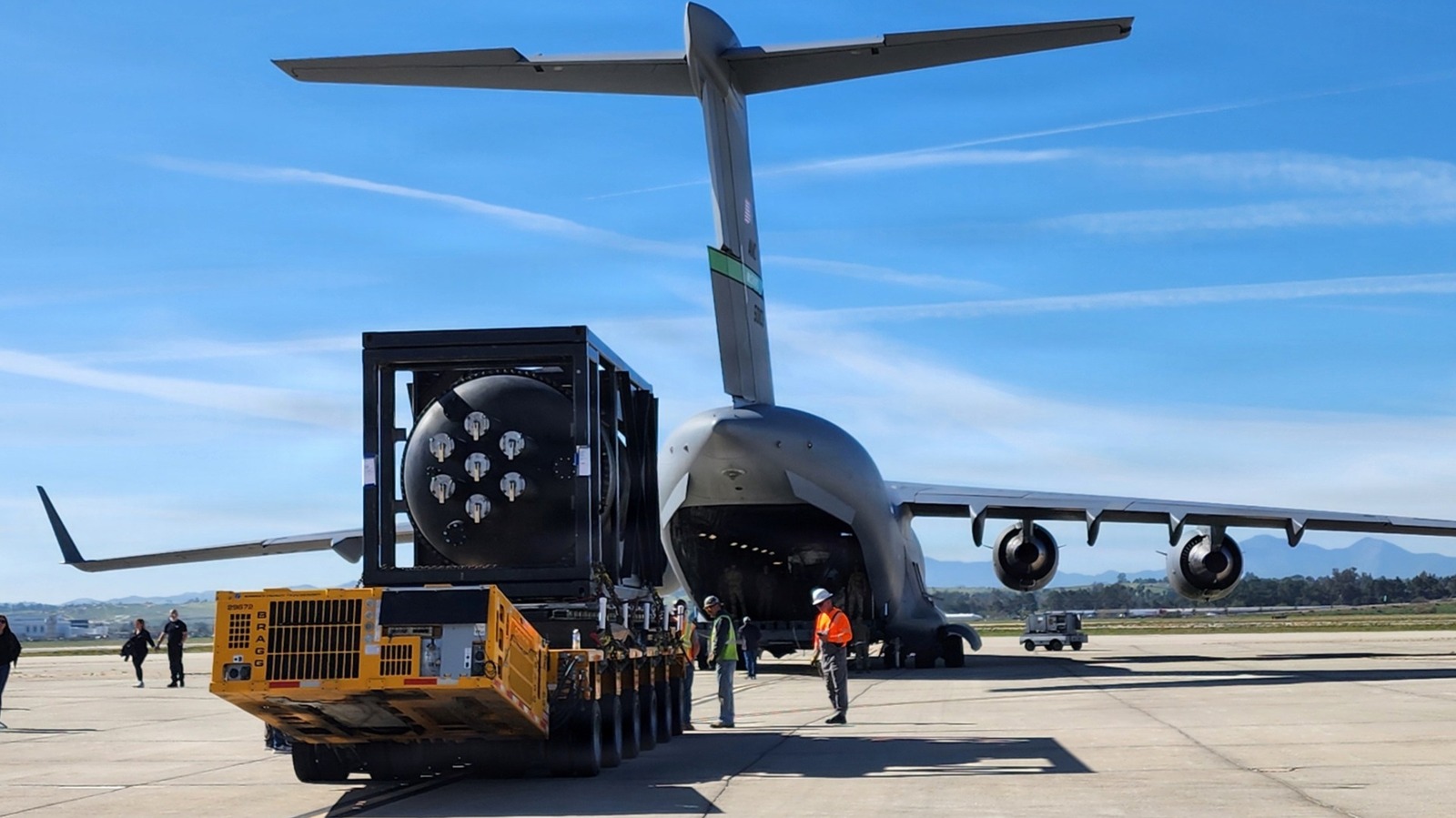
A 5-megawatt nuclear reactor was airlifted by a U.S. Air Force C-17 Globemaster III aircraft on February 15, 2026, marking the first time such a transport has occurred. The reactor, a Ward 250 microreactor developed by Valar Atomics, was flown from March Air Reserve Base in California to Hill Air Force Base in Utah, where it will undergo further testing at the Utah San Rafael Energy Lab, according to a statement from the Department of War.
The Ward 250 is designed to be a rapidly deployable power source, capable of providing enough energy for approximately 5,000 homes or a sizable military installation. This capability aims to reduce reliance on vulnerable civilian power grids and diesel generators for military operations globally. The reactor itself is roughly the size of a large van, facilitating its transport via the C-17.
Valar Atomics was selected to participate in the President’s accelerated nuclear program in August 2025, following a renewed national focus on nuclear energy. This interest was formalized through an Executive Order issued in May 2025, directing the U.S. Army to construct a nuclear microreactor and provide nuclear energy to a domestic military installation by September 30, 2028. The Ward 250 was also chosen by the Department of Energy as a project intended to “achieve criticality on American soil by July 4th, 2026,” as outlined in the Executive Order.
The C-17 Globemaster III, stationed at March Air Reserve Base with the 452d Air Mobility Wing, was chosen for the mission due to its cargo capacity and proximity to Valar Atomics. Although the larger C-5 Galaxy exists, the C-17’s capabilities closely matched the payload requirements and logistical needs of the operation. The Air Force describes the C-17 as “the most flexible cargo aircraft to enter the airlift force,” highlighting its ability to deliver cargo and personnel to forward operating bases worldwide.
The C-17 boasts a cruising speed of around 450 knots (0.74 Mach) and is equipped with four Pratt & Whitney F117-PW-100 turbofan engines, each generating up to 40,400 pounds of thrust. Its design also includes powerful reverse thrust capabilities, enabling it to maneuver on runways as short as 3,500 feet while carrying substantial payloads, with a maximum payload capacity of 170,900 pounds and a maximum gross takeoff weight exceeding 292 tons. The aircraft’s ability to perform 3-point turns on runways as narrow as 90 feet further contributes to its operational flexibility.
Further testing and evaluation of the Ward 250 are scheduled to continue at the Utah San Rafael Energy Lab, with no immediate public timeline for deployment or operational use announced by the Department of War.
