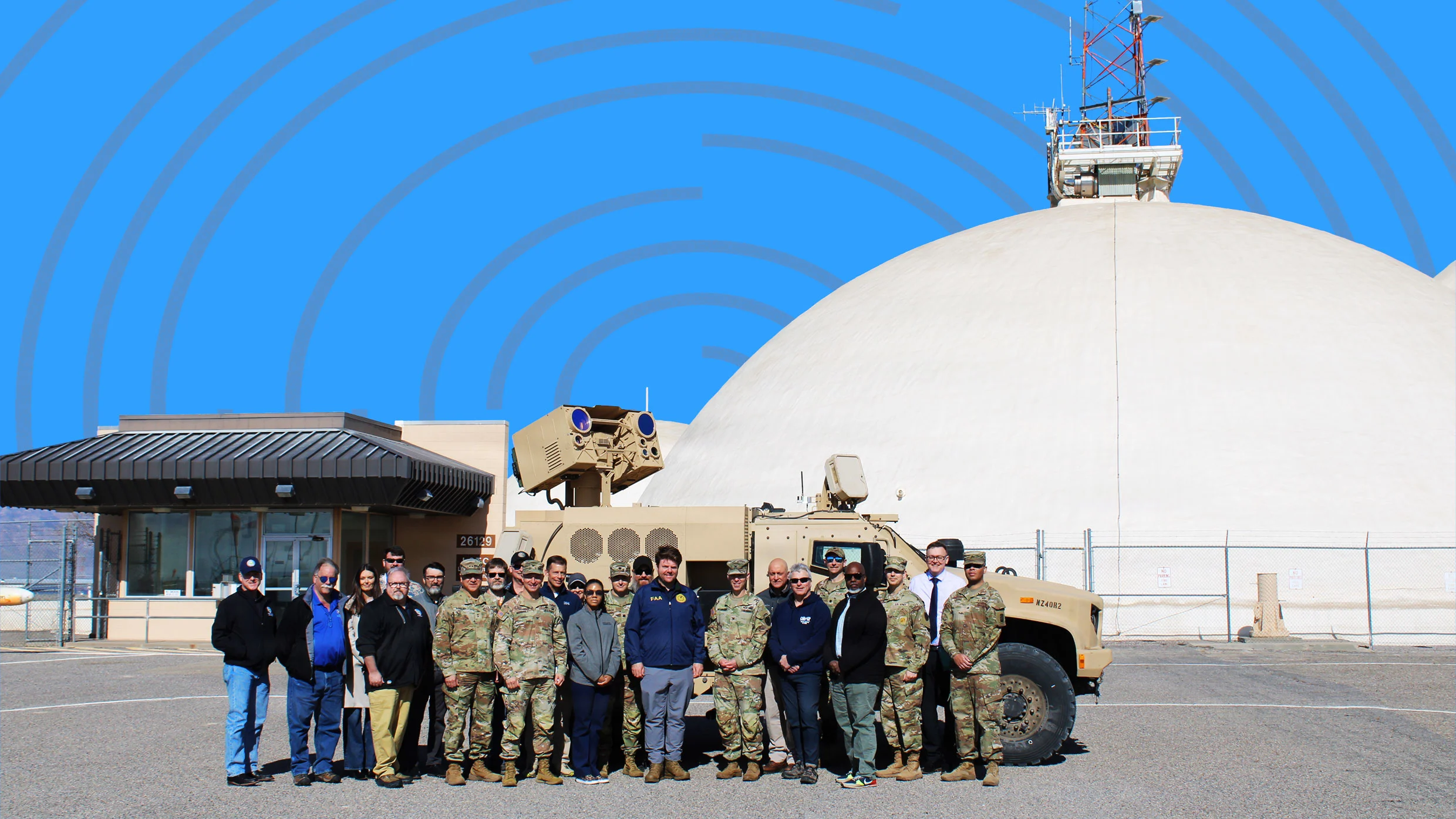
US Military and FAA Approve Laser Weapons for Domestic Drone Defense
America’s ‘Laser Dome’ Starts Here: The FAA-Pentagon Accord and What It Means for Directed Energy Defense
The U.S. Military’s deployment of high-energy laser weapons along the southern border has moved from experimental incidents to a formalized safety framework, following an FAA assessment that deemed the AV LOCUST system’s automatic shutoff mechanisms and beam dissipation characteristics safe for civilian airspace. This marks not a deployment surge, but a foundational step toward institutionalizing directed energy for domestic counter-UAS operations—a shift that hinges less on laser efficacy and more on resolving jurisdictional ambiguities between DoD, CBP, and FAA authorities during active engagements.
The Tech TL;DR:
- The AV LOCUST’s 20 kW solid-state laser uses layered hardware/software interlocks to prevent unsafe firings, validated against Boeing 767 fuselage tests at White Sands.
- No structural damage was observed even at max range (8-second dwell), countering myths about laser-induced catastrophic failure in transit corridors.
- Operational deployment remains constrained by unclear command-and-control protocols, not technical readiness—making policy middleware the true bottleneck.
The core issue isn’t whether lasers can shoot down drones—it’s whether they can do so without triggering NOTAMs or grounding civilian flights due to procedural gray zones. The February incidents at Fort Bliss and Fort Hancock weren’t failures of the LOCUST system; they were failures of coordination. When AV’s system engaged what it perceived as a threat, its internal safeties checked out—but external airspace authorities had no real-time visibility into the engagement decision loop. That’s the gap the FAA-JIATF-401 assessment begins to close: not by eliminating risk, but by bounding it through demonstrable failsafes.
Technically, the LOCUST system—derived from AV’s truck-mounted LOCUST Laser Weapon System—employs a diode-pumped alkali laser (DPAL) architecture scaled to 20 kW, with a beam director mounted on a Joint Light Tactical Vehicle (JLTV) platform. Its safety stack operates as a series of AND-gated interlocks: GPS-based geofencing to avoid “keep-out” zones (e.g., airport approach corridors), inertial measurement unit (IMU) validation of turret orientation, target lock confirmation via electro-optical tracking, and software-based pulsewidth validation. As Aaron Westman noted in AV’s internal blog, each subsystem must vote “yes” before the fire control computer enables the high-voltage driver stage. This isn’t security theater—it’s a formal verification layer baked into the real-time control loop, akin to a safety-certified PLC in industrial automation.
What the White Sands tests revealed—per Col. McLellan’s account—is that even when the system overrides all safeties (a scenario tested only in extreme boundary conditions), the 1064 nm beam lacks sufficient energy density to compromise aircraft integrity at operational ranges. At max effective range (~3 km), the irradiance on a Boeing 767 fuselage fell below 5 kW/m²—orders of magnitude below the threshold for thermal stress in aerospace-grade aluminum alloys. This aligns with independent studies from DEVCOM ARL’s directed energy branch, which modeling shows requires >500 kW/m² sustained exposure to initiate structural weakening in flight-critical components. In short: the laser can dazzle sensors or ablate thin-skinned UAS, but it won’t bring down a 737.
“The real innovation here isn’t the laser—it’s the systems engineering around it. We’ve spent years proving the physics; now we’re proving the procedure.”
From an integration standpoint, the LOCUST’s fire control system exposes a RESTful API over TLS 1.3 for status telemetry and safeties logging—though not for remote firing, which remains strictly air-gapped. The system logs each “vote” in the safety chain to a write-ahead log (WAL) in its embedded real-time OS (VxWorks 7), with SHA-3-256 hashing for tamper evidence. For units deployed along the border, this data feeds into JIATF-401’s command dashboard via STIX/TAXII over IPsec—a detail confirmed in the FY2027 PB-27 R&D justification documents. This level of auditability is what made the FAA comfortable: not trust, but verifiability.
Yet the operational model remains fragmented. Who authorizes a shot when a drone crosses from Mexican airspace into U.S. Territory, hovering near a CBP patrol zone but under FAA-enforced Class E airspace? The memorandum of understanding avoids this question, leaving it to “interagency coordination”—a phrase that, in DoD procurement parlance, often means “we’ll figure it out after the incident.” Until a joint air task force (JATF) with real-time deconfliction authority is established—complete with shared radar feeds and rules of engagement (ROE) encoded into the weapon’s safety logic—each deployment remains a policy experiment, not a program of record.
Where the Laser Meets the LAN: Practical Implications for Defense Contractors and MSPs
For firms operating in the defense industrial base, this isn’t just about laser physics—it’s about middleware. The true scalability of directed energy for homeland defense depends on integrating weapon safeties into civil air traffic management systems. Think ADS-B IN for lasers: a broadcast signal that tells nearby ATC and TCAS-equipped aircraft, “This beam is active, but safeties are green.” Companies like defense technology integrators are already prototyping such links using ASTERIX CAT 062 over UDP multicast, though certification remains pending with RTCA SC-228.
Meanwhile, the sensor-to-shooter loop—drone detection via RF sensors or electro-optical tracking, cueing the laser—remains vulnerable to latency and spoofing. A 2025 study from Johns Hopkins APL showed that adversarial spoofing of LWIR signatures could induce false positives in current UAS detection stacks at ranges under 500 ms. For units relying on open-source computer vision (OpenCV) pipelines, this means hardening the perception layer against thermal camouflage and lens flare attacks—function being done by computer vision specialists in the aerospace sector.
And for the MSPs managing the backend? Expect increased demand for hardened time-sensitive networking (TSN) configurations on tactical edge nodes. The LOCUST’s fire control loop requires <10ms jitter from sensor to effector—achievable only with TSN-enabled switches (IEEE 802.1AS) and precision time protocol (PTP) grandmasters. Firms offering industrial IoT support with expertise in deterministic Ethernet will locate themselves in the loop, not as vendors, but as enablers of mission-critical trust.
The path forward isn’t more lasers—it’s better boundaries. Technically, the LOCUST works. Procedurally, it’s still finding its feet. Until the DoD and FAA co-develop a real-time deconfliction protocol—perhaps modeled on the LAANC system for drones, but for directed energy—the “Laser Dome” remains a concept in search of a constitution.
“We can build the safest laser in the world. But if the guy in the tower doesn’t know it’s safe, it might as well be a cannon.”
# Example: Querying LOCUST safety telemetry via REST (simulated) curl -H "Authorization: Bearer $(kubectl gain secret locust-token -o jsonpath='{.data.token}' | base64 --decode)" https://locust-border-01.jiatf401.svc:8443/api/v1/safeties/latest | jq '.votes[] | select(.status == "NO")' # Output: [{"check":"geofence","timestamp":"2026-04-19T13:45:22Z","reason":"Approach corridor KELLY active"}] Disclaimer: The technical analyses and security protocols detailed in this article are for informational purposes only. Always consult with certified IT and cybersecurity professionals before altering enterprise networks or handling sensitive data.