
Astronomers have observed a planetary system defying conventional formation theories: a rocky planet orbiting outside the reach of its gaseous neighbors. The discovery, detailed in the journal Science on Friday, suggests the planet may have been a “late bloomer,” coalescing in an environment where constituent materials were nearly exhausted.
The system, observed using the European Space Agency’s (ESA) Cheops space telescope, consists of four planets – two rocky and two gaseous – orbiting LHS 1903, a red dwarf star approximately 117 light-years from Earth in the constellation Cetus. LHS 1903 has roughly 50% of the Sun’s mass and only 5% of its luminosity, according to the report.
What has captured the attention of scientists is the order of the planets. Closest to the star is a rocky planet, followed by two gas planets, and then, unexpectedly, another rocky planet. “Planetary formation paradigms suggest that planets closer to their host star should be smaller and rocky, with little gas or ice,” explained Thomas Wilson, an astronomer at the University of Warwick and lead author of the study. “Conversely, planets further out are thought to form in colder regions with abundant gas and ice, creating gas giants with substantial atmospheres. This system challenges that with a rocky planet outside the gas planets.” Wilson described the arrangement as “an inside-out system.”
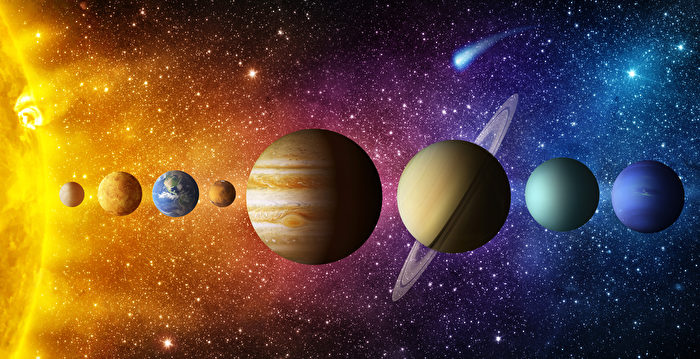
Our solar system features rocky planets closer to the Sun and gas giants further away. Beyond the orbits of the gas giants lies Pluto, a rocky dwarf planet significantly smaller than the major planets. Since the 1990s, astronomers have identified approximately 6,100 exoplanets – planets orbiting stars other than our Sun.
All four planets in the newly observed system orbit closer to their star than Mercury does to the Sun. The outermost planet’s orbit is only about 40% of the distance between Mercury and the Sun. This proximity is common for planets orbiting red dwarf stars, which are less energetic than our Sun.
The two rocky planets are categorized as “super-Earths,” meaning they have a rocky composition like Earth but with masses between two and ten times that of Earth. The two gas planets are classified as “mini-Neptunes,” gaseous planets smaller than Neptune but larger than Earth.
Researchers hypothesize that the planets did not form simultaneously within a large disk of gas and dust around the star, but rather sequentially. The fourth planet, they suggest, formed after its sibling planets had depleted the available gas that could have formed its atmosphere. Wilson characterized the fourth planet as a “latecomer,” forming in a gas-poor environment when little material remained. Another possibility is that it initially possessed a dense atmosphere that was later stripped away, leaving only the rocky core.
Andrew Cameron, an astronomer at the University of St Andrews and a co-author of the study, pondered the planet’s origins: “Did the fourth planet happen to be born when the gas ran out? Or did it lose its atmosphere in a collision with another body? The latter seems far-fetched, unless you remember that the Earth-Moon system appears to be the product of such a collision.”
The fourth planet is likewise attracting attention due to its potential habitability. It has a mass 5.8 times that of Earth and a temperature of approximately 140 degrees Fahrenheit (60 degrees Celsius). “60 degrees Celsius is very similar to the highest temperature ever recorded on Earth (57 degrees Celsius), so this planet could potentially be habitable,” Wilson stated. Future observations with the James Webb Space Telescope (JWST) may reveal more about the planet’s environment and its potential for supporting life.
