University of Auckland, NIST, and UMD Researchers Demonstrate Microcomb
University of Auckland, NIST, and UMD Demonstrate Octave-Spanning Chip-Scale Microcomb in Nature
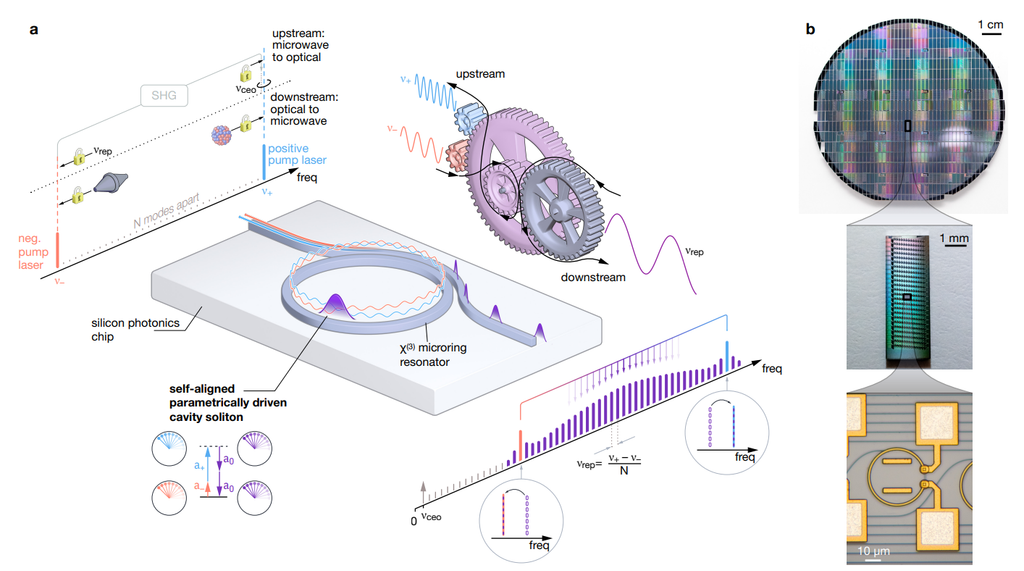
Researchers from an international collaboration demonstrated a chip-integrated optical frequency comb that overcomes long-standing stability and control limits in microcomb metrology, according to a study published in Nature. The research team, led by scientists from the University of Auckland, the National Institute of Standards and Technology (NIST), the University of Maryland (UMD), and UC Santa Barbara, inverted traditional frequency comb architectures to generate a self-aligned, octave-spanning microcomb operating on a single foundry-fabricated photonic chip.
The Tech TL;DR:
- Researchers integrated an octave-spanning optical frequency comb onto a single foundry-fabricated photonic chip using a dual-pump architecture.
- The design replaces complex external stabilization controls by utilizing two pumps placed an octave apart to drive a nonlinear χ(3) microresonator.
- The technical breakthrough establishes a hardware foundation for deployable optical atomic clocks, GPS-denied quantum positioning, and precision quantum sensing.
Inverting Frequency Comb Architecture on Photonic Chips
Conventional laboratory and chip-scale frequency combs create a spectrum by stepping light outward from one laser pump. On integrated photonic platforms, this method struggles to deliver strong, low-noise signals across an entire octave. That limitation makes it difficult to detect and lock the carrier-envelope offset frequency required for absolute stabilization.
By positioning two pump lasers an octave apart—reaching from telecom to visible wavelengths—to excite a nonlinear χ(3) microresonator, the research team addressed this challenge. The interaction between the two octave-separated pumps induces a parametrically driven cavity soliton that automatically fills in the spectrum between the two boundaries. This produces a stable, low-noise frequency ruler without complex external stabilization controls.
Executing Core Metrology Benchmarks on Foundry-Fabricated Chips
Using the self-aligned microcomb platform, the researchers successfully performed core benchmarks of optical frequency metrology using foundry-fabricated microresonator chips. The experiments covered integrated optical clock readout via direct optical clock transition readout and phase-locking across octave boundaries, enabling chip-scale deployable optical atomic timekeeping for satellite-free positioning. The platform also performed optical frequency synthesis, generating millions of precisely spaced optical frequencies from telecom to visible for precision optical metrology and multi-wavelength laser line synthesis on-chip. It also achieved low-noise millimeter-wave generation, producing low-phase-noise beat notes in the millimeter-wave domain for ultra-stable RF signal distribution, telecommunications synchronization, and sensing.
The study authors, including Professor Miro Erkintalo, Dr. Grégory Moille, and Dr. Kartik Srinivasan filed a provisional patent application based on the architecture to support commercialization across portable atomic timekeeping, defense positioning systems, and integrated quantum photonics. Details of the peer-reviewed research appear in Nature, institutional disclosures are available via the University of Auckland Newsroom, and scientific release information is hosted on EurekAlert.
Keep reading
- University of Denver Transitions From Zoom to Microsoft Teams by 2027
- 34% of US Shoppers Plan to Use AI for Holiday Deals, YouGov Survey Finds
- BU Researchers: Curbing Sugary Drinks Helps Shift Children’s BMI (newsdirectory3.com)
- Northeastern University Study Finds AI Struggles With Bodycam Speakers (time.news)