
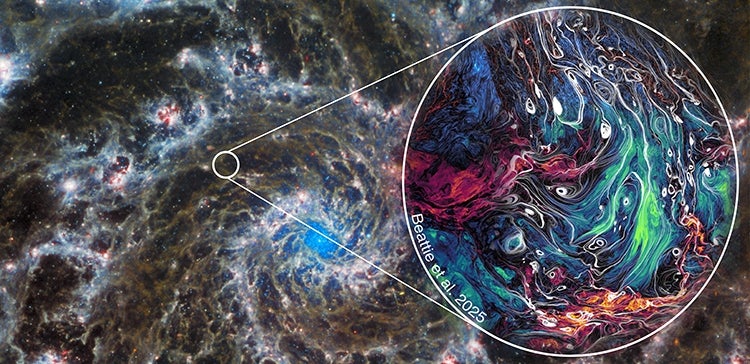
Unraveling Turbulence: A New Model Sheds Light on Interstellar mysteries
Turbulence, a phenomenon observed from the smallest coffee cup to the vast expanse of intergalactic space, has long puzzled scientists.A team of researchers is using advanced computer simulations to explore this complex phenomenon, notably in the interstellar medium (ISM).
The Enduring Mystery of Turbulence
Despite its ubiquity, turbulence remains a significant challenge in classical mechanics.Turbulence remains one of the greatest unsolved problems in classical mechanics,
said James Beattie, a postdoctoral researcher at the Canadian Institute for Theoretical Astrophysics at the University of Toronto and Princeton University.
Beattie emphasizes the importance of magnetic fields in astrophysical environments, noting that they fundamentally alter the nature of turbulent flows.
A Groundbreaking Simulation
Beattie is the lead author of a new paper published in Nature Astronomy, detailing a computer simulation designed to study magnetism and turbulence in the ISM with unprecedented detail. This model, the most powerful of its kind, leverages the capabilities of the SuperMUC-NG supercomputer in Germany.
The simulation challenges existing understandings of how magnetized turbulence operates in astrophysical environments and promises new insights into the ISM, the magnetism of the Milky Way, star formation, and the propagation of cosmic rays.
This is the first time we can study these phenomena at this level of precision and at these different scales.
James Beattie
The research involved collaborators from princeton University, Australian National University, the Australian Research Council Center of Excellence in All-Sky Astrophysics, Universität Heidelberg, the Center for Astrophysics, Harvard & Smithsonian, Harvard University, and the Bavarian Academy of Sciences and Humanities.
Galactic Magnetism and Star Formation
The model addresses the role of magnetic fields in the cosmos.Although the galactic magnetic field is millions of times weaker than a fridge magnet, it considerably shapes cosmic processes. The model can enhance our understanding of the Milky Way’s magnetic field and processes like solar wind.
Did you know? The motion of charged particles in interstellar space generates a magnetic field,similar to how Earth’s molten core creates our planet’s magnetic field.
The simulation’s higher resolution also offers potential for deepening our understanding of star formation. we know that magnetic pressure opposes star formation by pushing outward against gravity as it tries to collapse a star-forming nebula,
Beattie explained.Now we can quantify in detail what to expect from magnetic turbulence on those kinds of scales.
Density Dynamics in the Interstellar Medium
A key advancement of the model is its ability to simulate dynamic changes in the density of the ISM, ranging from near-vacuum conditions to the higher densities found in star-forming nebulas.
What our simulation captures really well is the extreme changes in density of the ISM – something previous models hadn’t taken into account.
James Beattie
Testing the Model Against Real-World Data
Beattie is refining the model with even higher resolution and testing it against data from observations of the sun-Earth system. We’ve already begun testing whether the model matches existing data from the solar wind and the Earth – and it’s looking very good,
Beattie said.This is very exciting as it means we can learn about space weather with our simulation. Space weather is very crucial because we’re talking about the charged particles that bombard satellites and humans in space and have other terrestrial effects.
Pro Tip: Understanding space weather is crucial for protecting satellites and astronauts from harmful charged particles.
The Future of Turbulence Research
The new model arrives at a time of growing interest in astrophysical turbulence and increased observations of the ISM. As new instruments like the Square Kilometre Array (SKA) Observatory come online, accurate theoretical frameworks for interpreting magnetic turbulence will become increasingly critically important.
Beattie finds the universality of turbulence particularly compelling. I love doing turbulence research because of its universality,
he said. It looks the same whether you’re looking at the plasma between galaxies, within galaxies, within the solar system, in a cup of coffee or in Van Gogh’s The Starry Night. There’s something very romantic about how it appears at all these different levels and I think that’s very exciting.
