
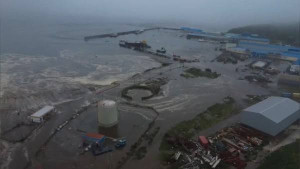
Massive Undersea Quake Off Kamchatka Triggers Widespread Tsunami Alerts Across Pacific
A powerful magnitude -8.7 undersea earthquake struck off teh eastern coast of Russia’s Kamchatka Peninsula earlier today, prompting significant tsunami alerts across a vast swathe of the Pacific Ocean, including Indonesia, Japan, and several Pacific island nations. The seismic event, originating at a depth of 18 kilometers within the Kurile-Kamchatka Trench, has raised concerns about potential coastal inundation and hazardous sea level fluctuations.
The Indonesian Meteorology, Climatology, and Geophysics Agency (BMKG) has indicated that the quake could generate tsunami waves of less than 0.5 meters in height in several coastal areas of eastern Indonesia. BMKG Earthquake and Tsunami Center Director, Daryono, advised communities in affected regions to remain calm, stay clear of the shoreline, and await official updates. As of 8:30 a.m. Western Indonesia Time (WIB), BMKG had registered at least seven aftershocks, with magnitudes ranging from 5.4 to 6.9. no damage or casualties have been reported in indonesian territory as a result of the initial quake.
The Pacific Tsunami Warning Center (PTWC) has also issued alerts for potential tsunami impacts in Russia, Japan, Alaska, the Philippines, Hawaii, and Guam.
Pacific Islands Mobilize Amidst Tsunami Threat
Several Pacific island governments have responded to the seismic event by issuing evacuation orders and tsunami warnings. In Guam,the homeland Security and Civil Defense Office has warned of significant threat levels to Guam,Rota,Tinian,and Saipan,anticipating possible hazardous sea level fluctuations and strong ocean currents. Waves were projected to arrive as early as 2:30 p.m. Australian Eastern Standard Time (AEST),with residents advised to move at least 30 meters inland and seek higher ground 15 meters above sea level.
american samoa is preparing for waves of up to 3 meters, with an estimated arrival time of around 9:39 p.m. local time, according to U.S.meteorological agencies. Other regions issuing similar tsunami alerts include Palau, expecting wave heights of 0.3 to 1 meter with an arrival time of 3:19 p.m.local time, and Tonga, anticipating waves of 0.3 to 1 meter with an estimated arrival time of 9:25 p.m.
Fiji, Kiribati, Nauru, New Caledonia, Solomon Islands, Tuvalu, Vanuatu, Marshall Islands, and jarvis Island are also expecting waves ranging from 0.3 to 1 meter.
BMKG has reiterated it’s appeal to the Indonesian public to rely solely on official information channels and disregard unverified online reports. The agency is actively monitoring seismic activity and ocean conditions in real-time.
According to BMKG data, specific areas under tsunami alert status in Indonesia include:
Talaud Islands (estimated arrival: 14:52:24 Central Indonesia Time or WITA)
Gorontalo City (estimated arrival: 16:39:54 WITA)
North Halmahera (estimated arrival: 16:04:24 eastern Indonesia Time or WIT)
Manokwari (estimated arrival: 16:08:54 WIT)
Raja Ampat (estimated arrival: 16:18:54 WIT)
Biak Numfor (estimated arrival: 16:21:54 WIT)
Supiori (estimated arrival: 16:21:54 WIT)
Sorong (North) (estimated arrival: 16:24:54 WIT)
Jayapura (estimated arrival: 16:30:24 WIT)
sarmi (estimated arrival: 16:30:24 WIT)
Authorities across the Pacific region are maintaining a heightened state of alert as aftershocks and sea-level anomalies continue to be observed throughout the day.
Contextual Information on Subduction Zones and Tsunami Generation
The earthquake’s origin in the Kurile-Kamchatka Trench highlights the significant seismic activity associated with subduction zones. A subduction zone is a geological area where one tectonic plate slides beneath another.This process, driven by the Earth’s mantle convection, can lead to immense pressure buildup. When this pressure is released suddenly, it generates powerful earthquakes.
The depth of an earthquake plays a crucial role in its potential to generate a tsunami. While shallower earthquakes are frequently enough more destructive on land due to their proximity to the surface, undersea earthquakes at moderate depths, like the one off Kamchatka
