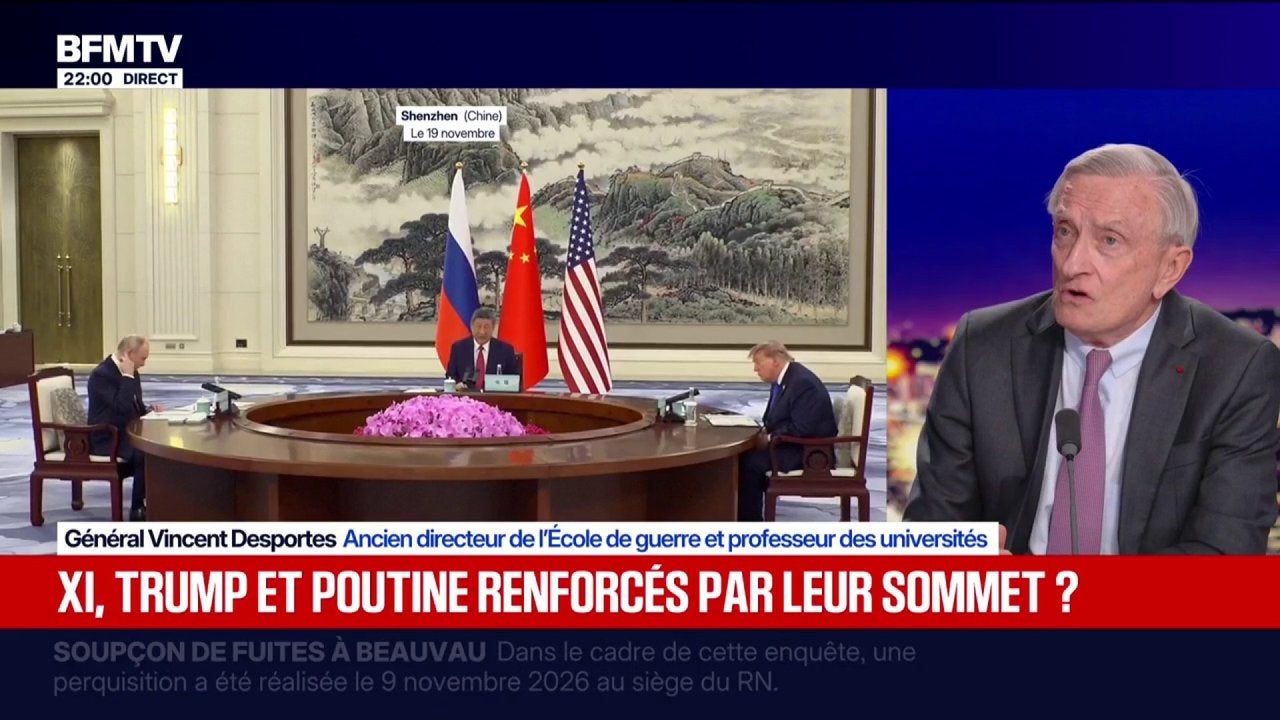
Trump-Xi-Putin Shenzhen Summit Produced Nothing, Says Général Vincent Desportes
The three leaders of the world’s leading military powers sat down together on Thursday in a villa set apart from the city, in southern China, and talked for one hour and 20 minutes, France Inter reported.
What emerged was a final declaration on peace, a shared line on nuclear weapons — and, by most readings, no concrete agreement on the war that overshadows everything else: Ukraine.
The gap between the stagecraft and the substance is the story. Trump opened the session by declaring, “We are building history here itself,” according to footage aired by BFM. Putin closed it by saying, “No one expected the summit to go as well as it did.” Desportes, in his BFM interview, cut through both.
A declaration, but nothing binding
The final statement, published by Chinese media and reported by France Inter, commits the three countries to “dialogue on nuclear risk reduction and the prevention of nuclear proliferation” and reaffirms that nuclear war “cannot be waged nor won.” Trump had pushed for exactly that framing; before the meeting he said the United States, Russia and China held “a unique position to begin discussions on reducing the number of nuclear weapons in the world.”

Ukraine dominated the private talks. Putin insisted the three countries shared a common interest in resolving the conflict, and he and Trump discussed it at length in a one-on-one, France Inter reported. Yet the meeting produced nothing concrete on the war. One reason, per France Inter: Xi Jinping did not want to carry the responsibility for any deal concluded without the Europeans.
The declaration also calls for reforming the United Nations, attacks the International Criminal Court — which issued an arrest warrant for Putin — and states the trio’s intent to increase oil product supplies, whose prices have surged in recent months, according to France Inter.
Desportes: image over outcome
“This summit produced nothing,” said General Vincent Desportes, former director of the War College and university professor, on BFM.”
His verdict landed the same day BFM aired a longer panel asking whether a credible “declaration of peace” had come out of Shenzhen. His answer, in effect: the meeting was spectacle. The visuals — a three-shot photo on a blue backdrop, the three powers side by side, Xi alone smiling at the center — did the work the communiqué did not.
Who won what in Shenzhen
China came out strongest in the assessments the sources offer. France Inter’s reporting framed the summit as Xi’s proof that his country can convene the American and Russian presidents — diplomacy as an assertion of power. Xi called the meeting “fruitful.”
Frédéric Encel, professor at Sciences Po Paris and author of The World War Will Not Take Place (Odile Jacob), told France Inter the tripartite summit was a good thing for Xi, who is “turning the media, visual test into a genuine rise in power” — economic, energy, industrial — built over recent years, and can now claim to be indispensable diplomatically, something China had lacked for decades, according to Radiofrance.
Putin’s gain was his return to the international stage, but Encel called it “a Pyrrhic victory.” Russia, he conceded, “can play in the new court of the two very great powers, that is undeniable.” Where Putin comes out relatively victorious, he said, is that “no one puts pressure on him over Ukraine.”
Encel also tempered expectations before anyone could inflate them: “We did not expect much that was very concrete,” he told France Inter, adding, “this really was not a Yalta that was being organized. There is no division of the world. There is no great winner.”
Where the two readings part ways
BFM’s coverage leaned on the emptiness of the result — Desportes’s “produced nothing” as the headline judgment. France Inter’s account acknowledged the same emptiness on Ukraine but weighed the declaration’s nuclear language and the image politics as real, if limited, outcomes. Both agree on the core facts: 80 minutes of talks, a peace declaration, no Ukraine deal. They differ on how much weight the symbolism carries.
A stranger detail from Shenzhen, aired by BFM: a member of the Russian delegation claimed to be carrying a nuclear briefcase, in what the channel described as a communication operation.
What Europe reads into it
The question France Inter put directly — should Europeans worry? — got a direct answer. “By mirror effect, we are not,” Encel said of whether the three powers gathered at the table — meaning Europe was not. His prescription: Europeans and democracies more broadly must “embody a genuine global power” in order to “defend our values and our interests.”
That pressure now falls on capitals from Paris to Warsaw to Kyiv, where governments, think tanks and international law specialists are already weighing what a three-power dialogue conducted without them means for the continent’s security architecture.
Desportes, born in 1953, is a retired French Army general and military theorist who graduated from Saint-Cyr, specialising in armour warfare, and also from the U.S. Army War College.
He served as military attaché at the French embassy in the United States and directed the Centre de doctrine et d’emploi des forces before heading the Collège interarmées de défense from 2008 to 2010, in what the article calls the War College.
The summit’s one firm deliverable — the nuclear risk-reduction dialogue — has no timetable attached in the declaration. What Putin left Shenzhen saying was this: “No one expected the summit to go as well as it did.”
Worth a look
- Èter Named Restaurant of the Year at the 23rd METRÓPOLI Gastronomy Awards
- Madrid Bans Strike Banners, Classroom Talk in Schools; Legal Scholars Call Rules Unconstitutional
- Donald Trump Appears to Nod Off During Xi Jinping Speech at APEC Summit (archyde.com)
- Lip Reader Claims Carney Insulted Trump at APC Summit (newsy-today.com)