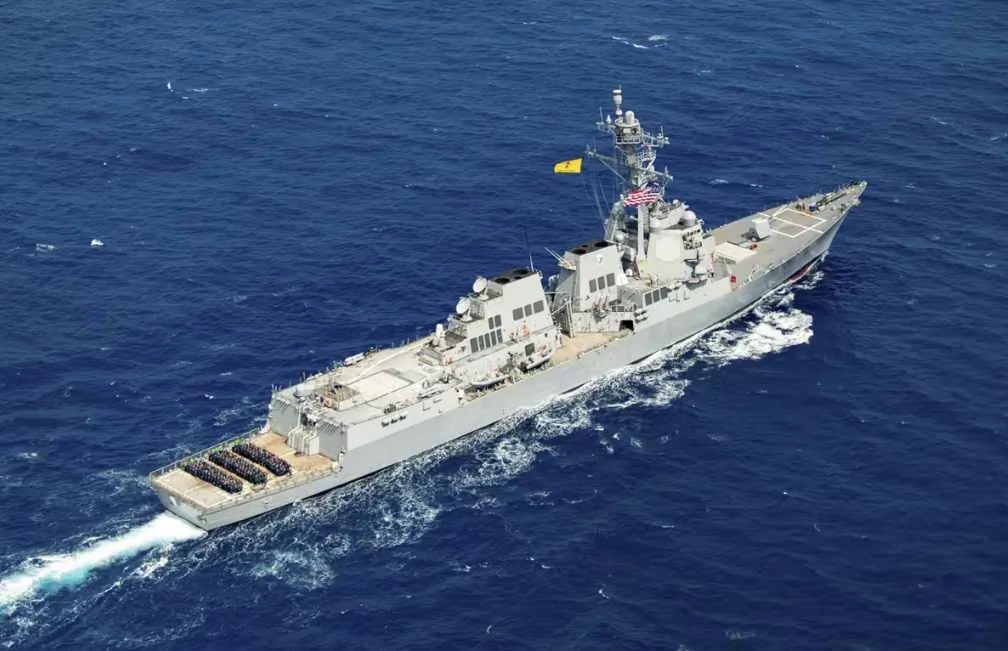
Trump: US Navy Seizes Iranian Ship After Disabling Engine
The United States Navy intercepted and seized an Iranian-flagged bulk carrier in the Gulf of Oman on April 19, 2026, after the vessel failed to respond to hails and was disabled by a precision strike to its engine room, escalating tensions in a critical global shipping corridor and raising immediate concerns about maritime security, insurance liabilities, and supply chain disruptions for energy and grain exports flowing through the Strait of Hormuz.
The incident occurred at approximately 14:30 UTC near the Omani coast, when the USS Arleigh Burke-class destroyer USS Ralph Johnson intercepted the MV Saviz, a 180,000-deadweight-ton bulk carrier registered to the Islamic Republic of Iran Shipping Lines (IRISL). According to a statement posted by former President Donald Trump on his social media platform, Truth Social, the ship’s Iranian crew did not respond to repeated radio and visual signals, prompting U.S. Forces to fire a single anti-ship missile into the vessel’s engine compartment, immobilizing it. U.S. Marines then boarded and took control of the ship, which is now being escorted to a undisclosed port for inspection. The Pentagon has not officially confirmed the details, but U.S. Central Command acknowledged an “interdiction operation” in the region consistent with maritime security protocols under Executive Order 13876, which authorizes interdiction of vessels suspected of violating sanctions against Iran. This seizure is not an isolated act but the latest flashpoint in a years-long shadow war over maritime commerce in the Middle East. Since 2021, Iran has repeatedly accused the U.S. And its allies of conducting “piracy” against its civilian vessels, while Washington counters that IRISL ships are frequently used to transport drones, missile components, and illicit oil in violation of UN Security Council Resolution 2231. The MV Saviz itself has a controversial history: originally deployed as an Iranian intelligence-gathering ship off the coast of Yemen in 2021, it was allegedly damaged by an Israeli limpet mine in 2021 before being converted back to commercial use. Its reappearance in a bulk carrier role raises questions about dual-use vessels and the difficulty of distinguishing humanitarian cargo from military logistics under sanctions regimes. The Gulf of Oman handles roughly 21 million barrels of oil per day—about a third of global seaborne petroleum trade—and any disruption risks triggering price spikes in Brent crude and affecting refineries as far away as India, China, and the Mediterranean. Omani authorities, while not directly involved in the interception, have expressed concern over the militarization of their territorial approaches. “We uphold freedom of navigation, but unilateral actions by external powers in our vicinity create instability that affects our port operations and fishing communities,” said Dr. Yousuf bin Alawi, Oman’s former Minister Responsible for Foreign Affairs, in a recent interview with Times of Oman. He emphasized the need for multilateral dialogue through the Indian Ocean Rim Association (IORA) to prevent accidental escalation. Legally, the seizure raises complex questions under the United Nations Convention on the Law of the Sea (UNCLOS). While warships may intercept vessels suspected of piracy, slavery, or unauthorized broadcasting, sanctions enforcement alone does not constitute a valid basis for seizure under international law unless authorized by the UN Security Council. “This blurs the line between interdiction and confiscation,” said Professor Mary Ellen O’Connell, Robert and Marion Short Professor of Law at the University of Notre Dame and expert in international humanitarian law.
“If the U.S. Is acting unilaterally under domestic executive orders to seize Iranian commercial vessels, it risks setting a precedent that could be invoked by other states against ships flying flags of convenience—or even against U.S. Own vessels in contested waters.”
She noted that any legal challenge would likely proceed in U.S. Federal courts under the Alien Tort Statute or via diplomatic channels at the International Tribunal for the Law of the Sea in Hamburg. For shipping companies and insurers, the implications are immediate, and costly. War risk premiums for vessels transiting the Gulf of Oman have already risen by 18 points since the incident, according to Lloyd’s Market Association data. Cargo owners face potential delays, rerouting around the Cape of Great Hope adding 10–14 days to Asia-Europe voyages, and increased scrutiny from banks wary of violating secondary sanctions. “When a bulk carrier is seized mid-voyage, it’s not just the shipowner who suffers—it’s the grain trader in Ukraine, the fertilizer distributor in Brazil, and the steel mill in Egypt waiting for their cargo,” said Marcus Bellini, senior risk analyst at Marsh McLennan. “Companies need real-time maritime intelligence and legal counsel versed in sanctions compliance and admiralty law to navigate this volatility.” What we have is where specialized professionals become essential. Firms offering maritime and international trade attorneys are now in high demand to advise clients on liability exposure, cargo claims, and defense against wrongful seizure allegations. Simultaneously, businesses relying on just-in-time inventory are turning to global supply chain consultants to reroute shipments, assess alternative ports like Duqm or Salalah, and implement blockchain-based tracking systems to prove cargo provenance. In the longer term, port authorities and coastal municipalities may seek maritime security consultants to strengthen surveillance, improve coordination with allied navies, and develop early-warning systems for anomalous vessel behavior—services that are increasingly vital as great power competition spills into the commercial maritime domain. The seizure of the MV Saviz is more than a tactical maneuver—it is a signal. It underscores how the world’s most critical trade routes have become frontlines in geopolitical competition, where civilian vessels are caught between sanctions enforcement, naval posturing, and the fog of war. As the U.S. And Iran continue to test boundaries without direct conflict, the maritime commons grows more fragile. For those whose livelihoods depend on the steady flow of goods across oceans, the message is clear: stability cannot be assumed. It must be actively managed—by experts who understand not just the law of the sea, but the human and economic currents that move beneath it.
Keep reading
- Cranberry Harvest Underway at A.D. Makepeace Company in Massachusetts
- Gregg Hull alone at New Mexico debate after Deb Haaland withdrew
- Houthi Strikes on Riyadh Airport Kill Three as Trump Rules Out Pre-Midterm Action (archyde.com)
- The Trump administration imposed sweeping sanctions against the International Criminal Court on Oct (newsy-today.com)