
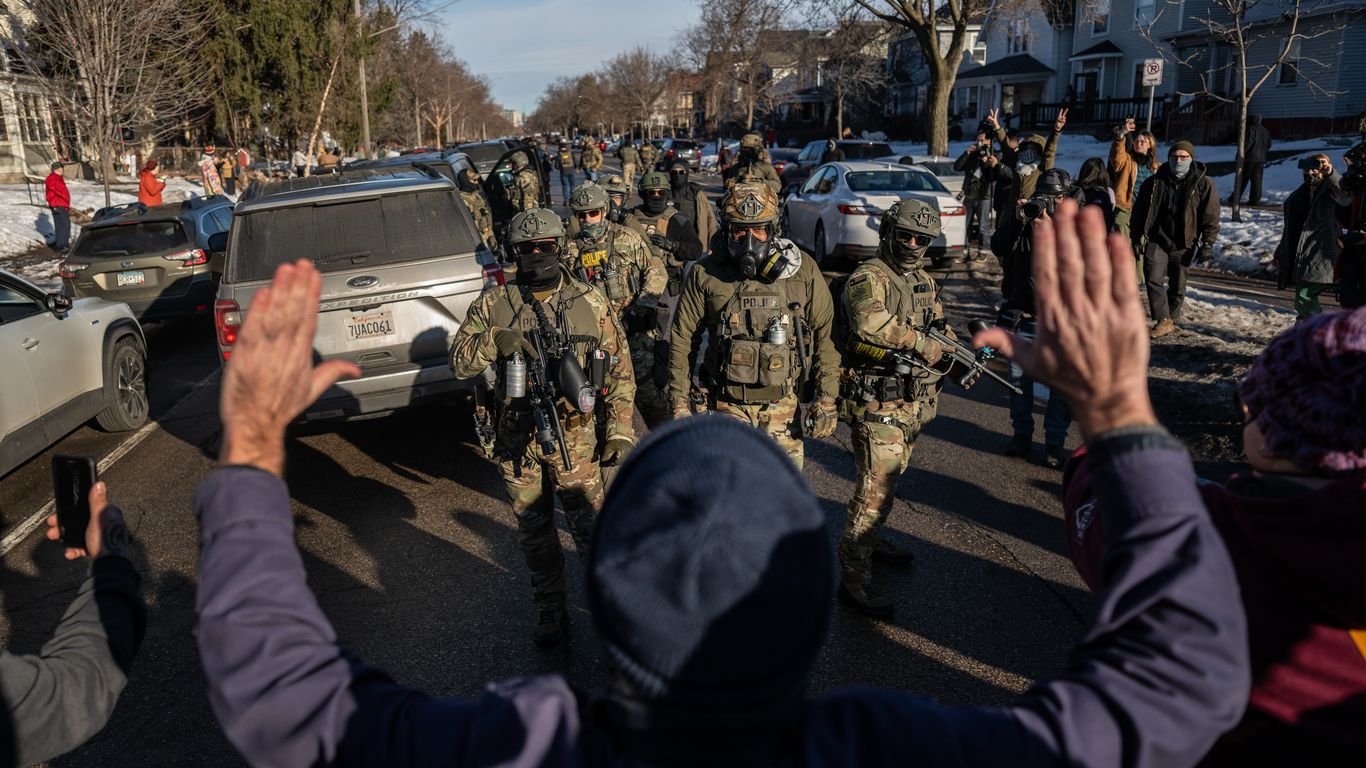
Trump Threatens to Invoke Insurrection Act Amid Minnesota Protests
Minneapolis, MN – January 20, 2026 – Escalating tensions in Minnesota have prompted former President Donald Trump to threaten the invocation of the Insurrection Act, a rarely used presidential power that would authorize the deployment of federal military forces to quell unrest. The threats come in response to protests that erupted following a series of incidents involving Immigration and Customs Enforcement (ICE) agents, including the fatal shooting of Renee good and a subsequent shooting of a Venezuelan man . Governor Tim Walz has fiercely opposed any federal intervention, labeling it an “occupation” and a “campaign of organized brutality.”
the spark: ICE Shootings and Rising Tensions
The current crisis stems from a series of confrontations between ICE agents and civilians. On January 8th, ICE agent shot and killed Renee Good, sparking immediate protests across Minnesota and the nation . Demonstrations quickly intensified as federal agents clashed with protestors, employing tactics that drew criticism from civil rights groups. Just days later, another incident saw an ICE agent shoot a venezuelan man in the leg, described by the Department of Homeland Security as an “ambush,” further fueling the fire .
these incidents have ignited pre-existing frustrations over immigration policy and police conduct, turning Minnesota into a focal point for national debate. Governor Walz has been locked in a battle with the White House over the appropriate response, vehemently opposing the deployment of federal agents and troops. He denounced the federal crackdown as an overreach of authority and a intentional attempt to escalate tensions.
The Insurrection Act: A History of Domestic Deployment
The Insurrection Act, enshrined in U.S. Code, grants the president the authority to deploy military forces within the United States under specific circumstances. The act contains several sections , some of which require the consent of state governments, while others allow for unilateral presidential action. These latter sections empower the president to deploy troops to enforce federal law, suppress insurrection, or respond to “domestic violence” that obstructs the execution of laws or deprives citizens of their constitutional rights .
A Check on Executive Power? The Posse Comitatus Act
The insurrection Act operates as a key exception to the Posse Comitatus act, a law generally prohibiting the use of federal military personnel for domestic law enforcement purposes . The Posse Comitatus Act has recently come under scrutiny, particularly following legal challenges to deployments of the National Guard. A recent ruling found Trump’s deployment of the National Guard in Los Angeles violated the act , highlighting the delicate balance between federal authority and states’ rights.
Historical Precedents: From Grant to Bush
The Insurrection Act has been invoked more than two dozen times throughout American history, typically in response to domestic unrest. Notable examples include:
- 1870s: Ulysses S. grant used the act to suppress white supremacist violence and protect Black voters in the South.
- 1894: Grover Cleveland deployed troops to break the pullman railroad strike.
- 1957: Dwight D. Eisenhower federalized the National Guard to protect Black students integrating Central High School in Little Rock, Arkansas, following the Brown v. Board of Education ruling.
- 1992: George H.W. Bush invoked the act to quell the rodney King riots in Los Angeles.
The last invocation of the Insurrection Act occurred in 1992, marking nearly three decades since its use.
Constitutional Concerns and Potential Misuse
Legal scholars have raised serious concerns about the potential for misuse of the Insurrection Act . Critics argue the act’s broad language allows for important presidential discretion, potentially leading to the suppression of legitimate protest and the erosion of civil liberties. The Brennan Center, a non-partisan law and policy institute, has called for reforms to narrow the scope of the act and safeguard constitutional rights .
“The Insurrection Act should only be invoked in the most extreme circumstances,” stated David Janovsky of the Project on Goverment Oversight. “That is not what’s happening here.”
The Current Situation: A Powder Keg in Minnesota?
as of January 20, 2026, the situation in Minnesota remains volatile. While governor Walz has vowed to resist federal intervention, Trump’s threat to invoke the Insurrection Act looms large. The potential deployment of federal troops could further inflame tensions and escalate the conflict, turning a localized crisis into a national one. The coming days will be critical in determining whether a peaceful resolution can be reached or if Minnesota will become the testing ground for a controversial assertion of presidential power.
Key Takeaways:
- Former President Trump has threatened to invoke the Insurrection Act in response to protests in Minnesota following ICE shootings.
- The Insurrection Act allows the president to deploy military forces domestically under specific circumstances, sometiems without state consent.
- The act has a long and controversial history,raising concerns about potential misuse and the erosion of civil liberties.
- Governor Walz opposes federal intervention, viewing it as an escalation of tensions.
- The situation remains highly volatile, with the potential for further unrest and a constitutional showdown.
