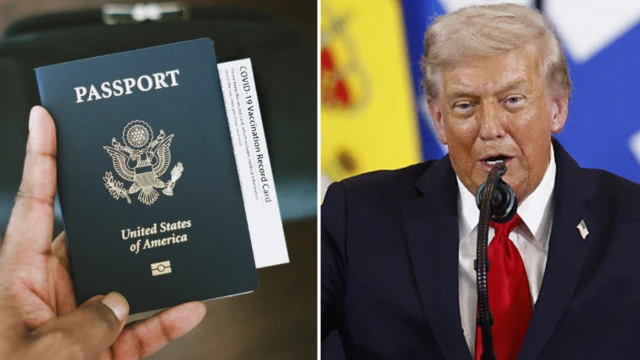
Trump passport cover sparks debate over political symbolism
The U.S. State Department’s rendering of the commemorative passport shows Donald Trump’s portrait framed by the Declaration of Independence and the American flag, his signature gleaming in metallic foil. The White House, in a statement to the BBC, called it another great way Americans can join in the spectacular celebrations for America’s 250th birthday.
Yet the design breaks from a tradition of depicting historical milestones—like the Moon landing or the Statue of Liberty—on passport covers, raising questions about how far official symbolism should bend to partisan legacy.
The Passport as Political Canvas
For generations, U.S. passports have avoided overt political figures, instead favoring neutral or broadly celebratory imagery. Even the 2026 semiquincentennial logo, unveiled last year, sticks to abstract patriotism—a stylized “250” with stars and stripes, devoid of any living figure’s likeness.
The Trump passport disrupts that precedent. The White House’s framing ties it explicitly to a broader campaign of renewal of national pride and patriotism,
bundling it with events like the UFC250 Fight and the Freedom250 Grand Prix. That bundling is no accident. By linking his image to a milestone anniversary, Trump’s team is positioning him not just as a participant in the celebration but as its central architect—a role typically reserved for the nation itself, not its leaders.
Historically, the U.S. has reserved commemorative passports for themes with near-universal appeal. In 2016, the State Department issued a limited-edition passport to mark the 100th anniversary of the National Park Service, featuring Yosemite’s Half Dome. In 2000, a millennium edition showcased the Statue of Liberty. Neither design carried the imprimatur of a sitting—or former—president. The closest parallel might be the 1976 bicentennial passport, which included a special seal but no political figures. Even then, the seal was a generic emblem, not a signature or portrait.
The Opt-Out Ambiguity
The State Department’s announcement is silent on whether citizens can decline the Trump-themed passport. Current reporting offers no clarity on whether the design will be an optional upgrade, a default for new applicants, or a limited-run collectible. That ambiguity matters. Passports are mandatory for international travel, and their design carries symbolic weight. A citizen who objects to Trump’s image on principle—or simply prefers the traditional design—has no confirmed avenue to avoid it.
Other countries have grappled with similar tensions. Canada’s 2017 sesquicentennial passport included Indigenous artwork and historical scenes, sparking debate over whose stories were centered. In the U.S., where presidents are polarizing figures, the stakes are higher. The lack of an opt-out mechanism could turn a commemorative gesture into a mandatory endorsement, a prospect that has already drawn quiet scrutiny from legal observers.
For now, the State Department has not addressed the question. A spokesperson for the agency told the BBC only that the design was part of the 250th anniversary celebrations, without elaborating on distribution or alternatives. That leaves the public in an unusual position: aware of the change but powerless to navigate its implications.
Branding a Semiquincentennial
The Trump passport is the latest in a series of high-profile events tied to America’s 250th anniversary, a milestone that has become a canvas for the former president’s political messaging. The White House statement groups it with the UFC250 Fight, the Great American State Fair, and the Freedom250 Grand Prix—all branded under the “Freedom250” banner, a phrase that echoes Trump’s 2024 campaign rhetoric. The repetition of “freedom” in the statement (this new passport celebrating our freedom
) is telling. It reframes a historical anniversary as a contemporary political project, one where Trump’s leadership is inseparable from the nation’s identity.
That reframing is not without risk. The semiquincentennial was intended to be a unifying moment, a chance to reflect on 250 years of American history. But by inserting a living political figure into the commemoration, the administration has invited scrutiny over whether the anniversary is being used to burnish a legacy rather than celebrate a shared past. The White House’s language—President Trump continues to proudly lead a renewal of national pride
—suggests a continuity between his presidency and the nation’s founding, a claim that historians and political opponents are likely to challenge.
The design itself reinforces that continuity. The Declaration of Independence text framing Trump’s portrait is not a random choice. It positions him as a steward of the nation’s founding ideals, a visual argument that his leadership is in the same tradition as the revolutionaries. Whether that argument resonates beyond his base remains an open question, but the passport’s very existence ensures the debate will play out on a highly visible stage.
A Symbol’s Long Shadow
The Trump passport may be a limited edition, but its implications could extend far beyond 2026. If the design is popular—or if future administrations follow suit—it could normalize the inclusion of political figures on official documents, blurring the line between state and partisan identity. The U.S. has long avoided this kind of politicization in its symbols. The American flag, the national anthem, and even the design of currency are carefully neutral, designed to represent the country as a whole rather than any one leader or party.
That neutrality is not accidental. It reflects a deliberate choice to prioritize national unity over partisan advantage. The Trump passport, by contrast, treats a political figure as a symbol of national pride, a shift that could set a precedent for future commemorations. If the 250th anniversary can feature a former president, why not the 300th? And if a passport, why not other official documents—currency, postage stamps, even government buildings?
The White House’s statement offers no answers to these questions. Instead, it frames the passport as a celebration of freedom, a theme broad enough to encompass both national history and political legacy. But freedom, in this context, is a contested term. For some, it may evoke the ideals of 1776. For others, it may feel like a partisan slogan, one that ties a historical milestone to a specific political movement. The passport’s design doesn’t resolve that tension—it embodies it.
What happens next is unclear. The State Department has not announced when the passports will be available, how many will be issued, or whether they will be optional. What is clear is that the design has already sparked a conversation about the boundaries of official symbolism, one that will likely intensify as the semiquincentennial approaches. For now, the gold-embossed signature on the passport cover stands as a reminder: in America’s 250th year, even the most mundane documents can become battlegrounds for national identity.