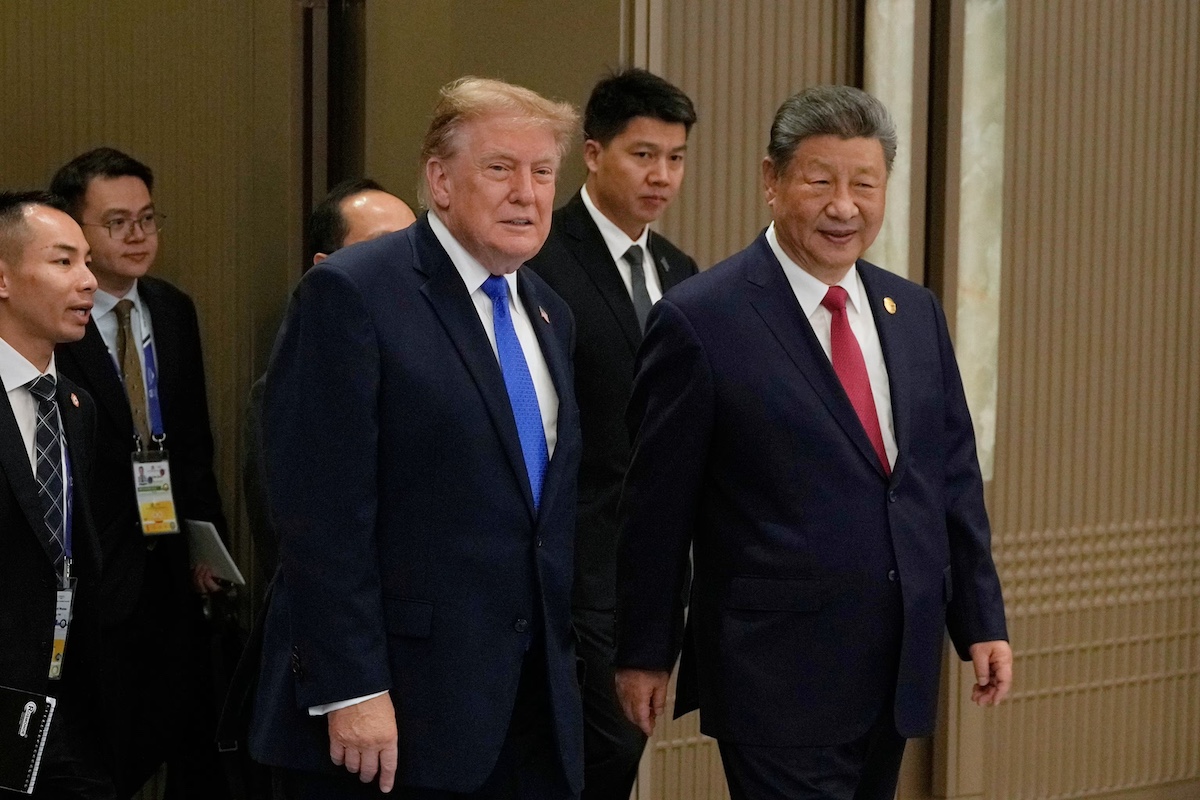
Trump Denounces Global Tech Rules as Xi Offers APEC Blueprint in Shenzhen
Southeast Asian cloud operators began enforcing new US export controls on Thursday, the same day Donald Trump denounced global tech regulation and Xi Jinping promised an institutional architecture for the Asia-Pacific at the APEC summit in Shenzhen.
The pairing of words and rules is the story. According to Asia Times, Trump told delegates that Washington opposes “any form of globalist regulation or anything to control or stifle SI (superintelligence),” even as newly published Commerce Department rules began imposing know-your-customer verification and licensing mandates on overseas data centers providing remote compute access to Chinese clients.
Xi, speaking moments later from the same plenary stage, countered with a four-pillar blueprint for an “Asia-Pacific community” and backed it with $20 million for practical APEC projects.
For the governments and businesses in the room, the contrast defines the region’s immediate dilemma. Beijing is offering institutional structure, data rules and development cash. Washington is denouncing international governance while its own unilateral controls take effect across Singapore, Malaysia, Indonesia and Thailand, Asia Times reported.
Two speeches, two blueprints for the Pacific
Trump’s pitch carried little for Asia’s digital economies, the report states. He touted an Alaska liquefied natural gas pipeline that Seoul is still hedging on financing, alongside expanding US oil operations in post-Maduro Venezuela, and left Beijing to address Southeast Asia’s more immediate need for low-carbon power for data centers.
His framing seemed aimed as much at Silicon Valley backers and a post-midterm base at home as at the Shenzhen hall, Asia Times reported.
“We should uphold open regionalism, steadily advance economic integration and develop a cooperation pattern that is open and integrated rather than exclusive or fragmented,” said Xi Jinping in the plenary address.
Xi paired the rhetoric with deliverables. According to Asia Times, the package included a new Center for Asia-Pacific Community Studies in Shenzhen and dedicated regional mechanisms covering digital technology, cross-border data flows, clean energy and small business development. He called on members to “strengthen the digital infrastructure development, improve data governance and collaboration in the region and achieve efficient, convenient and secure cross-border data flow.”
Donald Trump is arriving at an unprecedented summit meeting with Xi Jinping and Vladimir Putin politically weakened at home, yet perhaps even more eager to flex his power abroad https://t.co/tDckZNxgum
Xi’s speech functioned, the report says, as a pointed diplomatic rebuke to Washington’s unilateral chip and cloud export curbs. Vladimir Putin, on the same stage, declared Russia an “integral part of the Asia-Pacific region,” urged members to use Russian logistics infrastructure, and signaled Moscow’s support for the draft final APEC communiqué.
The rules Trump’s rhetoric collided with
The deregulation paradox landed hardest on regional telecom operators and cloud providers. At the exact moment Trump warned against rules that might “destroy the tremendous potential” of AI, the Commerce Department mandates came into force. Operators across Southeast Asia that host both Western hyperscalers and Chinese tech firms are now being forced to police Washington’s export perimeter even as the US president dismisses international rules as “globalist” overreach.

Xi seized on that opening. He positioned Beijing as the guarantor of institutional predictability, promising regional institutions to govern cross-border data and smart customs without unilateral political interference. khanlist.com carried the same report, quoting the identical passages from both leaders’ addresses.
For companies caught between the two systems, the practical work is compliance.
A tarmac greeting, a “$30 for 30” truce
Wednesday evening set the tone. Xi broke nearly five decades of protocol on Wednesday evening to greet Trump personally, offering Pacific Rim economies a stark diplomatic contrast with Washington’s approach.
Opening bilateral talks at Shenzhen’s Kylin Villa on Thursday afternoon, Trump cast the relationship transactionally. According to the report, he pointed to a “30 for 30” tariff-reduction package brokered through the bilateral Board of Trade, covering $30 billion in bilateral commerce, and pressed Beijing on agricultural purchases, citing a 97% drop in seaborne fentanyl and shared interests in keeping energy moving through the Strait of Hormuz.
US Donald Trump arrives in Shenzhen for APEC meeting.#APECChina2026 pic.twitter.com/iBJLiXGEil
Trump also waved aside the fallout surrounding Jensen Huang, treating it as a passing political headache rather than a reason to derail the bilateral tariff cuts.
“As long as you and I are in charge of things, we’ll never have a problem,” said Donald Trump at the start of the bilateral talks.
Three leaders, one round table
Within an hour of the bilateral ending, China’s Ministry of Commerce announced it would convene an agricultural working group with Washington “in the near future,” Asia Times reported. Beijing’s readout said both leaders agreed to draw up an action plan to stabilize ties and called for “greater cooperation on artificial intelligence.” Neither side announced any rollback of the new remote-cloud restrictions.
Running more than an hour behind schedule, Trump and Xi then joined Putin at a large round table at Kylin Villa for a three-way summit. Trump declared the trio were “making history” and should lead on nuclear disarmament. Xi hailed the talks as carrying “groundbreaking significance” for managing global challenges.
That closed-door session left smaller Pacific Rim nations on the outside. Asia Times reports a nagging regional fear that Trump prefers great-power sphere-of-influence dealmaking to multilateral Asian institutions, even as Xi used the plenary to promise deeper integration toward a Free Trade Area of the Asia-Pacific.
News Flash: U. S. President Trump departs for an Asia tour to attend the APEC summit. Foreign heads of state who have arrived in Shenzhen so far: • Mexican President Claudia Sheinbaum—the first foreign leader to arrive in Shenzhen for this APEC summit. • Prime Minister of Papua… pic.twitter.com/ZBNROgMttY
The gap ASEAN capitals can use
The distance between Trump’s appetite for trade truces and his administration’s hardline export-control bureaucracy gives ASEAN capitals room to maneuver, the report argues. By treating the Huang fallout as a passing political headache rather than a reason to derail tariff cuts, Trump showed that commercial enforcement stays negotiable at the top, even if Commerce Department compliance officers say otherwise.
The operational pattern from Shenzhen is compartmentalization. Washington and Beijing will run trade and farm working groups in parallel while leaving unilateral tech controls intact, with Big Three summitry over nuclear weapons and distant wars overshadowing APEC’s economic agenda.
What remains unresolved is whether the controls themselves are policy or bargaining chips. Neither leader said in Shenzhen whether the remote-cloud restrictions would survive their own “new definition of a constructive China-US relationship of strategic stability,” in Xi’s words, “based on ‘respect, fairness and reciprocity.'”
Shenzhen is hosting an organization with roots in Canberra: APEC was founded in 1989 on an Australian initiative by Prime Minister Bob Hawke, whose January 1989 call for economic cooperation across the Pacific Rim led twelve economies to meet that November.
Its 21 members are “member economies” rather than countries — Taiwan participates as “Chinese Taipei” alongside China and Hong Kong — and the forum, headquartered in Singapore, has grown into one of the region’s oldest and highest-level multilateral blocs.
Its 1994 Bogor Goals set targets of free trade and investment by 2010 for industrialized economies and 2020 for developing ones, and its rotating summits are known for the tradition of leaders dressing in the host country’s national costume.
Until that question is answered, the region builds, as Asia Times put it, “out of whatever space remains between American export rules and Chinese infrastructure cash” — and the compliance officers policing that perimeter have become the people determining how much space actually exists.
Keep reading
- Vatican at COP31: Climate Crisis Rooted in Ethical Failure, Demands ‘Deep Conversion
- British Columbia Grizzly Quest: No Bears, Skunk Chaos, and Rebirth in the Great Bear Rainforest
- Judge Orders Trump Administration to Release Law Firm Deal Records (time.news)
- Trump's Beef Quota Filled About 37% in Month One; Ground Beef Fell 13 Cents (daybreakwire.com)