
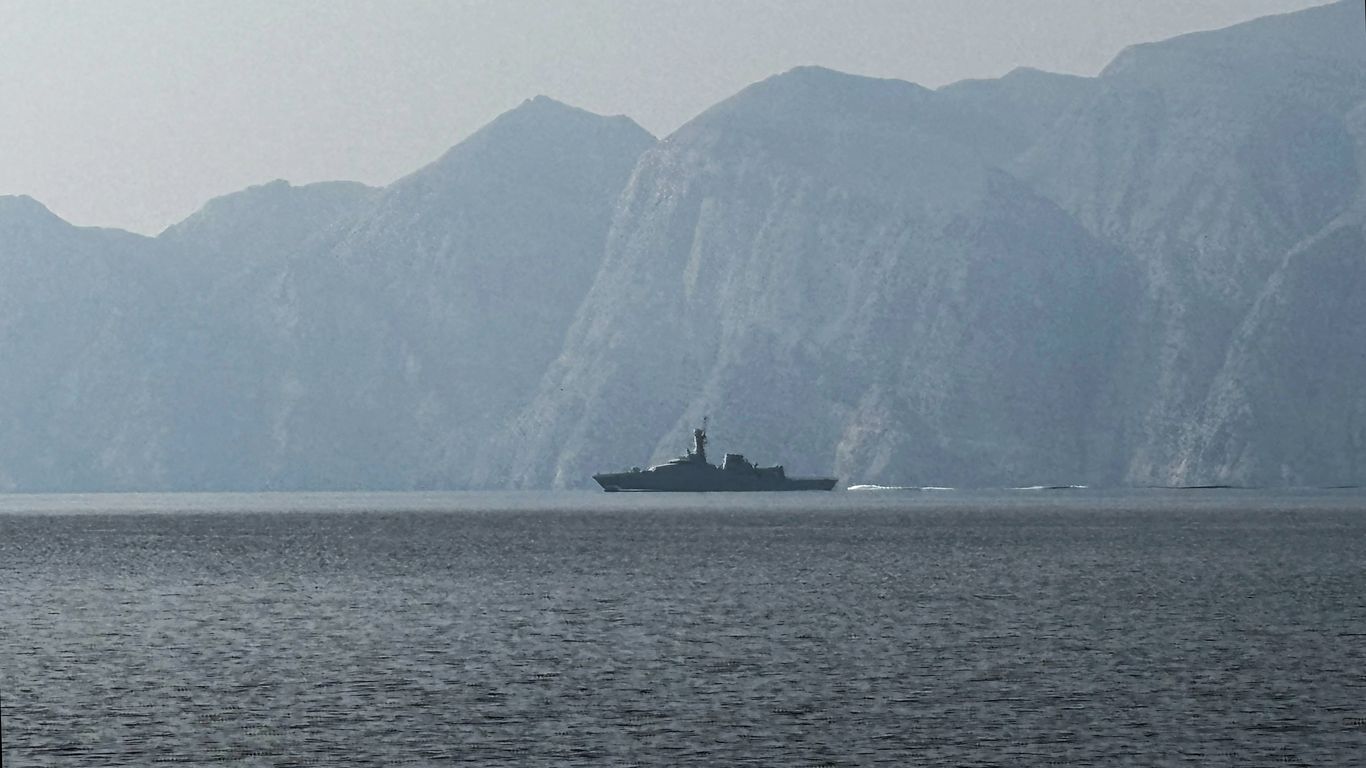
The U.S. Military has sunk nine Iranian naval vessels and is continuing operations to neutralize the remainder of Iran’s fleet, President Trump announced Sunday via a post on Truth Social. The action follows a weekend of escalating tensions in and around the Strait of Hormuz, a critical chokepoint for global oil shipments.
“I have just been informed that we have destroyed and sunk 9 Iranian Naval Ships, some of them relatively large and significant. We are going after the rest. They will soon be floating at the bottom of the sea, similarly! In a different attack, we largely destroyed their Naval Headquarters. Other than that, their Navy is doing very well!” Trump wrote. A U.S. Defense official confirmed the President’s account.
The strikes are a direct response to Iran’s attempts to disrupt maritime traffic through the Strait of Hormuz, according to the administration. On Saturday, Iranian naval ships issued warnings on emergency radio channels declaring the Strait closed to commercial vessels. The Islamic Revolutionary Guard Corps (IRGC) has since claimed responsibility for attacks on commercial ships and tankers in the region.
U.S. Central Command (CENTCOM) confirmed a specific operation, stating it sank an Iranian Jamaran-class corvette at a pier in Chabahar, southern Iran, during what it termed “Operation Epic Fury.” CENTCOM’s statement included a direct appeal to Iranian forces: “As the President said, members of Iran’s armed forces, IRGC and police must lay down your weapons. Abandon ship.”
The Strait of Hormuz, a narrow waterway connecting the Persian Gulf to the Gulf of Oman and the Arabian Sea, is one of the world’s most strategically important oil transit routes. Approximately 20% of the world’s oil supply passes through the strait daily, making its security paramount to global energy markets. As reported by the Associated Press, any disruption to traffic through the strait has the potential to significantly impact oil prices and global trade.
Whereas Iranian actions prompted the U.S. Response, ship traffic through the Strait has been significantly disrupted. Open-source ship tracking data indicates numerous commercial vessels are currently anchored, awaiting safe passage. Although, a U.S. Defense official stated that some ships are still transiting the waterway. The New York Times reported on the plummeting ship traffic following the initial Iranian attacks.
The current escalation builds on existing anxieties regarding Iran’s nuclear program and regional influence. John Bolton, former National Security Advisor to President Trump, recently warned of the risks associated with the administration’s approach to Iran, though details of his specific concerns were not immediately available. Politico reported on Bolton’s recent warnings.
As of Sunday evening, the extent of damage to Iranian naval infrastructure remains unclear, and the situation in the Strait of Hormuz remains fluid. The U.S. Has not specified whether further military action is planned, leaving open the possibility of continued escalation.
