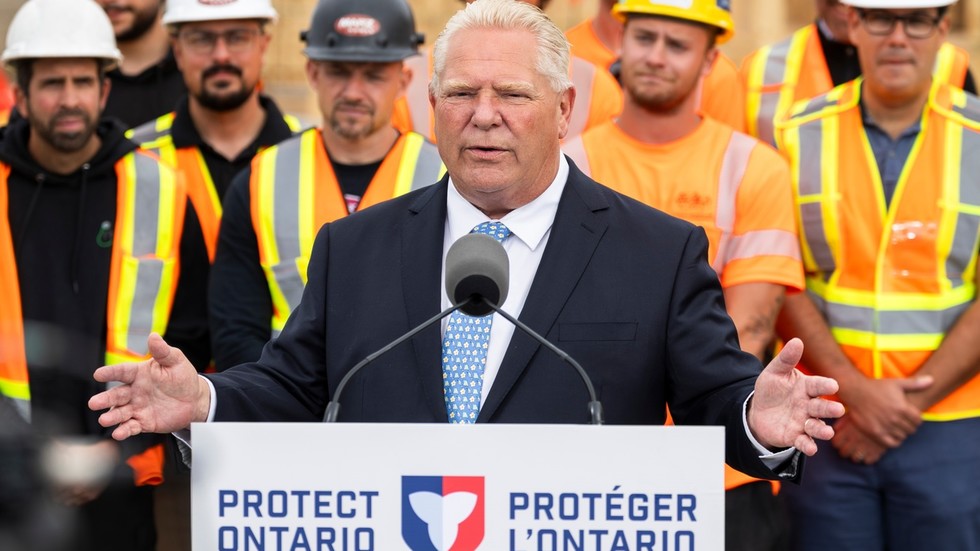
Trump and Doug Ford Clash Over Canada Trade War and Energy Threats
Ontario Premier Doug Ford threatened to cut electricity and critical minerals to the United States on August 24, 2026, as a trade dispute deepened following President Donald Trump’s decision to raise tariffs on Canadian steel and autos to 50 percent, threatening cross-border energy infrastructure in border states like New York, Michigan, and Minnesota.
The escalating dispute highlights vulnerabilities in North American energy security. As international trade friction spills over into power grids and critical supply chains, businesses and municipalities find themselves directly exposed to sudden regulatory and supply disruptions.
Trade War Escalates Over Auto and Steel Tariffs
The cross-border confrontation intensified on August 24, 2026, following the collapse of bilateral trade negotiations. President Donald Trump announced that US tariffs on Canadian cars, trucks, auto parts, and steel would increase to 50 percent starting January 1, 2027. This aggressive move arrived right on the heels of a separate 50 percent tariff that took effect on Saturday targeting approximately $20 billion worth of Canadian imports.
https://x.com/clashreport/status/2091955414728421780
Canadian leadership quickly rejected Washington’s terms. Prime Minister Mark Carney accused the US administration of attempting to systematically dismantle Canada’s domestic auto industry through unreasonable demands. After Canadian officials walked away from the negotiating table late Friday, Carney announced that Ottawa would implement dollar-for-dollar retaliatory tariffs beginning September 8.
President Trump responded sharply to Canadian resistance on Truth Social, dismissing provincial pushback as empty rhetoric and personally attacking the premier before warning Canadian leaders to “fall in line.” Trump asserted that the United States is far bigger, richer, and stronger, claiming that Canada cannot survive economically without its southern neighbor.
Ontario Premier Threatens Power Cutbacks and Mineral Restrictions
Ontario Premier Doug Ford adopted an uncompromising stance in response to the White House tariff announcements. Speaking to the Associated Press on Monday, Ford stated that everything remains on the table to counter American trade penalties. Ontario currently powers roughly 1.5 million homes and businesses south of the border.
“If he keeps trying to dismantle Canadian manufacturing, he better have a pack of batteries,” Ford warned regarding President Trump. When Trump dismissed the threats on social media, Ford fired back at a press conference by remarking that Trump has ample room for retaliation.
Ford urged federal authorities in Ottawa to implement progressively stronger economic counter-measures, pointing to potential restrictions on Canadian oil, potash, and strategic minerals. Meanwhile, Quebec Premier Christine Frechette noted that while her province—a massive hydroelectric supplier—is not immediately adopting Ontario’s exact retaliatory posture, she refuses to rule out further action as the dispute enters a contentious new phase.
Grid Exposure and Regional Power Strains
Data from the US Energy Information Administration indicates that Canada remains the largest foreign supplier of electricity to the United States. While nationwide US import dependence sits at a modest 0.2 percent of total consumption—with the US importing approximately 24.5 terawatt-hours of Canadian electricity in 2025 while exporting 16 terawatt-hours back—regional exposure is highly localized.

Border states including New York, Michigan, and Minnesota rely heavily on stable Canadian electricity imports, particularly during periods of peak seasonal demand. This reliance coincides with a massive surge in power demand driven by the artificial intelligence boom, as technology companies race to construct power-hungry hyperscale data centers.
Grid stability concerns are already manifesting at the state level. In July 2026, New York enacted a one-year moratorium on state discretionary environmental permits for new hyperscale facilities while crafting stricter regulations to safeguard local ratepayers and prevent blackouts.
Historical Precedent and Economic Fallout
This is not the first time Ontario has leveraged its electricity exports to push back against American trade pressure. In March 2025, Premier Ford instituted a 25 percent surcharge on electricity exports destined for northern US states, only suspending the measure after President Trump threatened to double tariffs on Canadian aluminum and steel.
As governments grapple with retaliatory economic measures, businesses caught in the crossfire face mounting logistical and financial hurdles.
With retaliatory Canadian tariffs slated for September 8 and sweeping American tariff increases looming in January 2027, the ongoing trade confrontation shows no immediate signs of abating. The resilience of North American energy and manufacturing networks now depends entirely on whether diplomatic channels can reopen before retaliatory state-level utility curbs take effect.