
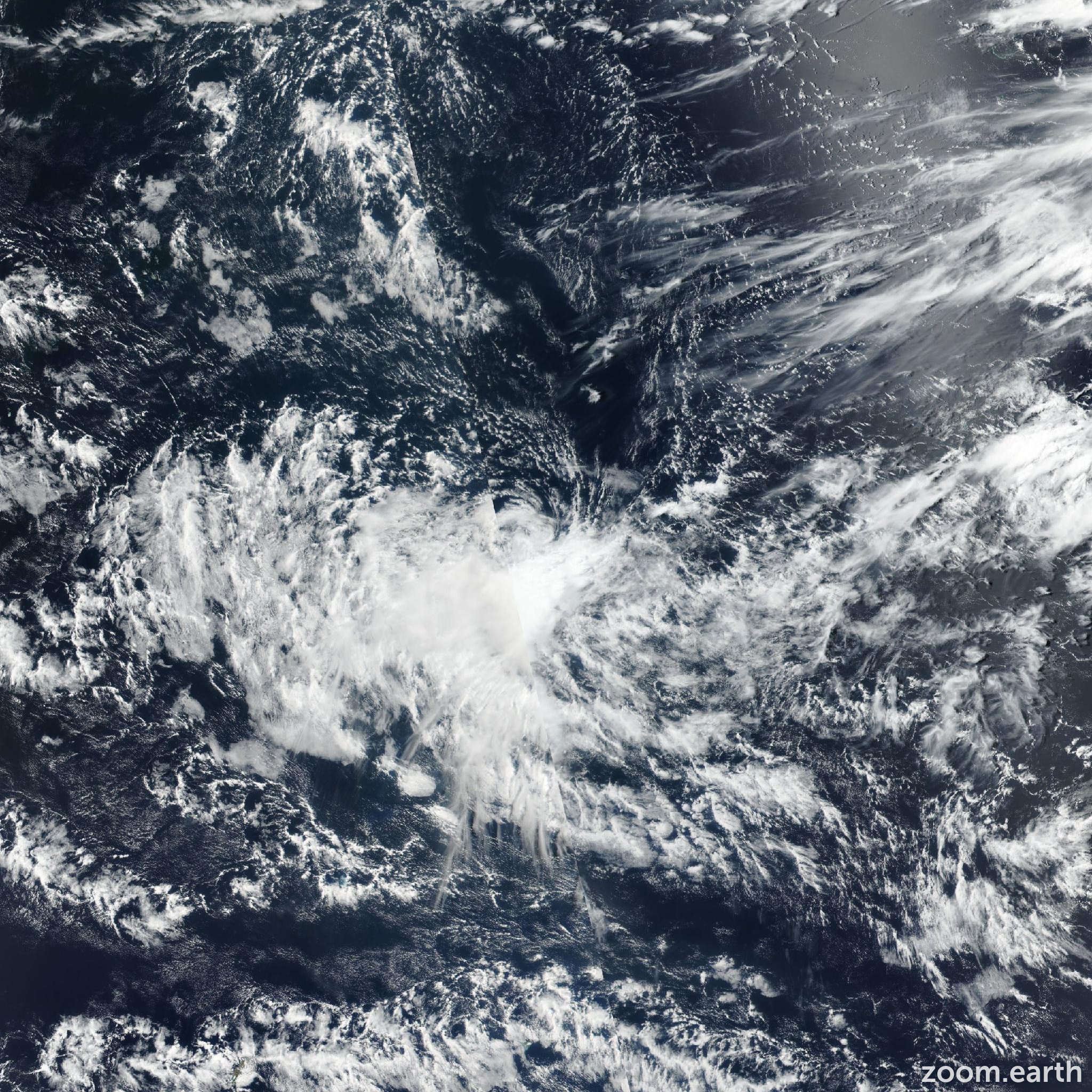
Tropical Storm Blossom: Live Tracking Update
As of the latest update, Tropical Storm Blossom is located 575 miles (924 km) west-southwest of Diego Garcia, moving northwest at 6 mph (9 km/h). Significant wave heights are currently reaching 14 feet (4.3 meters).
Blossom has exhibited a noticeable slowdown and a sharper turn towards the northwest over the past six hours. This shift is attributed to a temporary weakening in the steering winds caused by a break in the subtropical ridge south of the storm.
Though, forecast models indicate this break will quickly move eastward, with a strengthening ridge building in from the west. This will re-establish a strong steering flow, guiding Blossom on a continued northwest trajectory for the foreseeable future.
Despite persistent, strong northeasterly wind shear, Blossom has maintained a strength of at least 40 mph (65 km/h, 35 knots). This resilience is due to recurring bursts of atmospheric convection, providing enough energy to sustain the storm’s wind field. Current infrared imagery shows another of these convective cycles, expected to last several more hours before dissipating. Mesoscale models accurately reflect this pattern and predict it will continue for approximately 24-36 hours.
Looking ahead, conditions are expected to become increasingly unfavorable. The atmosphere is forecast to dry considerably, and wind shear is predicted to intensify, suppressing further convective development and disrupting any attempts at strengthening.
The storm is currently forecast to weaken below warning levels within 48 hours.There is a high degree of consensus among deterministic, ensemble, and artificial intelligence (AI) model trackers regarding its path, with minimal divergence in predicted tracks. Some slight spread in long-range forecasts exists,but is not considered significant. The Joint Typhoon Warning Center (JTWC) forecast aligns closely with the consensus mean.
Intensity predictions are more varied. The HWRF model suggests a brief intensification to around 53 mph (85 km/h, 45 knots) before a rapid decline. Conversely,COAMPS-TC and HAFS-A models indicate a relatively stable intensity for the next 24-36 hours,followed by a sharp weakening. Other guidance suggests immediate weakening. The JTWC forecast currently favors the HAFS-A scenario with medium confidence.
