Triple-Band Circularly Polarized Stacked Patch Antenna with Sunlight-Shaped Slots for GNSS Applications
Researchers have developed a triple-band, circularly-polarized stacked patch antenna for Global Navigation Satellite System (GNSS) applications, according to a report published in Nature. The antenna utilizes sunlight-shaped slots etched into metallic patches to optimize signal performance across the L1, L2, and L5 frequency bands through precise modal current redistribution.
Stacked FR4 Substrates and Metallic Patches Form Antenna Structure
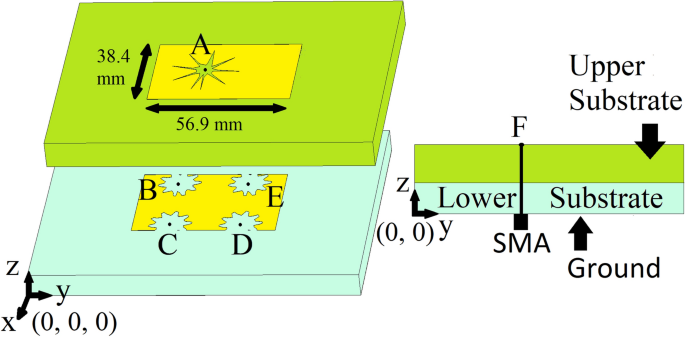
The antenna design features two stacked FR4 substrates, each measuring 99.2 mm by 130.2 mm with a dielectric constant of εr = 4.3. The top substrate is 11.2 mm thick, while the bottom layer measures 9.6 mm in thickness, Nature reported. Rectangular metallic patches measuring 38.4 mm by 56.9 mm sit atop each substrate. A single coaxial probe at point F provides the feed for the entire structure.
Engineers integrated sunlight-shaped slots into these patches to manipulate surface currents. One slot is centered on the top patch, while four additional slots are carved into the bottom patch to influence electromagnetic resonance. The geometry of these slots follows the Gielis superformula, allowing for fine-tuned control over the antenna’s radiation characteristics.
Slots and off-Center Probe Feed Optimize Signal Performance
The stacked configuration induces mode frequency splitting, which broadens the impedance bandwidth and improves the axial ratio at the L2 and L5 bands. By using an off-center probe feed, the design simultaneously couples the TM010, TM100, and TM110 modes. Nature reported that the sunlight-shaped slots are critical for breaking the central anti-symmetry of the TM110 mode, enabling broadside radiation.
| Component | Dimension/Value |
|---|---|
| Substrate Area | 99.2 x 130.2 mm² |
| Dielectric Constant | εr = 4.3 |
| Top Substrate Thickness | 11.2 mm |
| Bottom Substrate Thickness | 9.6 mm |
| Metallic Patch Size | 38.4 x 56.9 mm² |
This redistribution of currents allows the antenna to achieve a broadside gain of 6.9 dBic at the L1 band. The slots also optimize the phase delay between modes, which enhances the axial ratio performance across all three target frequency bands. The final geometry is the result of an iterative parametric sweep of Gielis parameters to monitor broadside axial ratio and beam widths at principal cuts.