
Rogue black HoleS Delayed Star Destruction baffles Astronomers
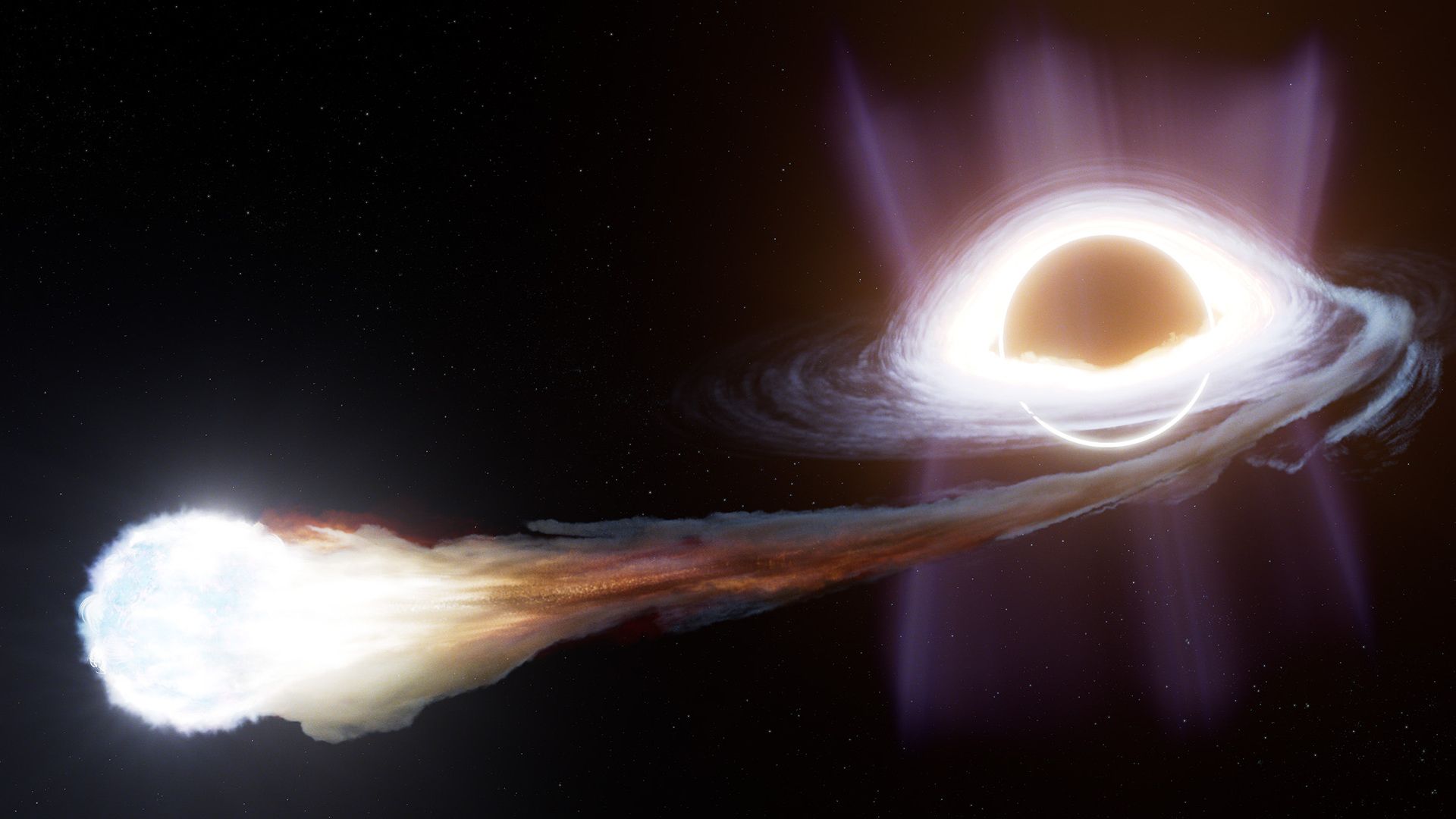
October 26,2023 – Astronomers have observed a black hole exhibiting unusual behavior after tearing apart a star,with radio emissions appearing months after the initial event and presenting a puzzle for current astrophysical models. The findings,published October 13 in The Astrophysical Journal Letters,detail a tidal disruption event (TDE) where the black hole’s response was significantly delayed and unfolded in two distinct flares.
The event was first detected following a TDE – when a black hole’s gravity overwhelms a star and pulls it apart – and was observed using the Atacama Large Millimeter/submillimeter Array (ALMA) in Chile and the Arcminute Microkelvin Imager Large Array (AMI-LA) at Cambridge University’s Mullard Radio Astronomy Observatory.
AMI-LA captured the rapid growth of radio emission,indicating a quick rise and change in energy. These radio waves originate from material ejected from the black hole colliding with surrounding gas, which could be interstellar medium or debris from the destroyed star.
the initial radio flare was accompanied by X-ray emissions, leading researchers to believe it was “accretion-driven” – caused by material from the star’s accretion disk being ejected by the black hole’s magnetic fields. However, a second, even more perplexing flare followed.
Scientists theorize this second flare could be either a jet of material traveling at half the speed of light launched 170 days after the TDE, reaching the surrounding gas 24 days later, or a near-light-speed jet launched 190 days after the initial disruption. The connection between the two flares, and whether they stem from the same material, remains unknown.
The black hole responsible is estimated to be an intermediate-mass black hole, with a mass between 1,000 and 100,000 times the mass of our sun. Its location outside the galactic center suggests it may have been ejected during a triple black hole interaction or originated as the central black hole of a smaller galaxy that merged with a larger one, now wandering and consuming stars.
