
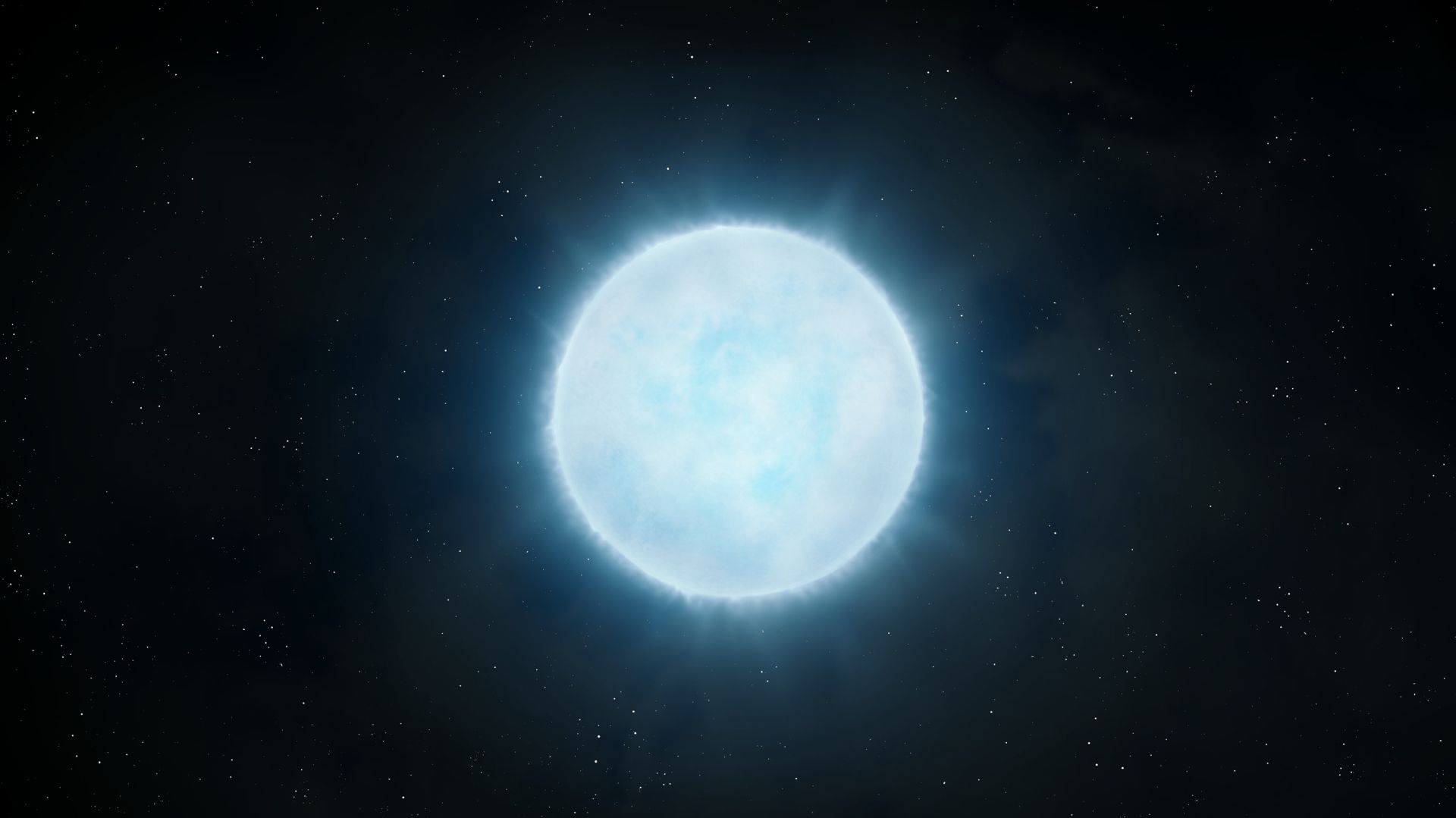
Last Light of the Universe: The Eventual Fate of Stellar Cores
New research suggests that even the densest remnants of dead stars, known as black dwarfs, are not eternal objects. While currently none exist in the observable universe due to its relatively young age, theoretical physics predicts a dramatic end for these stellar cores-long after all other stars have faded.
Black dwarfs are the theorized final stage in the life cycle of low-to-medium mass stars, formed after a white dwarf has cooled to the point of no longer emitting significant heat or light. Reaching absolute zero is unachievable, but these stellar remnants approach it closely. However, the universe is currently not old enough-it woudl require a thousand times its current age-for the first black dwarf to form.
But their existence wouldn’t signify permanence. Two primary processes could ultimately dismantle these incredibly dense objects.
The first is space-time curvature-induced pair production.Quantum particles constantly appear and disappear in a vacuum,but within the intense gravity of a black dwarf,these particles could become permanently separated by the curvature of space-time,effectively “creating” matter at the expense of the black dwarf’s energy. Over approximately 1078 years, this could lead to complete evaporation.
A more violent fate awaits a small percentage of black dwarfs through pycnonuclear decay. This occurs when nuclei within the core randomly fuse due to quantum mechanical chance, a process favored by the extreme density within a black dwarf.
Degeneracy pressure normally supports the core against collapse, but as nuclei fuse and are lost, this support weakens. For a few percent of black dwarfs already near the point of collapse, this loss triggers a catastrophic supernova detonation. These events will become a primary source of light and radiation in the distant future, long after all conventionally-fueled stars have ceased to shine.
Researchers estimate these black dwarf supernovae will occur between 101,100 and 1032,000 years from now.
