
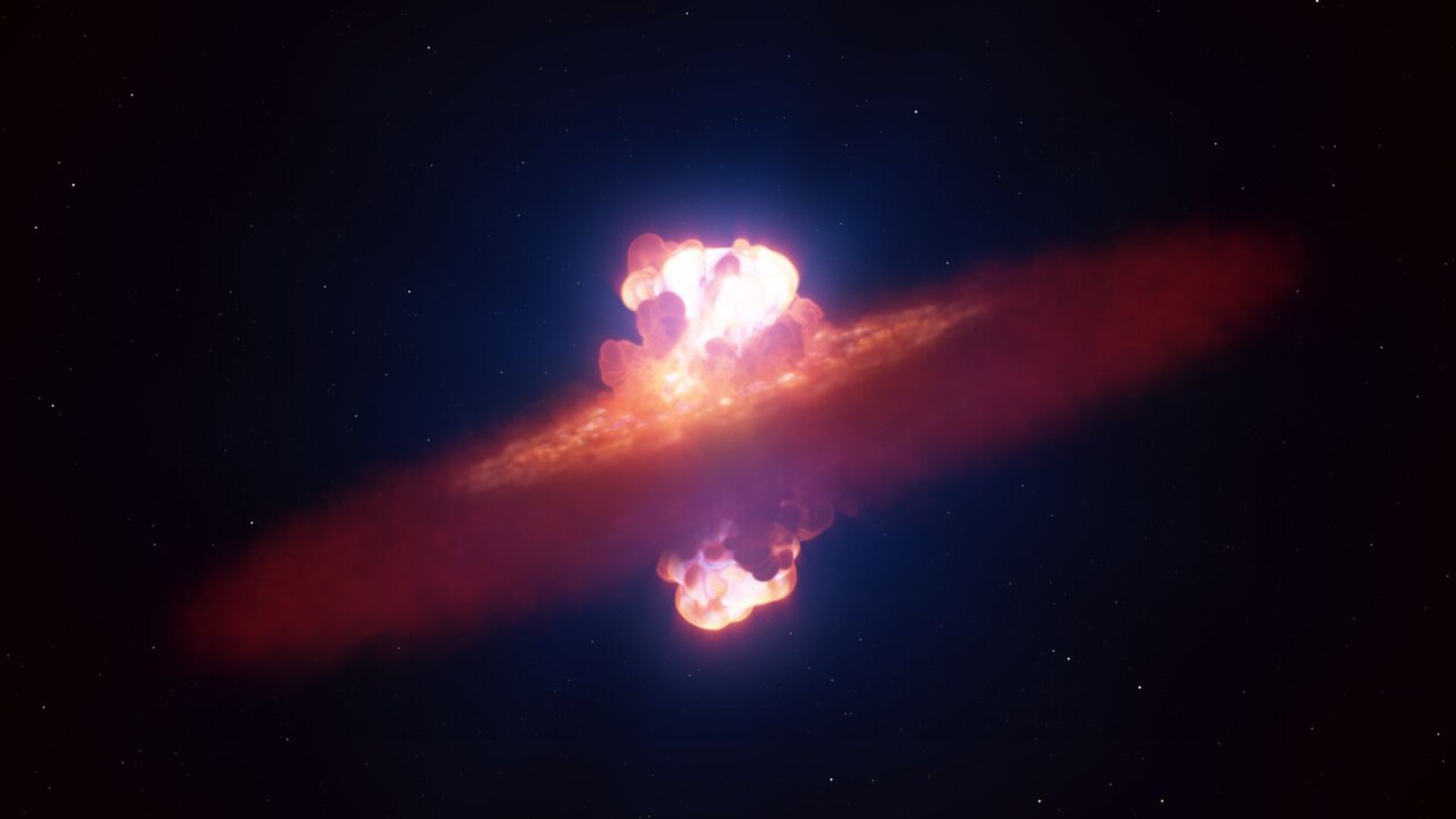
Scientists Witness Supernova Shockwave‘s Journey Through a Dying Star in Real-Time
For the first time,astronomers have directly observed a supernova shockwave propagating through the interior of a dying star,offering unprecedented insight into the explosive deaths of massive stars. The breakthrough, detailed in a study published Nov. 12 in Science advances, utilized the European Southern Observatory’s (ESO) Very Large Telescope (VLT) in Chile to track the progression of the shockwave within supernova SN 2024ggi, located in the galaxy NGC 3621.
Supernovae are among the moast energetic events in the universe, marking the end of life for massive stars and scattering heavy elements into space – elements essential for the formation of new stars, planets, and even life itself. While astronomers have long studied the aftermath of these stellar explosions,directly observing the shockwave’s journey through the star has remained a meaningful challenge.
The team, led by Yuchen Yang of Peking University, employed a technique called spectropolarimetry using the VLT’s FORS2 spectrograph. This method measures the polarization of light, revealing facts about the geometry of the explosion that other observational techniques cannot.”Spectropolarimetry delivers information about the geometry of the explosion that other types of observation cannot provide because the angular scales are too tiny,” explained Lifan Wang of Texas A&M University, a team member.
The observations revealed that the breakout explosion had a flattened shape, resembling an olive or grape, but propagated symmetrically even as it collided with a surrounding ring of circumstellar material.”These findings suggest a common physical mechanism that drives the explosion of many massive stars,which manifests a well-defined axial symmetry and acts on large scales,” said Yang.
The findings have implications for existing models attempting to explain the driving force behind supernova shockwaves. Some theories propose that neutrinos – elusive subatomic particles – contribute energy to the shockwave. However, neutrino absorption typically leads to asymmetrical explosions, a characteristic not observed in SN 2024ggi. The team suggests that powerful magnetic fields may be responsible for any asymmetry seen in later stages of some supernova events, rather than neutrinos.
The research is available on the ESO website: https://www.eso.org/public/archives/releases/sciencepapers/eso2520/eso2520a.pdf.
