
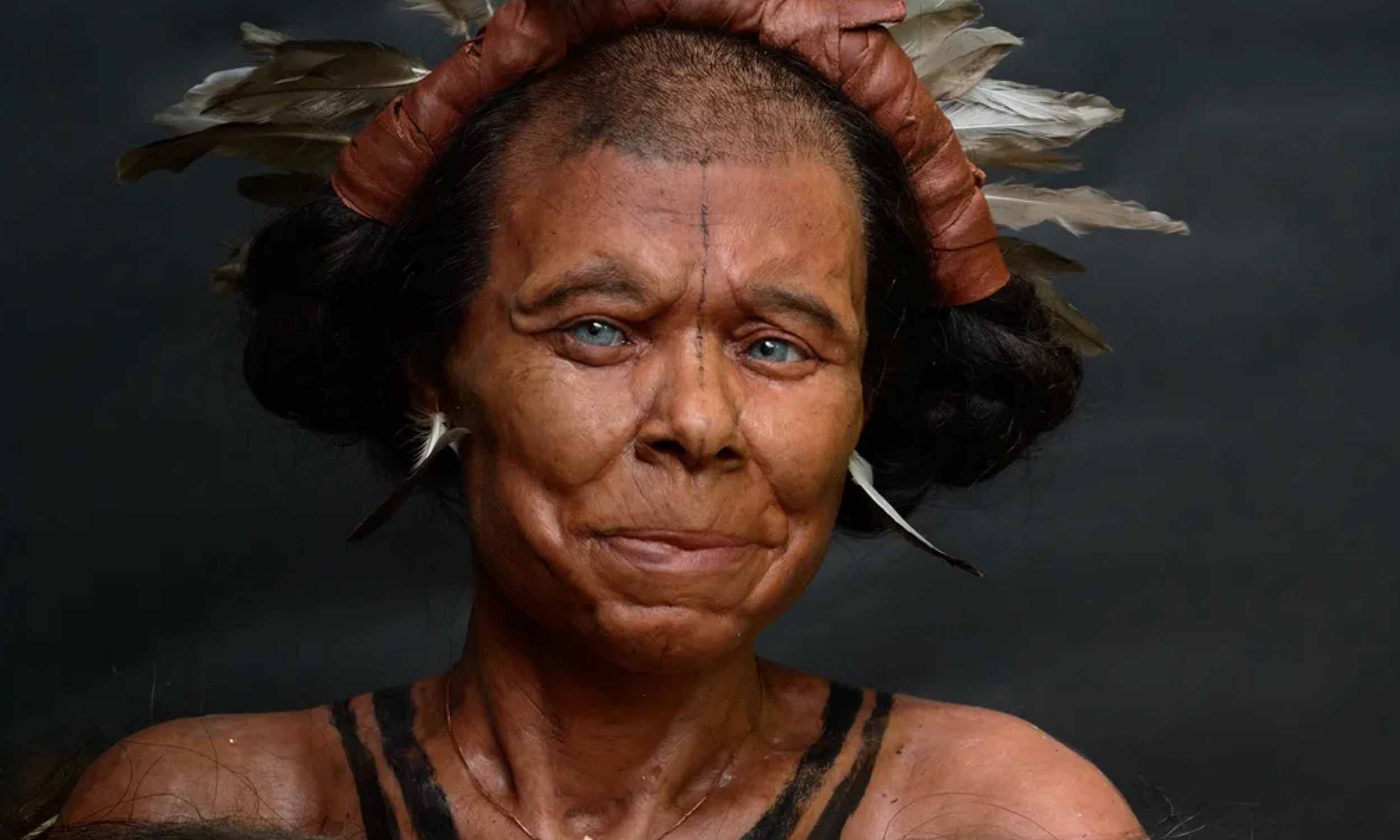
Unveiling Mos’anne: A 10,500-Year-Old Woman reconstructed Through Science
Archaeologists have reconstructed the face of Mos’anne,a woman who lived approximately 10,500 years ago,offering a tangible connection to Europe’s Mesolithic period.The reconstruction, based on skeletal remains discovered at the Margaux site in France, utilizes a multidisciplinary approach combining ancient DNA analysis with detailed archaeological evidence.
The margaux assemblage, notable for its distinct patterns in burial practices, provided the foundation for the reconstruction.Physical traces on tools and bones revealed details about Mos’anne’s life, including evidence of adornment – hair tied with a leather band dyed with ochre, and charcoal markings forming simple geometric patterns. Cut marks on one skull suggest postmortem ritual handling, while pigment traces around cranial bones indicate careful planning of the body.
Ancient genome analysis revealed a surprising level of diversity among early Europeans, challenging previous assumptions of homogeneity. Skin color, influenced by genetics, diet, and sunlight exposure, didn’t shift uniformly across Europe, and Mos’anne’s genome demonstrates that variation existed in Western Europe before the spread of farming from the near East. This finding emphasizes the importance of focusing on regional histories rather than relying on broad generalizations.
While genetic predictions for eye, hair, and skin color are based on statistical models derived from modern populations, and reconstructions of facial features utilize averages from contemporary samples, the team acknowledges inherent uncertainties. Details like hairstyle and ornamentation remain informed choices based on archaeological context,rather than definitive facts. As Dr. Rivollat stated, “Until now, the phenotypic diversity among European hunter-gatherers was only known from a small number of fossils and was thought to be fairly homogeneous.”
The reconstruction isn’t intended as a definitive portrait, but as a “living summary of evidence” that can be refined as new data and methods emerge. Complementary analyses, such as stable isotope analysis of bone and teeth, are being used to pinpoint Mos’anne’s geographic origins and dietary habits.Further sampling of burials at the Meuse site could perhaps reveal kinship ties and social structures within the community.
The project, published in the American journal of Physical Anthropology, aims to move beyond studying “anonymous skeletons” and foster a deeper understanding of health, social connections, and daily life in the Mesolithic period.Museums can also utilize these reconstructions to explore public understanding of scientific uncertainty.
Image credit: ©2025 Kennis en Kennis.
