
Webb Telescope Detects Potential First Generation of Stars, Offering Glimpse into Universe’s Dawn
WASHINGTON – The James Webb Space Telescope (JWST) may have identified the first generation of stars to ever illuminate the universe, a groundbreaking discovery that could unlock secrets about the cosmos’ earliest moments. A team of astronomers, analyzing data from JWST, has found evidence of Population III (POP III) stars within a gravitationally lensed galaxy, LAP1-B, dating back to a period just 500 million years after the Big Bang. The findings, published in late October in The Astrophysical Journal Letters, represent a notable step forward in the decades-long search for these elusive stellar ancestors.
These primordial stars, born from a universe composed almost entirely of hydrogen and helium, have remained hypothetical untill now. “POP III stars have been elusive as they mostly form at early times, so they are very far away and in small clusters,” explained researcher Visbal. “This makes them very faint.”
Unlike modern stars like our sun (classified as Population I), POP III stars are expected to have extremely low “metallicity” – meaning they contain very few elements heavier than hydrogen and helium. This unique composition, stemming from the universe’s initial conditions, should make them distinguishable from later stellar generations.
The team’s analysis of LAP1-B revealed gas surrounding the stars with minimal traces of metals, and the stars appear to be grouped in clusters of around 1,000 solar masses. Simulations suggest that the lack of heavier elements in the early universe resulted in less efficient cooling of primordial gas, leading to the formation of exceptionally massive stars.
“Simulations indicate that since primordial gas cools less efficiently than gas with heavy elements like carbon and oxygen,there is less gas fragmentation during star formation,” Visbal said. “This leads POP III stars to be more massive than metal-enriched stars, possibly with typical masses of 100 times the mass of the sun.”
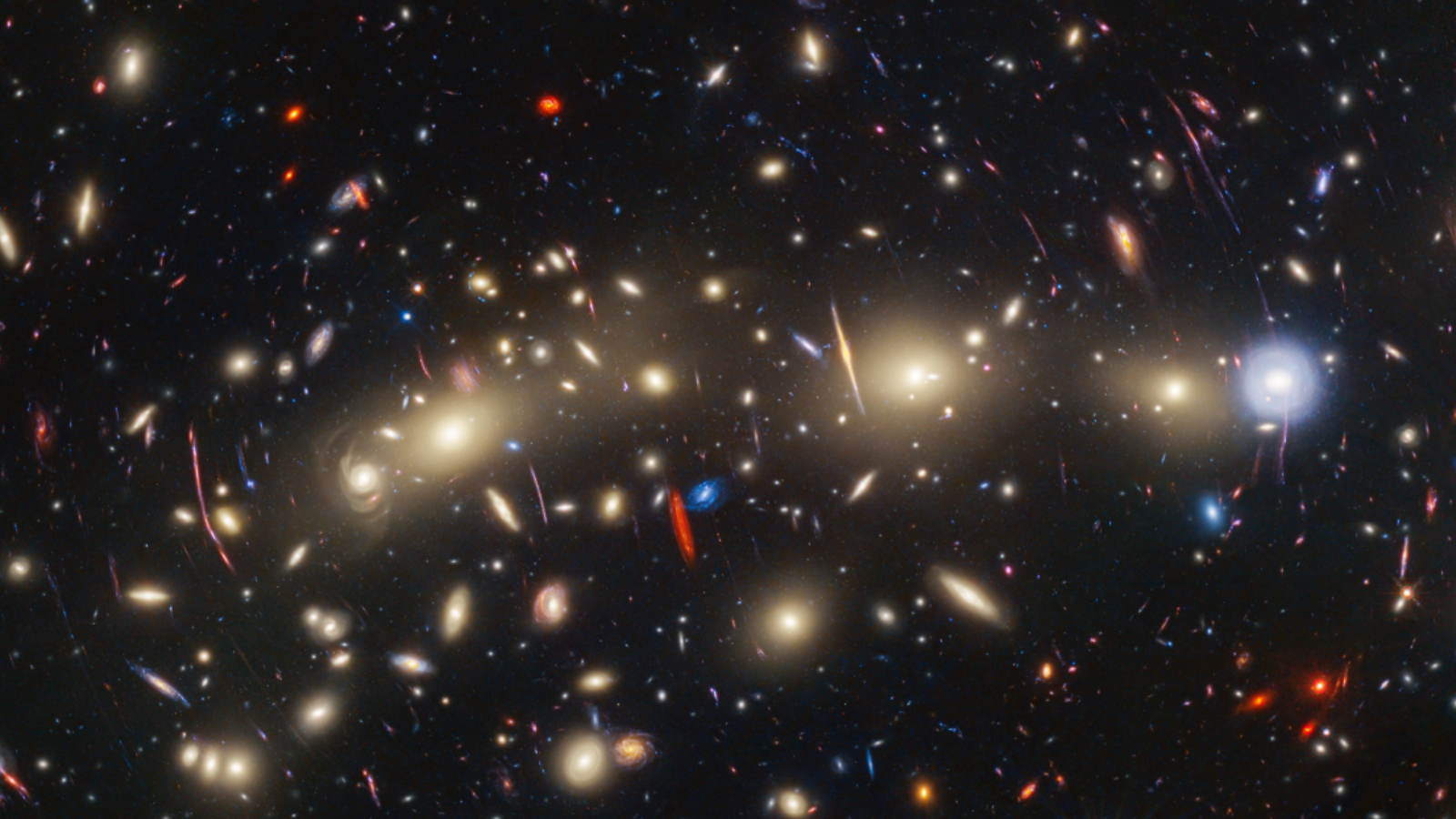
The discovery was facilitated by gravitational lensing – a phenomenon where the gravity of a massive foreground object, in this case a galaxy cluster called MACSJ0416, magnifies the light from a more distant object behind it.Visbal noted, “until we did the calculation, I thought our model would find that Pop III stars are too rare at a redshift of 6.6 to be found in a strongly magnified part of a gravitational lens. I was pleasantly surprised to find that our calculation showed that they should be common enough to observe behind a cluster like MACSJ0416.”
Researchers believe gravitational lensing will be a crucial tool in continuing the hunt for these early stars. The team plans to conduct more detailed simulations to understand the transition from POP III to Population II stars, and to further analyze the spectrum of LAP1-B and similar objects. This research promises to provide unprecedented insights into the universe’s formative years and the origins of the stars we see today.
https://iopscience.iop.org/article/10.3847/2041-8213/ae122f
