
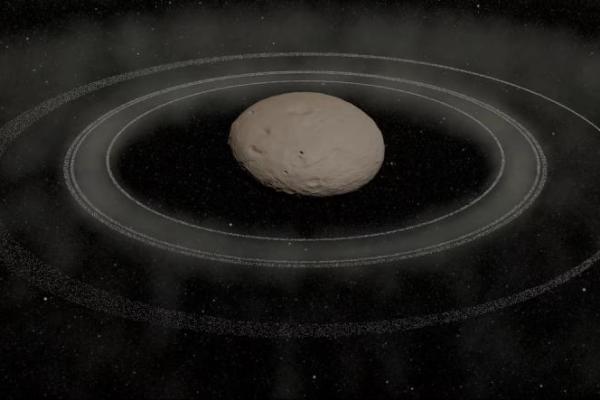
Astronomers Detect Rings Around Distant Centaur Chiron, Challenging Planetary ring Theories
RIO DE Janeiro, Brazil - October 17, 2025 – In a revelation reshaping understanding of ring system formation, an international team of astronomers has confirmed the presence of rings encircling Chiron, a small celestial body orbiting between Saturn and Uranus. The finding, announced today, expands the known number of ringed objects in our solar system to four, alongside the centaur Chariklo, and the distant icy worlds Haumea and Quaoar. This observation suggests that ring formation is a more common phenomenon than previously believed, not limited to gas giants.
The presence of rings around Chiron, a relatively small object measuring approximately 200 kilometers in diameter, challenges existing models that linked ring systems primarily to the gravitational influence of large planets. “This diversity reminds us that ring formation does not onyl occur on large planets. It is a global process that can occur wherever there are the right physical conditions,” explained Dr. felipe Pereira, a researcher involved in the study. The discovery opens new avenues for investigating the origins and dynamics of ring systems throughout the cosmos, possibly revealing insights into the early stages of planetary system development.
Researchers from Brazil,France,and Spain utilized a technique called stellar occultation to detect the rings. On multiple locations across Earth,they precisely timed how Chiron blocked the light of a distant star as it passed in front of it. Analyzing the subtle variations in the starlight’s dimming allowed the team to map the structure surrounding Chiron with kilometer-scale accuracy.
“We can reconstruct the shape and surroundings around the object with kilometer-scale precision,” pereira stated. The team’s observations provide detailed details about the rings’ composition and distribution, furthering the understanding of the forces that maintain these delicate structures in the harsh environment of the outer solar system. Further study of Chiron’s rings is planned, with astronomers hoping to determine their age and origin, and to compare them with the rings of other celestial bodies.
