
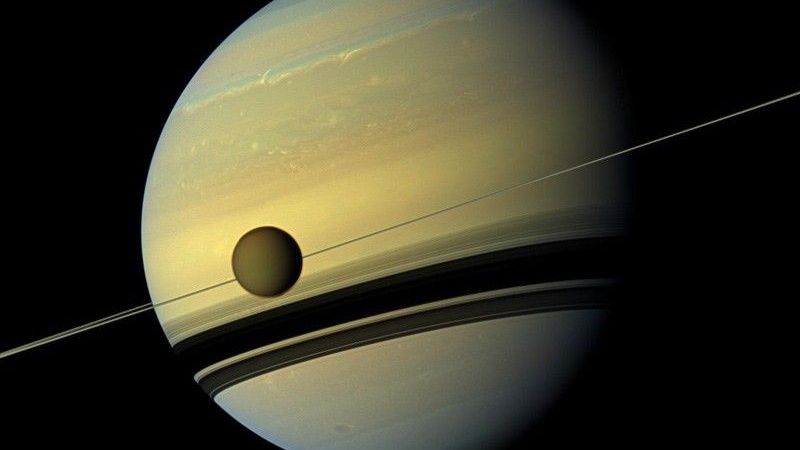
A dramatic collision between two of Saturn’s moons, including its largest moon Titan, may have occurred 100-200 million years ago, triggering the formation of Saturn’s iconic rings and reshaping the Saturnian system, according to recent research accepted for publication in the Planetary Science Journal.
The theory, led by Matija Ćuk of the SETI Institute, attempts to resolve long-standing mysteries surrounding Saturn’s rings – their relatively young age – and the unusual orbital characteristics of several of its moons. Cassini-Huygens mission data revealed a slight discrepancy in Saturn’s moment of inertia, the measure of its resistance to changes in rotation, which suggested an external force had altered the planet’s internal mass distribution.
Scientists initially proposed a moon named Chrysalis, once in orbit around Saturn, had its orbit destabilized and was torn apart by Saturn’s gravity, forming the rings. However, simulations showed Chrysalis was more likely to collide with Titan than be tidally disrupted. Ćuk’s team found that a merger between Chrysalis and Titan offered a more plausible explanation.
“Hyperion, the smallest among Saturn’s major moons, provided us the most key clue about the history of the system,” Ćuk stated. “In simulations where the extra moon became unstable, Hyperion was often lost and survived only in rare cases. We recognized that the Titan–Hyperion lock is relatively young, only a few hundred million years classic. This dates to about the same period when the extra moon disappeared. Perhaps Hyperion did not survive this upheaval, but resulted from it. If the extra moon merged with Titan, it would produce fragments near Titan’s orbit. That is exactly where Hyperion would have formed.”
The collision would have dramatically altered Titan, potentially wiping clean its surface and explaining the moon’s lack of impact craters, despite its size. It would also account for the presence of Titan’s dense, nitrogen-rich atmosphere, which scientists believe leaked from the moon’s interior during the impact. The altered orbit of Titan would have then destabilized other mid-sized moons, leading to further collisions and the creation of Saturn’s rings from the resulting icy debris. Simulations also suggest the event could explain the unusual, highly inclined orbit of Iapetus, Saturn’s third-largest moon.
Before the Cassini-Huygens mission arrived at Saturn in 2004, Titan was known as a hazy orange sphere roughly the size of Mercury, possessing a dense nitrogen atmosphere – the only moon in the solar system with such a feature. The Cassini mission, a joint effort by NASA, the European Space Agency (ESA), and the Italian Space Agency (ASI), began orbiting Saturn on July 1, 2004, and the Huygens probe landed on Titan on January 14, 2005. Data from the mission revealed lakes and seas of liquid methane and ethane on Titan’s surface, and evidence of a subsurface liquid ocean composed of water and ammonia.
While the theory provides a compelling explanation for several anomalies in the Saturnian system, direct evidence remains elusive. NASA’s Dragonfly mission, scheduled to launch in 2028, will explore Titan and may uncover evidence of a relatively young surface, supporting the collision hypothesis. The mission will analyze Titan’s surface composition and search for geological features indicative of a recent, large-scale impact.
