
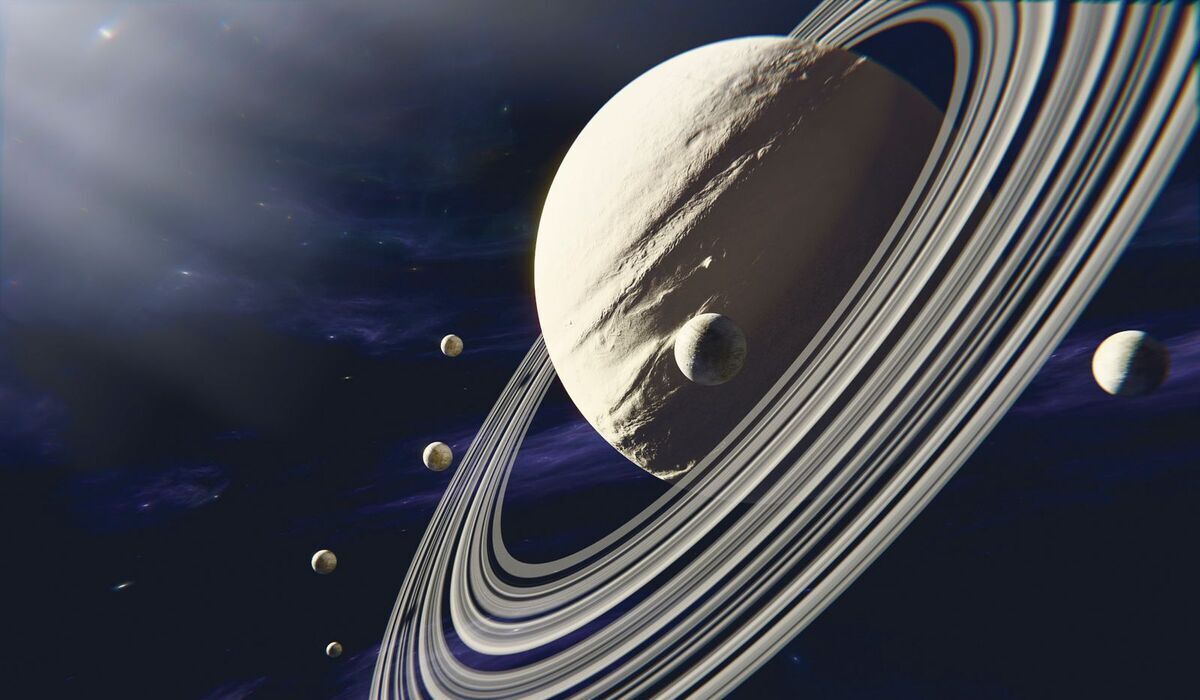
Titan’s Origin: Ancient Moon Collision & Saturn’s Rings Age Revealed
Novel modeling of cosmic dynamics in early February 2026 suggests Saturn’s largest moon, Titan, may not have formed alongside its parent planet. Instead, emerging scientific hypotheses propose Titan is the product of a cataclysmic cosmic event: the collision of two ancient moons orbiting Saturn hundreds of millions of years ago.
Titan holds a unique position in the solar system as the only natural satellite with a thick, stable atmosphere. Its distinctiveness lies not only in its size, but also in its methane-based hydrological cycle. The surface features rivers, lakes and seas composed of liquid methane and ethane, making it a primary focus in global astrobiology studies.
Research led by scientists at the SETI Institute and published in February 2026, proposes a “Merger Moon” scenario. Based on gravity data collected during the final phase of the Cassini mission, researchers found indications that Titan formed from the accretion of debris resulting from a collision between two mid-sized satellites. This event is estimated to have occurred between 400 and 500 million years ago.
The collision theory potentially explains Titan’s somewhat eccentric, yet stable, orbit, as well as the irregular shapes of smaller moons in its vicinity, such as Hyperion, which may be remnants of the cosmic wreckage.
Perhaps the most provocative finding of this hypothesis is its connection to the age of Saturn’s iconic rings. Recent data supports the theory that the rings are relatively young. It is theorized that when the ancient moons collided to form Titan, some of the resulting debris crossed the Roche limit—the gravitational boundary where Saturn’s pull is too strong for material to coalesce back into a moon. This dispersed ice material then formed the ring system, making it an astronomically recent structure, potentially less than 400 million years aged.
NASA is progressing with preparations for the Dragonfly mission to further investigate this theory. As of February 2026, the nuclear-powered rotorcraft has entered Phase D, the stage of hardware integration and thorough system testing at the Johns Hopkins Applied Physics Laboratory.
Dragonfly is scheduled to launch in July 2028 and arrive at Titan in 2034. The mission is designed to perform “hops” across Titan’s surface to directly analyze the chemical composition of the soil and atmosphere. Scientists hope Dragonfly will uncover signs of prebiotic chemistry or even geological evidence of the ancient collision that formed the moon.
People Also Ask (FAQ)
Is Titan habitable for humans? Technically, not without advanced technology. Its atmosphere is extremely cold and lacks oxygen, but its rich organic content makes it the most promising place to search for microscopic life.
Why is Titan’s atmosphere dominated by nitrogen? The nitrogen on Titan is believed to originate from ammonia ice trapped during the early formation of the Saturn system, which was later released through internal heating or photolysis in the atmosphere.
When will definitive results about Titan’s origins be known? Geological certainty is expected to emerge after the Dragonfly mission conducts isotope analysis on Titan’s surface in the mid-2030s.