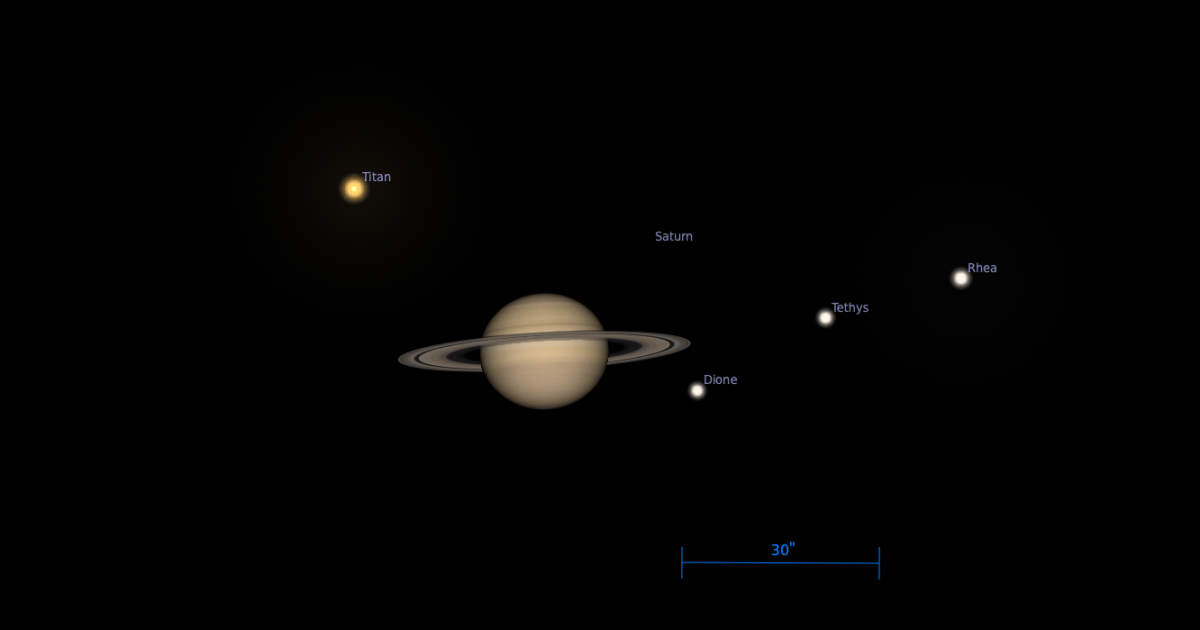
Titan Passes North of Saturn on Oct 7 and 8, per astronomy.com
Titan Passes North of Saturn on October 7 and 8
Astronomy.com reports that Titan, the most luminous moon of Saturn, has drawn closer to its host planet to position itself under 1’ to the northeast of the ringed world this evening. The celestial event takes place overnight on October 7 and 8, with the moon moving from east to west as it passes north of Saturn.
The Tech TL;DR:
- Titan passes less than 1’ northeast of Saturn overnight on October 7 and 8.
- The moon shines at mid-8th magnitude, making it easily distinguishable from fainter neighboring moons.
- Dione, Tethys, and Rhea shine around 10th magnitude closer to the planet with rapidly changing positions.
Observing Titan and Surrounding Moons
With Saturn already positioned above the horizon as the sky darkens, observers can take their time tracking the event. Titan shines at mid-8th magnitude, which helps it stand out among the fainter moons clustering closer to the planet. Dione, Tethys, and Rhea all shine around 10th magnitude. Due to their fairly confined orbits, the positions of these three moons shift rapidly during the evening, starting the night situated to the west of the planet. Rhea and Tethys track westward, while Dione moves eastward.
Dione Disappears Behind Saturn Before Titan Moves North
Dione undergoes an occultation by the southwestern limb of the planet just before 2:15 A.M. EDT on October 8, an event occurring early in the morning for all but observers in the Pacific time zone. It reappears just under two hours later at the southeastern limb. During this window, Titan moves westward and stands due north of Saturn around 6 A.M. MDT on October 8, a timestamp representing dawn or near-dawn farther east. By the evening of October 8, Titan moves northwest of the planet and continues tracking farther away.
# Observation Parameters (40° N 90° W)
Sunrise: 7:02 A.M.
Sunset: 6:32 P.M.
Moonrise: 3:43 A.M.
Moonset: 5:03 P.M.
Moon Phase: Waning crescent (7% illumination at 10 P.M.)