
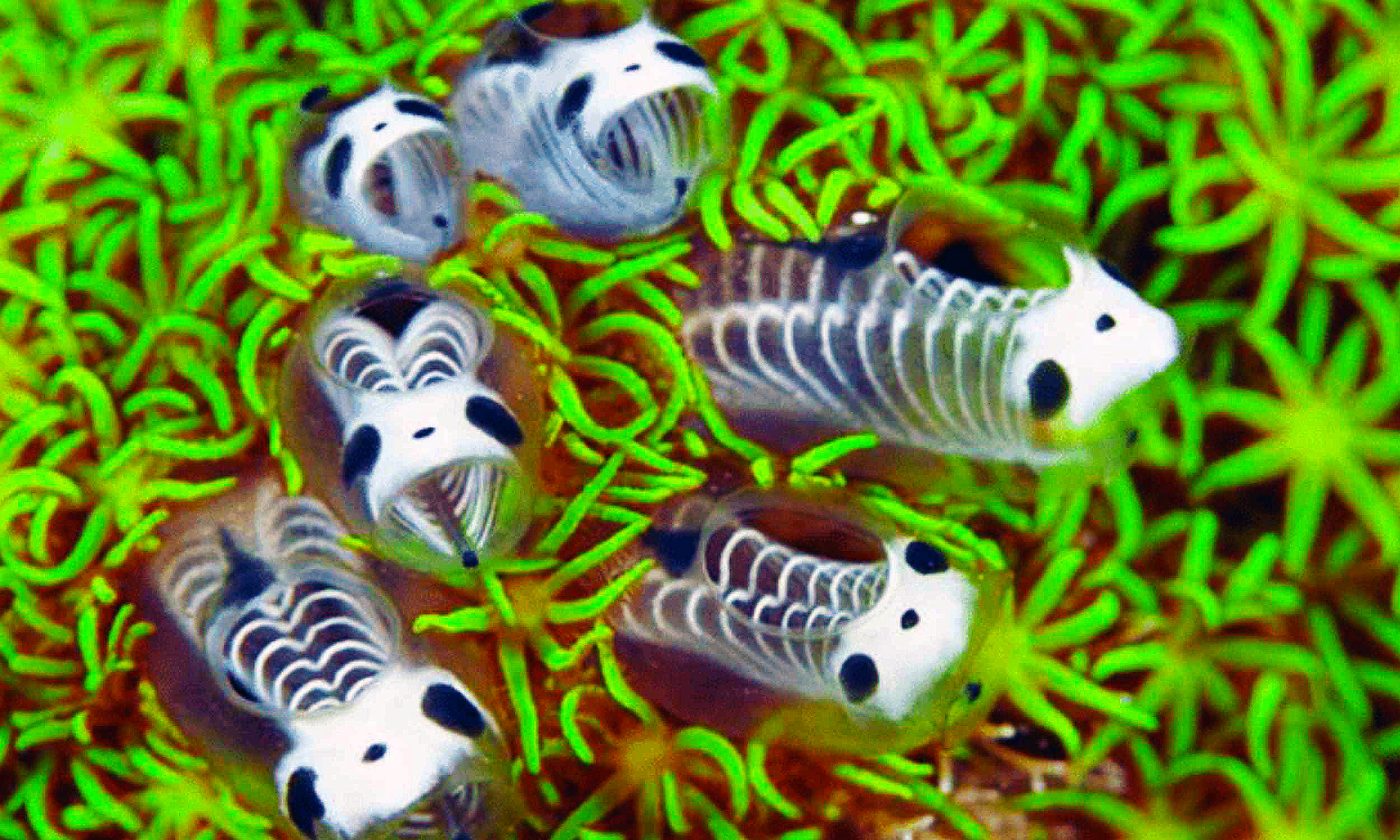
“Skeleton Panda” Sea Squirt Discovered Off Japan
Tiny Creature’s Striking Appearance Led to Scientific Identification
Divers off Kumejima Island, Japan, encountered an extraordinary marine marvel: a diminutive sea squirt with stark white stripes and eye-like black spots, resembling a panda in a skeletal costume. Initially mistaken for novelty aquarium decorations, the creatures’ unique appearance went viral in diving communities, sparking a scientific investigation that ultimately identified a previously uncatalogued species.
A New Species Emerges from Online Fascination
The remarkable discovery began with photos shared online in 2017. These images allowed scientists, including **Naohiro Hasegawa** of Hokkaido University, to examine the organism’s body shape and color patterns from afar. Subsequent independent sightings by different dive operators confirmed the animal’s presence across multiple reef locations, dispelling any notion of a photographic anomaly.
In 2022, **Hasegawa** and his team were able to collect specimens. Laboratory analysis revealed the creature belongs to the genus *Clavelina* but possesses distinct characteristics. Microscopy mapped internal blood vessels, revealing transverse white bars that create the “bone” illusion, and four dark pigment patches on each individual zooid.
Unveiling *Clavelina ossipandae*
The newly identified species has been christened *Clavelina ossipandae*. The name honors its bottle-shaped body, as *Clavelina* is Latin for “little bottle,” and its striking bone-and-panda coloration. Each transparent zooid measures less than an inch, approximately 20 millimeters, and, crucially, they grow individually rather than sharing a common tunic, distinguishing it from 44 related species.
A defining feature is the jet-black mucus-secreting groove, or endostyle, used for trapping food. Unlike the pale endostyles found in other *Clavelina* members, this dark characteristic provides an easy identifier for photographers.
Divers exploring coral outcrops near Kumejima Island in Japan thought they had found novelty props for an aquarium display. Instead, their cameras captured a tiny siphon-pumping animal whose stark white stripes and dark eye-like spots looked like a cartoon panda wearing a skeleton costume.
Citizen Science Accelerates Discovery
This taxonomic approach emphasizes the growing trend of “passive citizen-science,” where researchers leverage social media for reliable species observations. This method significantly expedites the discovery process, as seen with this “skeleton panda” sea squirt. Such findings highlight the vast amount of undiscovered biodiversity that may exist in plain sight.
A 2024 study noted that citizen science initiatives like those managed by the Reef Environmental Education Foundation have gathered over 300,000 underwater surveys from 18,000 volunteer divers, vastly expanding scientific reach (Earth.com, 2025).
Ecological Role and Genetic Confirmation
Sea squirts, classified within the phylum Chordata, are filter feeders. The larvae possess a notochord, similar to a backbone, but adults anchor themselves and adopt a sessile lifestyle. *Clavelina ossipandae* pumps water through oral siphons, filters out bacteria and microalgae through gill slits, and expels it via atrial siphons. In just one hour, a thumbnail-sized zooid can filter volumes of water many times its own size.
Their shallow reef habitat ensures ample plankton, and these efficient organisms act as natural water purifiers, crucial for the health of coral reefs and juvenile fish populations. To confirm its distinct status, scientists sequenced 810 base pairs of the cytochrome c oxidase subunit I gene. The genetic divergence indicated it was not a color variant of an existing species.
Broader Implications for Conservation
“We don’t really know why the pattern is there,” admitted **Hasegawa**. The “skeleton panda” raises evolutionary questions about coloration in animals that may not rely heavily on vision. Potential functions include predator deterrence, protection from ultraviolet light, or simply metabolic byproducts.
This discovery underscores the importance of broad habitat protection, not just for large, charismatic species, but also for smaller, unique creatures that form critical links in marine food webs. The research, including detailed morphological descriptions and genetic data, has been archived with Japan’s National Museum of Nature and Science for future study.
