Time-Resolved Single-Cell Phenotyping Reveals Two Classes of Antimicrobial Peptide Action and Key Trade-offs
A new study using time-resolved single-cell phenotyping has identified two major classes of antimicrobial peptides (AMPs) with distinct mechanisms of action and key trade-offs between speed and efficiency, according to research published in Nature.
The work addresses a longstanding challenge in the field: the difficulty of building a unified understanding of how diverse AMPs kill bacteria.
To overcome these limitations, researchers employed a high-throughput microscopy platform using E. coli strains engineered with fluorescent reporters. Additional strains expressing RplA-msfGFP and HupA-msfGFP probed the spatial localization of ribosomes and DNA with respect to fluorescently labelled AMPs.
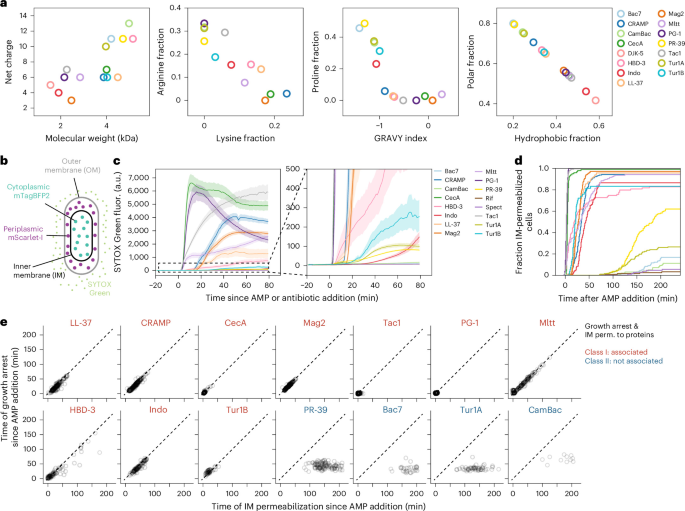
Experiments were conducted in a defined medium (M9gluCAAT) under standardized growth conditions. Cells were grown to stationary phase, diluted, and grown to mid-exponential phase before being loaded into microwells for imaging. The platform allowed researchers to track the real-time dynamics of membrane permeabilization, cytoplasmic condensation, ribosome and DNA reorganization, and growth arrest at the single-cell level across multiple peptide classes.
The analysis revealed two major classes of AMP action. The first class comprises membrane-disruptive peptides that compromise the physical integrity of the cytoplasmic membrane, often after promoting their own access across the outer membrane via “self-promoted uptake.” This permeabilization facilitates the influx of peptides into the cytoplasm, where they interact with anionic targets such as DNA, RNAs, and ribosomes, inducing aggregation or cytoplasmic phase separation.
The single-cell resolution further uncovered key trade-offs between these classes. While the study identifies the shared principles governing AMP action—specifically the sequence of envelope permeabilization, cytoplasmic target engagement, and growth arrest—it highlights that the speed of killing and the efficiency of target engagement differ fundamentally between the two mechanistic classes.
The precise molecular determinants that dictate whether a peptide follows the membrane-disruptive or membrane-inactive pathway, and how these trade-offs can be tuned for therapeutic development, remain active areas of investigation.